
Amtrak's Bright Idea: More Guns On Trains, Just Days After Someone Tried To Shoot The President
Amtrak is reportedly weighing letting passengers store firearms on most trains, just days after the WHCA dinner shooting. The timing is, frankly, baffling.












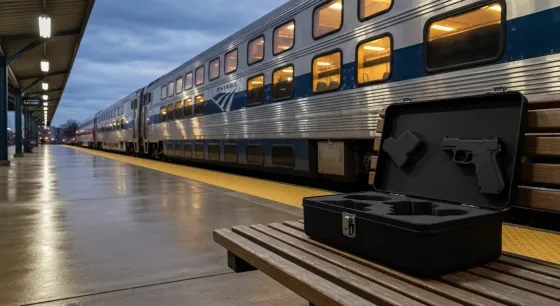
You really cannot make this up. Days after a man allegedly travelled across America by train carrying a shotgun and a semiautomatic pistol, then attempted to shoot the US president at a black-tie dinner, Amtrak is reportedly mulling whether to let passengers stash firearms in lockboxes on most of its services. Timing, as they say, is everything.
What Amtrak Is Actually Proposing
The plan, which predates last weekend's drama, would extend firearms transport from a couple of dozen long-distance routes (where guns currently travel in locked baggage cars) to the bulk of Amtrak's network. According to AP reporting, that would mean opening up more than 1,500 trains a day, including the famously busy Northeast Corridor, which shuttles around 750,000 passengers between Washington, New York and Boston every single day.
Passengers would store their weapons in lockboxes rather than carry them at their seat. Reassuring, perhaps, until you remember Amtrak does not screen passengers, does not run names against criminal databases, and bears roughly the same resemblance to airport security as a village fete does to Wimbledon.
The Inconvenient Backdrop
On Saturday 25 April 2026, the White House Correspondents' Association dinner at the Washington Hilton was interrupted in spectacular fashion. Cole Tomas Allen, a 31-year-old from Torrance, California, allegedly tried to barge past security barricades. A Secret Service officer was shot during the confrontation, his life saved by a bullet-resistant vest. The same officer reportedly fired five times at Allen and missed, which is its own conversation for another day.
Allen has since been charged with attempting to assassinate the president, alongside firearms offences. His lawyer says he has no criminal record. He has been ordered detained pending trial.
How He Allegedly Got There
Here is the bit that makes the lockbox proposal land with a particularly loud thud. Allen, prosecutors say, boarded the Southwest Chief in Los Angeles on 21 April, stopped briefly in Chicago, then carried on to Washington DC. With him, allegedly, were a shotgun and a semiautomatic pistol. Investigators later turned up more kit at his home in Torrance, including long gun bags, a Mossberg buttstock, a holster, a training pistol and ammunition.
Importantly, the rules he is alleged to have used are already on the books. A 2010 appropriations law, championed by Senator Roger Wicker, requires Amtrak to permit firearms transport when properly checked. The new proposal would expand that, not invent it. Cold comfort, but worth knowing.
Why This Matters For Everyday Passengers
Trains are not planes. There are no body scanners, no liquids rules, no shoes coming off. That is, frankly, part of the appeal. You rock up, you sit down, you watch the country roll past. Adding more firearms into that mix, even locked away, raises an obvious question: what exactly is being gained, and at what cost?
Supporters of the change argue it brings Amtrak in line with other transport options for licensed gun owners who simply want to move a firearm from A to B. Critics, including John Feinblatt of Everytown for Gun Safety, say the timing is borderline tone-deaf and that security should be tightened, not loosened. As Sheldon Jacobson has noted, with almost 400 million guns already in circulation in the United States, the marginal upside of making transport easier looks slim. The marginal downside, after a near-miss at the country's most photographed dinner, looks rather less slim.
The Security Gap Nobody Wants To Talk About
Here is the awkward truth. American rail travel runs on trust. Amtrak does not match the aviation security model, and rolling out airport-style screening across 1,500 daily trains would be eye-wateringly expensive, deeply unpopular, and probably impossible at busy commuter stations. So the system relies on the assumption that most people are not bringing weapons, or if they are, they are doing so legally and responsibly.
Once you formally sanction firearms on the vast majority of services, that assumption shifts. Crew members notice. So do passengers. There are already two bills in Congress that would make assaulting a rail worker a federal crime, mirroring protections airline crews already enjoy. That is hardly the legislative mood of a network that thinks everything is fine.
What About The Driver Behind The Change?
Reporting suggests the lockbox proposal has been pushed along by Trump administration officials. Which is its own delicious irony, given the alleged target of last weekend's incident. Whether that political pressure survives the optics of the past few days is anyone's guess. Politically, defending a 'more guns on trains' policy in the same news cycle as 'man allegedly travelled by train to shoot the president' is not a brief most communications teams would relish.
A View From This Side Of The Atlantic
For UK readers, the whole thing has a slightly otherworldly feel. The idea of stashing a shotgun in a lockbox on the 18:03 from Euston is so far outside our frame of reference that it sounds like satire. But it is a useful reminder of how differently the two countries weigh the same trade-offs. We argue about ticket prices and delayed Avantis. They are arguing about whether the bloke in coach D should be allowed to pop a Mossberg in the overhead.
The Verdict
Could the policy be implemented sensibly? In theory, yes. Lockboxes, paperwork, ID checks, the works. In practice, the alleged events of 25 April have torched whatever benefit-of-the-doubt Amtrak might have asked for. Pushing ahead now would look spectacularly off-key, and would hand critics a very easy line: the trains got more dangerous the same week someone took a train to shoot the president.
If Amtrak wants public trust, the smarter play is the opposite direction. Tighter rules, better screening on high-risk corridors, and federal protection for rail workers. The lockbox plan can wait, or quietly disappear into a long grass siding where bad ideas go to retire.
Either way, the next few weeks of congressional reaction will tell us a lot, not just about rail policy, but about how seriously Washington takes the warning it just received.
Read the original article at source.