
Ukraine War Briefing: Odesa and Dnipro Bloodied as Zelensky Tells Trump to Show His Working
Russia launches 200+ drones at Ukraine, hitting Odesa flats and a kindergarten, as Zelensky demands clarity on Trump's Victory Day ceasefire idea.








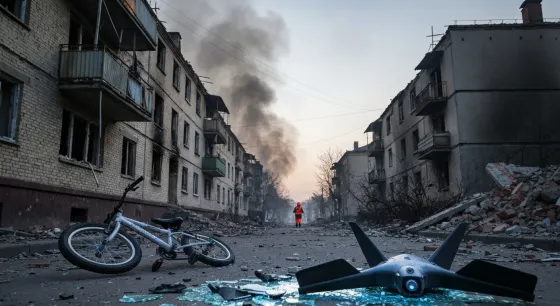
Another night, another barrage. Russia hurled more than 200 drones and a ballistic missile at Ukraine, leaving one person dead and dozens injured, while Volodymyr Zelensky publicly asked Donald Trump to please, for the love of clarity, explain what on earth this new ceasefire idea actually is.
The headline numbers
Ukrainian officials say Russia launched 206 attack drones overnight, a mixed bag of Shahed, Gerbera and Italmas types, plus a single Iskander-M ballistic missile. The drones are cheap, slow and dim-witted compared with the Iskander, but in those quantities they do not need to be clever. They just need to get through.
In the Dnipropetrovsk region, one person was killed and 11 injured. In Odesa, a swarm of drones tore into residential neighbourhoods and damaged a kindergarten. At least 16 to 20 people were hurt there, including a 17-year-old. Nine were taken to hospital, two of them in critical condition.
If you have followed this war for any length of time, those figures will feel grimly familiar. They should not.
Why a kindergarten matters more than a statistic
It is easy for readers in the UK to scroll past another tally of injured Ukrainians. So here is the bit that should stick. The buildings hit in Odesa were not military command posts or industrial sites. They were flats, the kind of low-rise blocks you see on any commute through a European city. And a kindergarten. In April. In 2026.
This is not a one-off. The April briefings have read like a copy-and-paste exercise of pain. A mass strike on 25 April killed at least 10 and injured 67 across Dnipro and other cities. The pattern is the point.
The Trump and Putin phone call
While Odesa was patching up its windows, Washington and Moscow were on the phone. Trump and Putin reportedly spoke for around 90 minutes on 28 April. Out of that came a curious little proposal: a short ceasefire pegged to Russia's 9 May Victory Day parade.
Who came up with it? Depends who you ask. The Kremlin says Putin floated the idea. Trump says it was his. The two camps cannot even agree on the authorship of a peace plan, which is not a hopeful sign for the plan itself.
Zelensky's reply, in plain English
The Ukrainian president was not impressed. He said Ukraine wants a proper, long-term ceasefire, not, in his memorable phrasing, "a few hours of safety for a parade in Moscow." That is a quote with teeth. It implies, fairly bluntly, that a one-day truce around Victory Day would mostly serve to keep Russian tanks rolling smoothly down Red Square without inconvenient Ukrainian drones spoiling the photo opportunity.
Zelensky has now formally asked Trump to explain the proposal. What are the terms? Who verifies it? What happens on 10 May? These are not awkward questions. They are the only questions that matter.
What Ukraine actually wants
Kyiv has reportedly counter-proposed a 30-day truce, or an open-ended one. The logic is straightforward. A genuine ceasefire needs time to mean anything. Soldiers need to stand down, monitors need to be in place, and civilians need to trust that the air raid app on their phone will stay quiet for more than a long lunch.
A 24-hour holiday pause does none of that. It would let Moscow tick a diplomatic box, give Trump a headline, and reset to business as usual once the fireworks were swept up.
The Kremlin's mood music
Adding to the unease, Russian officials have suggested they do not actually need Ukraine's agreement for the Victory Day ceasefire to happen. That is a strange definition of ceasefire. Normally it requires, at minimum, two sides agreeing to stop firing. A one-sided pause is just a press release with extra steps.
It also hints at the deeper problem. Moscow appears to be using the diplomatic process to manage optics around 9 May rather than to end the war. Whether Trump realises he is being cast in a supporting role here is one of the more interesting open questions in international politics this week.
Why this matters to readers in the UK
Three reasons, briefly.
- Energy and prices. Every escalation, and every fake de-escalation, ripples through European energy markets. UK households are still feeling the long tail of 2022's price shocks.
- Defence spending. The UK is one of Ukraine's larger backers. The shape of any ceasefire, real or theatrical, will influence how much taxpayer money flows into aid, weapons and reconstruction.
- Precedent. If a major power can bombard a neighbour's kindergartens and then dictate the terms of a parade-day pause, that sets a template. Other capitals are watching.
The honest take
The Victory Day proposal looks, on current evidence, less like peacemaking and more like stage management. Ukraine is right to demand clarity. Trump is, at best, being played; at worst, playing along. And the people of Odesa and Dnipro are paying the bill in broken windows and hospital beds while diplomats argue over whose idea it was.
A real ceasefire would be welcome. A theatrical one, timed to a parade, is not the same thing. Pretending otherwise is how you get more nights like this one.
What to watch next
Three things worth keeping an eye on over the coming days.
- Whether Washington publishes any actual terms for the proposed ceasefire, or keeps it vague.
- Whether Russia scales drone attacks up or down in the run-up to 9 May. A surge would suggest the parade-day pause is cover for an offensive.
- Whether European capitals, including London, line up behind Kyiv's longer-truce counter-proposal or quietly hope Trump's plan sticks.
Read the original article at source.