
Trump and the Bulletproof Vest: Why the President Keeps Shrugging Off the Kevlar
After the White House Correspondents' Dinner shooting on 25 April 2026, Trump is shrugging off body armour. Stoic, stubborn, or just Trump?







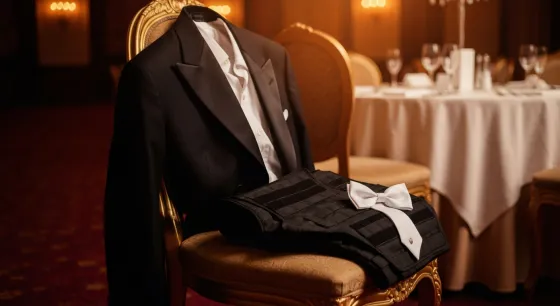
If you were nearly shot at a black-tie dinner, you might consider a wardrobe upgrade. A bit of Kevlar under the dinner jacket. A discreet panel of ballistic fibre tucked behind the lapel. Something, anything, that says: I would prefer not to be ventilated this evening, thank you.
Donald Trump, apparently, is not most people.
Following the shooting at the White House Correspondents' Dinner on 25 April 2026, the President has been notably relaxed about the idea of strapping on body armour. His tone in the days since has been less 'this changes everything' and more 'mildly inconvenient Tuesday.' For a man with multiple assassination attempts on his CV, it is, at the very least, a curious posture.
What actually happened at the Washington Hilton
At roughly 8:40 p.m. on 25 April 2026, gunfire erupted at the Washington Hilton during the annual White House Correspondents' Dinner. The suspect, named by the Department of Justice as Cole Tomas Allen, 31, of Torrance, California, had reportedly booked a room at the venue for three nights, from 24 to 26 April. He travelled across the country by train, via Chicago, allegedly carrying a shotgun, a handgun and a small armoury of knives.
Allen has been charged with three federal counts, including attempted assassination of the president. A Secret Service officer was shot during the incident and survived, reportedly because he was wearing a bulletproof vest. Which is, you would think, a rather persuasive advert for the product.
Trump's reaction: stoic, stubborn, or just Trump?
Speaking to Norah O'Donnell on 60 Minutes, Trump struck the same tone he tends to reach for after these incidents: defiant, unfazed, and faintly bemused that anyone would expect otherwise.
He told her he 'wasn't worried' during the shooting, described the presidency as 'a dangerous profession,' and added that he 'likes not to think about it.' He pointed to the Secret Service officer whose vest had stopped a bullet, almost as proof that the system, in his telling, is working as designed.
Notice what he did not do. He did not say he would now wear a vest at every public event. He did not promise a sweeping security overhaul of his own wardrobe. He did not, in fact, mention personal body armour at all, except as something other people wear.
Has Trump actually refused a vest?
Here is where we should pump the brakes a little. The neat headline 'Trump refuses to wear a bulletproof vest' is tidy and clickable, but the on-record reality is fuzzier.
There is no single, clean quote in which the President says, in so many words, 'I will not wear a vest.' What we have instead is a vibe. A pattern. A general air of someone who would rather talk about perimeter security and rescheduling the dinner within 30 days than about whether his suit jacket is concealing ballistic panels.
Reporting suggests senior White House and Secret Service officials are quietly debating whether to push for mandatory protective gear at his public appearances. That debate, by definition, would not be necessary if he were enthusiastically requesting Kevlar with his morning coffee.
So: not a confirmed refusal, but not exactly a hearty endorsement either.
The mysterious bulge under the suit
Of course, the internet has done what the internet does. Viewers of the 60 Minutes interview zoomed in, screenshotted, squinted, and concluded with great confidence that there was a Suspicious Bulge under Trump's jacket.
Cue speculation. Is it a vest? A discreet plate carrier? An unusually generous wallet? Nobody outside his immediate detail can say for sure, and the White House has not offered a tour of the presidential undergarments.
The honest answer is that he may already wear protective gear sometimes, even if he is reluctant to crow about it publicly. The image he wants to project, after all, is one of cheerful invincibility, not nervous precaution.
Why the optics matter to him
To understand why a vest is such a politically loaded bit of clothing for Trump, it helps to remember how he has built his brand around moments of physical defiance. The raised fist. The shouted 'fight, fight, fight.' The mugshot. The post-shooting photographs that flew around the world.
A visible bulletproof vest does not fit that script. It signals fear, or at least caution, and Trump's entire political theatre is built on appearing immune to both. Even quietly admitting he wears one would, in his eyes, hand his critics a stick to beat him with.
For a politician who treats every appearance as a stage, costume choices are not trivial. They are part of the message.
The case for the vest, however unfashionable
Let us be blunt. The argument for body armour is not complicated.
- He is a sitting US president with a documented history of being targeted.
- One of his own protective officers was just saved by a vest at a public event.
- The threat picture, judging by federal charging documents, is not exactly cooling off.
- Modern soft armour is lighter and less obvious than it used to be, especially under tailored suits.
Set against that, the counter-arguments are largely about image. Comfort is real, but solvable. Vanity is real, but a poor reason to gamble. The 'it would not have helped against a head shot' line is technically true and strategically silly, since most attackers do not aim with surgical precision under stress.
What happens next
Expect a fairly predictable choreography. The Secret Service will tighten perimeters, sweep venues more aggressively, and lean harder on advance teams. The rescheduled correspondents' dinner, if it goes ahead within the 30-day window the President floated, will look more like a fortified bunker than a glitzy media bash.
Behind the scenes, the quiet conversations about a vest will continue. Trump will keep performing nonchalance in public. Aides will keep performing diplomacy in private. Somewhere in the middle, a compromise will probably emerge, almost certainly without a press release attached.
The verdict
Trump's public stance is classic Trump: he is not scared, he is not changing, and he is certainly not going to admit that a piece of fabric might save his life. Whether he privately wears a vest, occasionally or regularly, is a separate question, and one the bulge-watchers will keep chewing on.
For a UK audience used to politicians who would happily climb into a full suit of medieval armour at the first sign of a raised voice, his bravado is either admirable or maddening, depending on your taste. What it almost certainly is not, however, is sensible.
If a vest stopped a bullet for one of his own officers in April, the strongest argument against wearing one is starting to look a lot like ego.
Read the original article at source.