
Venice Biennale 2026: Entire Jury Walks Out Days Before the Curtain Lifts
The 61st Venice Biennale's full jury quit on 30 April 2026 over Russia and Israel's participation. Here's what happened and why it matters.






Imagine planning the world's most prestigious art party for two years, only to have your judging panel quit in unison nine days before opening night. Welcome to the 61st Venice Biennale, where the drama outside the pavilions is currently outshining anything inside them.
What just happened?
On 30 April 2026, the entire five-person international jury of the Venice Biennale resigned, just over a week before the 9 May inauguration. Their parting message was unambiguous: they would not hand out prizes to countries whose leaders face charges of crimes against humanity. Cue an almighty row, and an art world scrambling to work out what an awards ceremony looks like when there are no judges left to do the awarding.
Why the jury packed up its easels
The flashpoint is Russia's return to the Biennale for the first time since its full-scale invasion of Ukraine in 2022. Back then, the curator and artists of the Russian pavilion famously withdrew in protest. In 2024, Russia handed the keys to Bolivia. This year, the pavilion swings open again with an exhibit titled The Tree is Rooted in the Sky, although in a curious twist it will only be accessible during the professional preview days from 5 to 8 May before quietly shutting to the general public.
Israel's participation has also been part of the row. Both Vladimir Putin and Benjamin Netanyahu are subject to International Criminal Court arrest warrants, Putin's issued in March 2023 over alleged war crimes in Ukraine, and Netanyahu's confirmed by ICC judges in November 2024. For a jury asked to crown the world's best national pavilion, that was apparently a bridge too far.
The political backdrop
It is not just the jury feeling queasy. Italian Prime Minister Giorgia Meloni said publicly that allowing Russia to take part was a decision not shared by the government, which is a polite way of saying she would rather it had not happened. Italy's culture minister, Alessandro Giuli, has reportedly launched an investigation and is boycotting both the preview and the opening, which is quite the statement when your job title literally includes the word 'culture'.
Across Europe, the diplomatic pile-on has been substantial. Twenty-two European governments lodged formal protests over Russia's inclusion. Thirty-seven MEPs urged the European Commission to suspend funding. The Commission duly obliged, pulling a grant worth roughly two million euros, around 2.3 million dollars, that had been earmarked across three years. Few things sting an arts institution quite like a yanked subsidy.
So why was Russia let back in at all?
The Biennale Foundation's defence is essentially a property law argument. Russia owns its pavilion in the Giardini, the historic park that hosts the national pavilions, and the Foundation claims it has no power to bar a state from its own building. Whether that is a watertight legal position or a convenient one depends on who you ask, but it is the official line and the Foundation appears to be sticking to it.
An awards ceremony with no judges, and now no ceremony
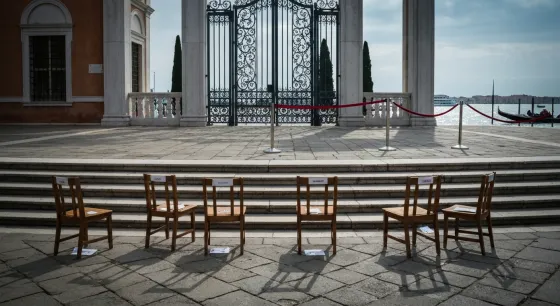
Here is where it gets genuinely odd. The traditional 9 May inauguration awards ceremony has been cancelled. Instead, the prizes have been reimagined as two 'Visitors' Lions', voted on by members of the public, with the ceremony pushed to 22 November, the Biennale's closing day. Out goes the Golden Lion, in comes a popularity contest stretched across six months.
You can see the logic. With no jury, somebody has to pick the winners, and asking visitors is at least democratic. But it does turn one of the art world's most coveted prizes into something closer to a music festival fan vote. Whether that is refreshing or faintly absurd will depend on your patience for institutional reinvention under pressure.
Curatorial heartbreak
Adding a layer of genuine sadness to the chaos, the 61st edition is curated by Koyo Kouoh under the title In Minor Keys. Kouoh, one of the most respected curatorial voices of her generation, died earlier in 2026 before the Biennale opened. Her vision will shape what visitors see, but she will not be there to defend it, contextualise it, or watch it land. The exhibition was always going to be discussed through that lens. Now it sits within an even messier moment.
Why this matters beyond the art bubble
You could be forgiven for thinking this is all rather niche, a squabble among curators and culture ministers over who gets to hang what in a Venetian park. But the Biennale has long served as a kind of cultural barometer. It is where soft power, diplomacy and aesthetics meet for a long, expensive lunch.
When 22 governments and 37 MEPs intervene, when the EU pulls funding, when an entire jury resigns on principle, the question stops being about art and starts being about whether cultural institutions can credibly host nations whose leaders are wanted by the ICC. That is a question with implications well beyond Venice, from the Olympics to Eurovision to film festivals. If you draw the line here, where else does it apply?
What to expect when the doors open
Despite everything, the Biennale will run from 9 May to 22 November 2026. Visitors will still wander the Giardini and Arsenale, queue for the headline pavilions, argue about which national contribution is the most pretentious, and post moody photographs of the canals. The Russian pavilion, by contrast, will likely be closed by the time most of the public arrives, with only press and professionals seeing it during the early days.
Expect protests. Expect think pieces. Expect the absence of a traditional awards night to feel like a missing piece of furniture. And expect the conversation to circle back, again and again, to whether the Biennale Foundation made the right call.
The verdict
The Biennale has weathered scandals before, but this one is unusually layered. A returning Russia, a participating Israel, an EU funding cut, a resigning jury, a grieving curatorial team, and a public vote replacing one of the art world's most prestigious prizes. It is, frankly, a lot. Whether In Minor Keys can rise above the noise and be remembered for the work rather than the walkout is the only question that really matters now. Art history is rarely tidy. This edition will be remembered for the mess as much as the masterpieces.
Read the original article at source.