
Drones, Distillation Columns and a One-Day Truce: Ukraine Hits Perm as Putin Pitches a Victory Day Pause
Ukraine struck Lukoil's Perm refinery 1,500km inside Russia while Putin floated a one-day Victory Day truce to Trump. Here's what it means.











Just when you thought the choreography of this war could not get any stranger, Ukraine sent long-range drones screaming more than 1,500km into Russia to clobber an oil refinery, while Vladimir Putin rang Donald Trump to suggest everyone down tools for a single day in May. Subtle, it is not.
What actually happened in Perm
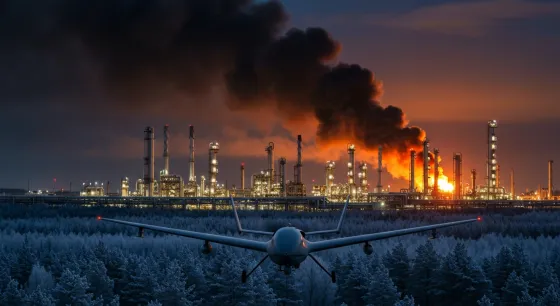
On the nights of 28-29 and 29-30 April 2026, Ukrainian drones struck oil infrastructure deep inside Russia's Perm region, an area that until recently most Russians probably considered safely tucked behind the Urals. The targets were not random: the Lukoil-Permnefteorgsintez refinery, one of the largest in the country with a capacity of around 13 million tonnes per year, and a Transneft oil pumping and dispatch station that funnels crude through Russia's pipeline network.
Reports from Bloomberg, the Moscow Times and Euromaidan Press point to the AVT-4 primary refining unit, the bit that handles vacuum and atmospheric distillation, being knocked out of action. In refinery terms, that is roughly equivalent to taking the engine out of a car and asking it to keep up on the motorway. Ukraine's SBU Special Operations Centre Alpha is said to have used a domestically produced Liutyi long-range drone to do the job.
1,500 kilometres is the part to dwell on
The headline statistic here is the distance. Perm sits more than 1,500km from the front line. That is a London-to-Warsaw sort of journey, give or take, and it has now become a place where local residents wake up to chemical emergency alerts. Authorities in Perm later insisted the alert was 'a test', which is the sort of explanation that fools precisely no one.
For Kyiv, hitting Perm is partly military, partly political theatre. Russia's war effort is paid for in oil revenue, so degrading refining capacity is a way of squeezing the wallet that funds the front line. It is also a not-so-gentle reminder that Ukrainian drones can now reach places the Kremlin once treated as untouchable.
Enter Putin, on the phone, with a proposal
While the smoke was still drifting over Perm, Putin spent roughly 90 minutes on the phone to Donald Trump on 29 April. According to readouts from the Kyiv Independent, Moscow Times and Kremlin aide Yuri Ushakov, the Russian president floated the idea of a ceasefire on 9 May, the anniversary of the Soviet defeat of Nazi Germany. One day. Twenty-four hours. A symbolic pause to coincide with Victory Day.
If you are wondering why Putin is suddenly feeling generous, you are not alone. Ukraine certainly is. Volodymyr Zelensky has said Kyiv wants the details and, more importantly, a longer-term ceasefire rather than a one-day photo opportunity. He has a point. Ukraine recorded hundreds of alleged Russian violations during the brief Easter truce earlier in this war, and there is little appetite for another short, telegenic pause that mainly benefits the side doing the inviting.
Why the timing matters
Victory Day is the most sacred date on Russia's political calendar, the moment when the Kremlin wraps itself in the memory of 1945. The BBC reports that this year's military parade is being pared back, with officials citing a 'terrorist threat' from Ukraine. That claim has not been independently confirmed elsewhere in the sources reviewed, so treat it as Kremlin framing rather than verified fact. Still, it is telling that the most heavily choreographed event in Russia's calendar is reportedly being trimmed.
A one-day ceasefire on 9 May would let Putin stand on Red Square, claim a moment of statesmanlike calm, and present himself to Trump as the reasonable party. For Kyiv, agreeing to that without firm commitments would be all downside.
The Tuapse footnote
The Perm strikes are not happening in isolation. Earlier in April, Ukrainian attacks on the Tuapse oil terminal on the Black Sea coast caused significant environmental damage, with locals reporting 'oil rain' and wildlife coated in crude, as confirmed by CNN. It is grim stuff, and it underlines a point that often gets lost in the strategic chatter: striking oil infrastructure is effective, but it is rarely clean.
What the analysts are saying
The Institute for the Study of War argues that Ukraine is 'imposing increasing costs and casualties' on Russian troops, and that the Kremlin is misrepresenting its battlefield position when speaking to Trump. In other words, the picture Putin paints down a phone line to Washington is not quite the picture on the ground. None of which will surprise anyone who has watched this war for the last four years.
The BBC also reports that a Russian attack on Ukraine on Wednesday night killed at least three people and injured 79, including a child. That figure has not been independently verified in this research pass, but it is consistent with the pattern of overnight strikes Ukraine has endured throughout the conflict.
Why this should matter to readers in the UK
Two reasons. The first is energy. Every successful strike on a major Russian refinery has the potential to ripple through global oil markets, and global oil markets have an irritating habit of showing up on UK petrol forecourts and household energy bills. The second is diplomatic. A Trump-Putin phone call producing a Victory Day ceasefire proposal, with Ukraine pointedly not on the line, tells you something about how negotiations may unfold from here. If you live in a Nato country, that matters.
The honest take
Putin's one-day ceasefire offer reads less like a peace initiative and more like a stage cue. It hands the Kremlin a propaganda win, gives Trump something to claim credit for, and asks Ukraine to provide the silence on Russia's biggest political holiday. Kyiv's response, asking for a proper, longer ceasefire with verifiable terms, is the only sensible reply.
Meanwhile, the drones keep flying. Perm is now firmly on the map of places Russia must defend, and that is a strategic shift that will not be reversed by a 24-hour pause. Whatever 9 May brings, the underlying war is being fought a long way from the spotlight, in distillation columns, pipeline pumping stations and the quiet calculations of which refinery goes offline next.
Read the original article at source.