
Tuapse Takes Another Hit: Ukraine's Drones Pay a Fourth Visit to Russia's Black Sea Oil Hub
Ukraine strikes Russia's Tuapse oil refinery for the fourth time in a fortnight on 1 May 2026, reducing processing capacity at the key Black Sea export hub.












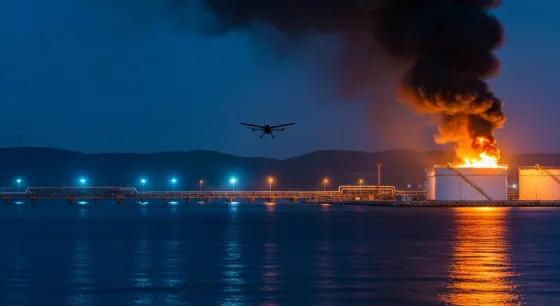
If Russia's Tuapse oil terminal had a frequent flyer scheme for Ukrainian drones, it would be racking up serious points by now. On 1 May 2026, Ukraine's General Staff confirmed yet another strike on the Black Sea facility, marking the fourth attack on the same site in just over a fortnight. At this stage, calling it a pattern feels generous. It is practically a scheduled appointment.
What Happened at Tuapse
Ukrainian forces struck the Tuapse oil terminal in southern Russia, with previous hits logged on 16, 20 and 28 April. Russian local officials, quoted across multiple outlets, reported no casualties from the latest attack, although the fires tell their own story.
Ukrainian monitoring channel CyberBoroshno geolocated the blaze to a tank farm containing four 10,000 cubic-metre storage tanks. At least two of them were reportedly burning. Regional governor Veniamin Kondratyev later said the fire at the city's oil refinery had been extinguished by Thursday, which is the kind of update that suggests the firefighters in Krasnodar Krai have been working overtime lately.
Why Tuapse, and Why So Often?
Tuapse is not a random pin on a map. The Rosneft-operated refinery processes around 12 million tonnes of oil a year and serves as a key Black Sea export hub. In other words, it is exactly the sort of infrastructure that turns crude into cash for the Russian state. Hit it once, and you make a point. Hit it four times in two weeks, and you are making a strategy.
Olha Melyoshina, spokeswoman for Ukraine's Unmanned Systems Forces, said the repeated strikes have measurably reduced the refinery's processing capacity. That is a polite way of saying the place is having a rough month.
The campaign is part of a wider Ukrainian effort to chip away at Russia's refining and export infrastructure, a slow squeeze on the revenues that fund the war.
It Was Not Just Tuapse
While the Black Sea coast was lighting up, Ukraine itself was on the receiving end of a sizeable barrage. President Volodymyr Zelenskyy said Russia launched 210 drones overnight, of which around 140 were Shahed types. Ukrainian Air Force reporting lined up with that figure, noting 190 of the drones were intercepted, which is a respectable strike rate but still leaves plenty getting through.
Odesa
In Odesa, two multi-storey residential buildings and port infrastructure were damaged, according to Ukraine's State Emergency Service via the Associated Press. Damaging civilian housing alongside ports has become an unwelcome regular feature of these overnight raids.
Ternopil
Then came the daytime drone attack on Ternopil, in western Ukraine, which is the part that should make readers in the UK sit up. Mayor Serhii Nadal said over 50 drones targeted the city, with at least 10 people wounded. Ternopil sits roughly 130 km from the Polish border, which is to say, NATO's eastern flank. A daytime mass drone attack that close to EU territory is not a development anyone in Brussels or Whitehall will be filing under 'business as usual'.
Kryvyi Rih and Kharkiv
Zelenskyy also reported damage in Kryvyi Rih and to railway infrastructure in the Kharkiv region. Railways may sound dull next to refineries and Shaheds, but they are the arteries that move troops, fuel and grain. Hitting them is rarely accidental.
Why This Matters to Readers in the UK
It is tempting to skim over another headline about drones and refineries, especially when the war has been grinding on for years. But there are a few reasons this particular flurry deserves more than a passing glance.
- Energy markets: Repeated hits on a major Black Sea export hub feed into global oil price jitters. Petrol forecourts in Britain are not insulated from that.
- NATO proximity: A daytime drone swarm 130 km from Poland is the sort of thing that tests alliance reflexes, even if no missile crosses a border.
- Aid debates: Each new strike, in either direction, becomes ammunition in Westminster's ongoing argument about how much support to send and how fast.
The Bigger Picture
Ukraine's strategy here is not subtle, and it does not need to be. By repeatedly targeting the same high-value energy nodes, Kyiv is forcing Russia to either absorb the financial pain, divert significant air defence resources to protect them, or both. Either outcome is useful to Ukraine.
Russia, for its part, is trying to overwhelm Ukrainian air defences with sheer volume. Two hundred and ten drones in a single night is not a precision operation. It is a saturation tactic, and it relies on the simple fact that even a 90 percent intercept rate still leaves around 20 drones getting through. Some of those will hit homes. That is the point.
What to Watch Next
A few things worth keeping an eye on in the coming days.
- Whether Tuapse comes back online quickly, or whether the cumulative damage keeps it offline for weeks. The longer it is down, the louder the signal.
- How Poland and other NATO neighbours respond to the Ternopil attack, particularly given its proximity to the border.
- Whether Russia escalates the overnight drone tempo further, or whether 210 in a night turns out to be a ceiling rather than a new floor.
The Take
None of this is happening in a vacuum. The Tuapse strikes are part of a deliberate, sustained Ukrainian campaign against Russian energy infrastructure, and the overnight Russian barrages are part of an equally deliberate effort to grind Ukrainian cities down. Neither side appears to be running out of drones any time soon.
For UK readers, the most important takeaway is that the war's centre of gravity has, in many ways, moved into the air. The fights are happening above oil tanks and tower blocks, in the small hours and in broad daylight. The figures, the frequency and the proximity to NATO territory are all creeping in the wrong direction.
Tuapse will probably be hit a fifth time. The question is whether anyone is still surprised when it is.
Read the original article at source.