
MI5 Sounds the Alarm: UK Terror Threat Level Hits 'Severe' After Golders Green Attack
MI5 raises the UK terror threat level to severe after the Golders Green stabbing. What it means for policing, communities and everyday life.









For the first time in nearly half a decade, MI5's analysts have nudged the UK's terror threat dial up a notch. It's not the sort of news anyone wants to wake up to over a cuppa, but here we are.
What's actually changed?
On 30 April 2026, the Joint Terrorism Analysis Centre (JTAC), the bit of MI5 that does the heavy lifting on this stuff, raised the UK threat level from substantial to severe. That's the second-highest rung on a five-step ladder, and in plain English it means an attack is judged 'highly likely' in the next six months.
The last time we sat at severe was November 2021, after the Liverpool Women's Hospital bombing and the murder of Sir David Amess. It was eased back down to substantial in February 2022, and there it stayed. Until now.
The Golders Green stabbing
The trigger was a stabbing in Golders Green, north London, on Wednesday 29 April. Two Jewish men, aged 34 and 76, were seriously injured. The suspect, named as Essa Suleiman, 45, has been charged with two counts of attempted murder.
Here's where it gets uncomfortable. Suleiman had reportedly been referred to the Prevent counter-terrorism programme back in 2020, and is said to have a history of serious violence and mental health issues. Cue the inevitable, and frankly overdue, questions about whether Prevent is fit for purpose, or whether it has become a referral system with nowhere meaningful to refer people to.
Why the threat level matters to ordinary people
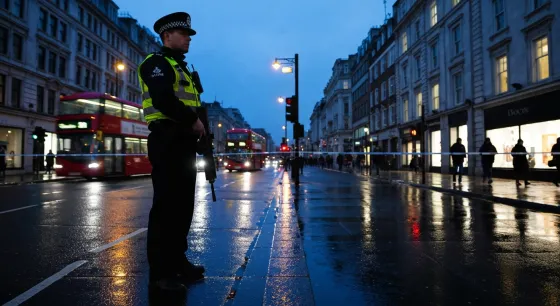
Threat levels are not just civil service homework. They unlock funding, shift police priorities, and quietly change the texture of daily life. Expect more visible patrols outside synagogues, Jewish schools, and community centres. Expect bag checks at events that previously felt low key. Expect, sadly, more anxiety in communities that have already had a rough run.
Keir Starmer's government has announced an extra £25 million for police patrols and protection at Jewish sites. Whether that money lands where it's needed or gets swallowed by the usual procurement gremlins is, of course, a separate question.
The Middle East connection
The Independent's framing leans hard on Donald Trump and Benjamin Netanyahu, and you can see why. The war in the Middle East has plainly raised the temperature globally, and the political choices made in Washington and Jerusalem have consequences that ripple out to Hendon high streets and Manchester suburbs.
That said, MI5's actual wording is more measured. The Service refers to 'the conflict in the Middle East' and an 'elevated threat to Jewish and Israeli individuals and institutions'. No names dropped. Spies, it turns out, prefer not to write headlines.
State actors are part of the picture
It's not just lone individuals MI5 is fretting about. Director General Ken McCallum has previously flagged that more than 20 Iran-backed 'potentially lethal' plots were disrupted in the year ending October. That's a quietly staggering number, and it underlines that the threat picture is hybrid: home-grown radicalisation, state-sponsored mischief, and everything in between.
The political response
Starmer visited Golders Green and was met, awkwardly, with angry chants from residents who feel the government has been asleep at the wheel. He described the attack as 'not a one-off' and acknowledged that Britain's Jewish community feels 'scared'. The Chief Rabbi went further, saying 'visibly Jewish' people are 'not safe' in Britain. That's a hell of a sentence to read in 2026.
The attack didn't appear out of nowhere either. There has been a string of arson attacks on Jewish sites in recent weeks, and the cumulative effect is the kind of low-grade dread that doesn't show up neatly on a Home Office spreadsheet.
What 'severe' actually means for you
- Higher visibility of armed and uniformed police at faith venues and large public gatherings
- More security checks at events, transport hubs, and crowded shopping areas
- Tighter coordination between MI5, counter-terror policing, and local forces
- An expectation that the public report anything that feels off, via the usual 0800 789 321 hotline
It does not mean staying home or cancelling your weekend plans. Severe is a planning posture, not a panic button.
The wider context, with no spin
Britain has bounced between threat levels for two decades, and the rhythm of these announcements has, oddly, become part of national life. What's different this time is the explicit naming of a community, Jewish Britons, as being at heightened risk. That is not abstract. That is your neighbour, your colleague, your kid's classmate.
It also raises a thornier question that politicians of all stripes tend to swerve: how do you keep a society open and confident when state-linked actors and lone individuals are both pulling in the same nasty direction? There's no slick answer. More money helps. Better intelligence sharing helps. Honest conversations about Prevent's gaps would help most of all.
The bottom line
The threat level has gone up because the evidence says it should. MI5 doesn't move this dial for fun, and they certainly don't move it on a politician's say-so. The Golders Green attack was the trigger; the Middle East conflict, state-sponsored plotting, and a creeping rise in antisemitic incidents form the broader backdrop.
For most of us, life will look largely the same. For Britain's Jewish community, it won't, and that's the part of this story that deserves more than a one-day news cycle. Stay alert, stay kind to your neighbours, and keep an eye out for the people in your community who might be feeling especially exposed right now.
Read the original article at source.