
Trump's Redistricting Gamble: Missouri Wins Big, South Carolina Wobbles
Missouri's Supreme Court backs Trump's redrawn congressional map while South Carolina's Senate falls two votes short. Inside the 2026 redistricting battle.












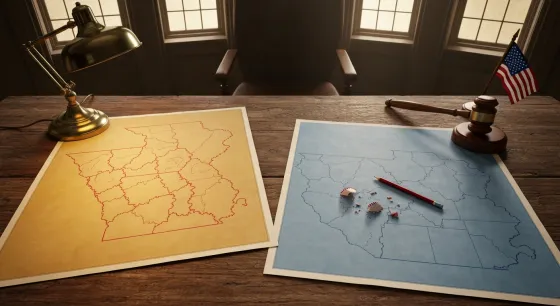
If American politics in 2026 had a soundtrack, it would be the constant scratching of pencils on congressional maps. President Donald Trump's mission to redraw House districts before the midterms had a properly bumpy Tuesday, with a courtroom triumph in Missouri colliding with a stinging legislative stumble in South Carolina. The result is a redistricting scoreboard that looks less like a Republican blowout and more like a chaotic away day.
Two states, two very different Tuesdays
In Jefferson City, Missouri's Supreme Court delivered two unanimous rulings hours after oral arguments, upholding the state's newly redrawn congressional map. That is judicial speed bordering on indecent haste, and it handed Republicans a clean win.
Meanwhile, in Columbia, South Carolina's Senate held a vote that Republicans had every reason to expect would sail through. It did not. The tally came in at 29-17, two votes shy of the two-thirds supermajority needed, after five Republicans crossed the aisle to join every Democrat in voting no.
One state advanced Trump's plan. The other quietly tripped over it. Welcome to redistricting season.
Missouri: a map that takes the scenic route
The Missouri map is doing some serious geographical gymnastics. The Kansas City-based district, previously a fairly tidy affair stretching roughly 20 miles across two counties, has been stretched out to around 200 miles across 15 counties. That is not a congressional district so much as a road trip.
The idea, broadly, is to dilute reliable Democratic voters in Kansas City by mixing them into a sea of rural Republican support. Critics called it a compactness disaster. The court disagreed, rejecting both the compactness challenge and the argument that filing a referendum petition should automatically suspend the new map.
That second point matters. Opponents have until 4 August 2026, which happens to be Missouri's primary day, to have referendum petition signatures validated by Secretary of State Hoskins. Even if they succeed, the map stays in place for now. It is a procedural plus substantive double win for Republicans, the kind lawyers frame and hang on the wall.
Missouri becomes the second Republican-led state, after Texas, to redraw its congressional districts at Trump's urging. The dominoes, it seems, are tipping.
South Carolina: when your own side blinks
South Carolina was supposed to be the easy one. Republicans hold a supermajority in the Senate. The maths should have been straightforward. Instead, five Republican senators looked at the proposed map, did some quiet calculations, and decided they would rather not.
Why the cold feet? In a word: dummymanders. That is the inelegant term for a gerrymander that backfires on the party that drew it. The new map reportedly aimed to flip the seat held by veteran Democrat James 'Jim' Clyburn, but doing so would have required spreading reliable Democratic voters thinner across other districts. Stretch them too thin and you do not get a 6-1 Republican map. You get a 5-2 or 4-3 map, with previously safe Republican seats suddenly looking nervous.
Several Republicans clearly preferred the bird in hand. The vote failed. For Trump's redistricting push, it is the first proper wobble.
The bigger picture: a national arms race
For UK readers wondering why any of this matters, here is the short version. The US House of Representatives is so closely divided that a handful of redrawn seats could decide who controls Congress, which decides whose legislation passes, which decides what happens on everything from healthcare to climate policy. The stakes are not small.
By current AP wire estimates, Republicans could pick up as many as 14 seats from new maps across Texas, Missouri, North Carolina, Ohio, Florida and Tennessee. Democrats could claw back six from California and Utah. The arithmetic favours the GOP, but the courts and the occasional unruly state senator keep complicating things.
Adding fuel: a recent Supreme Court ruling that weakened Section 2 of the Voting Rights Act. Districts that previously had to preserve majority-minority representation no longer face the same scrutiny, which has emboldened Republican legislatures to redraw boundaries that would have been legally radioactive a few years ago.
Virginia, Alabama and the legal scrum
The action is not confined to two states. Last week, Virginia's Supreme Court struck down a Democratic redistricting effort that could have produced four winnable seats. So the courts are slapping down both parties, depending on the day and the bench.
In Alabama, Governor Kay Ivey has scheduled a special primary for 11 August 2026, covering four of the state's seven congressional districts. Translation: voters in those districts are about to be very busy.
Louisiana: when politics turns nasty
And then there is Louisiana, where the redistricting debate has curdled into something genuinely alarming. State Senator Jay Morris, who chairs a redistricting committee, told members of the public to 'shut up' during a contentious hearing. The response was disproportionate and frightening.
Over the following weekend, Morris's office received roughly 150 voicemails. One reportedly called for a mass shooting. Death threats followed. Louisiana Attorney General Liz Murrill publicly condemned the threats, and rightly so. Whatever you think of Morris's manners, this is not how democratic disagreement is supposed to work.
State Senator Gary Carter has withdrawn from the redistricting committee and is being replaced by Senator Royce Duplessis. The shuffle continues, but the bad taste lingers.
What it all adds up to
Tuesday was a useful reminder that redistricting is not a single battle but a sprawling, multi-front war fought in courtrooms, state houses and, regrettably, voicemail inboxes. Trump's push has momentum, but momentum is not the same as a clean sweep.
Missouri shows what happens when the courts move quickly and Republican unity holds. South Carolina shows what happens when one's own senators get nervous about overreach. Louisiana shows what happens when the temperature gets dangerously high.
For anyone watching from the UK, where boundary reviews are handled by an independent commission and largely ignored by the public, this is a useful study in what overtly political map-drawing looks like in practice. It is messy. It is slow. And it is far from over.
Expect more rulings, more votes and more lines drawn in places that defy geography. The midterms are still months away, and the maps are still drying.
Read the original article at source.