
Crisps Go Goth: Why Calbee Is Ditching Colour for Monochrome Packets
Calbee is swapping colour for black and white packets on 14 snacks from 25 May 2026, as the Iran war chokes off naphtha supplies. Here's why.







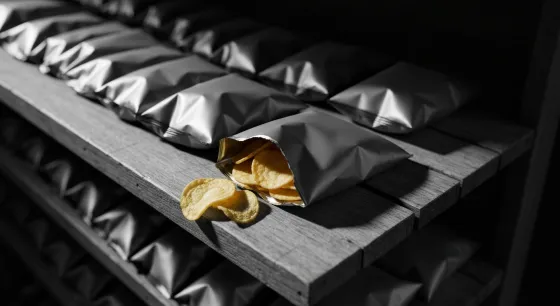
Walk into a Japanese convenience store on 25 May 2026 and you might wonder if someone has invented Instagram filters for snacks. Calbee, the country's crisp king, is swapping its trademark riot of colour for moody black and white packaging on 14 of its most popular products. The culprit is not a designer having an existential crisis. It is a war thousands of miles away that has throttled the world's supply of a humble petrochemical called naphtha.
What Calbee is actually doing
From 25 May 2026, Calbee will temporarily roll out monochrome packaging across 14 products, including its flagship Potato Chips, Kappa Ebisen prawn crackers and Frugra granola cereal. The company has been at pains to point out that the snacks themselves are unchanged. Same crunch, same flavours, same slightly addictive quality that has you reaching for another handful at midnight. Only the wrappers have gone Bauhaus.
It is, frankly, a clever pivot. Rather than quietly tweaking colours and hoping no one notices, Calbee has leaned into the change. Design industry titles have already picked up on it, which is more publicity than a bag of crisps usually earns in a lifetime.
So what on earth does ink have to do with Iran?
Here is where things get genuinely interesting. Naphtha is a colourless liquid produced as a byproduct of oil refining. It is also the unsung hero of modern consumer goods, used to make plastics, solvents and, crucially, printing inks. If you have ever admired a vividly printed crisp packet, you have naphtha to thank.
Since the Iran war kicked off on 28 February 2026, the Strait of Hormuz has effectively been closed. Traffic through the strait is reportedly running at around 5% of its pre-war average, which the International Energy Agency has called the largest supply shock in oil market history. That is not hyperbole from a tabloid headline writer. That is the IEA.
Why Japan is feeling it especially hard
According to Japan's deputy chief cabinet secretary Kei Sato, roughly 40% of the country's naphtha came from the Middle East before the war. That figure has not been independently cross-checked beyond the original briefing, but even if it is in the right ballpark, it explains why Japanese manufacturers are scrambling. Asian naphtha prices have nearly doubled since the conflict began, according to reporting from Nikkei Asia and Bloomberg.
South Korea has not helped matters by slapping a five-month restriction on naphtha exports, tightening an already tense regional market. When your neighbour's house is on fire, you tend not to lend them your garden hose.
It is not just crisps
Calbee is the photogenic face of a much broader problem. Japanese vinegar and condiments maker Mizkan has reportedly suspended some product lines and raised prices from 1 May, blaming a shortage of polystyrene containers. Both of those claims come from the BBC and we have not independently verified them, so treat with a pinch of salt. A salty, monochrome pinch.
Further afield, the BBC also reports that UK fashion chain Next has raised prices by up to 8% in some non-European markets, and that carmakers including Toyota and Hyundai have seen profits dented by higher material costs and weaker sales. Again, plausible given the wider picture, but worth flagging as unverified in our research pass.
Why this matters for British shoppers
You might be sitting in Surbiton thinking this is all very interesting but utterly remote. It is not. Global supply chains do not respect borders, and a shock this size eventually ripples through to British shelves. Plastics, packaging, fuel, fertilisers, paint, cosmetics, polyester clothing, kids' toys, electronics components, the list of things downstream of naphtha is uncomfortably long.
If naphtha stays expensive, expect manufacturers across the board to do one of three things. Absorb the cost and watch margins crumble. Pass the cost on and watch shoppers grumble. Or get creative, which is exactly what Calbee has done. Strip back the inks, simplify the design, and frame the whole thing as a transparent response to global events.
A masterclass in honest marketing
There is something refreshingly grown up about Calbee's approach. They could have quietly downgraded inks and pretended nothing was happening. Instead they have effectively said, here is what is going on, here is why your bag looks different, and we promise the crisps inside are exactly the same. That kind of candour is rare in the snack aisle, where most communication tends to be a sugary blizzard of cartoon mascots and bold exclamation marks.
It also turns a problem into a talking point. Limited edition packaging is a marketing trick as old as marketing itself, but a limited edition driven by a geopolitical crisis is a first. Expect collectors. Expect eBay listings. Expect at least one earnest think piece arguing that monochrome crisps are the look of our anxious times.
What to watch next
The big questions are how long the disruption lasts and how widely the pain spreads. If the Strait of Hormuz reopens to anything close to normal traffic, naphtha supplies will ease and pretty packaging will return faster than you can say Quavers. If the conflict drags on, expect more companies to follow Calbee's lead with stripped back design, smaller pack sizes, and quieter price rises.
For now, the monochrome crisp packet is the most visible reminder that a war on the other side of the planet has a habit of reaching into your kitchen cupboard. It is also a useful nudge to think about how much of our everyday stuff is quietly dependent on oil derivatives we never see and rarely think about.
The verdict
Calbee deserves credit for honesty, creativity and a sense of occasion. The packaging may be drained of colour, but the story behind it is anything but grey. Whether you find that reassuring or alarming probably says more about your worldview than it does about a bag of prawn crackers.
Either way, if you spot a monochrome bag of Kappa Ebisen on your travels, grab one. It might just be the most historically significant snack you ever eat.
Read the original article at source.