
Back to Beijing: Trump Returns to a China That No Longer Blinks First
Trump heads back to Beijing in May 2026 for his first state visit in nearly a decade. Why this trip matters and what's changed in US-China relations.











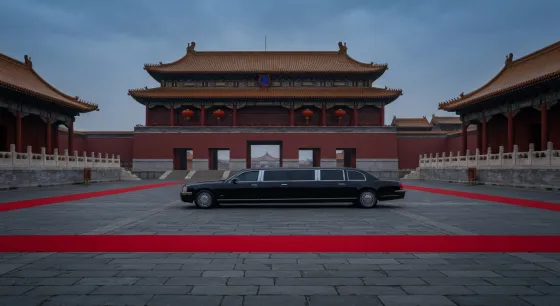
Nearly a decade after his last red-carpet stroll through the Forbidden City, Donald Trump is heading back to Beijing. Same president, same showmanship, very different China.
A Familiar Face, An Unfamiliar Host
When Trump last touched down in China in 2017, Xi Jinping laid on a banquet inside the Forbidden City itself, a flourish no foreign leader had enjoyed in modern times. It was flattery with Chinese characteristics, and Trump lapped it up.
Fast forward to his state visit on 13-15 May 2026, the first by a sitting US president in roughly nine years, and the choreography has shifted. The stops reportedly include Zhongnanhai, the leafy compound where China's top leaders actually live and work. Symbolic? Absolutely. It says: welcome back, but this time we set the tone.
Xi Has Settled In, Properly
The man across the table is no longer the relatively new strongman of 2017. Xi is now into an unprecedented third term, having reshaped China's political rulebook to keep himself at the top. Term limits? Gone. Rivals? Quieter. Confidence? Through the roof.
One analyst put it bluntly to the BBC: Beijing is arguably the most powerful competitor Washington has ever squared up to. Not the Soviets, not Imperial Japan, not even Cold War-era rivals. China today is something genuinely new.
Why The UK Should Care
British readers might wonder why a chat between two leaders in Beijing matters at breakfast in Birmingham. Short answer: everything from your next iPhone, your EV, your gas bill and the shipping cost of your Amazon order runs through the US-China relationship.
If these two get on, global markets exhale. If they don't, expect tariffs, export controls and a fresh wave of supply chain headaches that eventually nibble at UK prices.
A Trade Map That Has Quietly Redrawn Itself
Here's the bit that should make Washington pause. America is no longer China's biggest customer. It's not even the second. The US has slipped to third place, behind ASEAN (the South East Asian bloc) and the European Union.
Chinese exports to the US have dropped by roughly 20 percent in recent years, according to reporting from outlets like the Washington Post and CNBC. Beijing didn't curl up and cry. It diversified. It found new buyers. It built new routes.
One of those routes literally runs through Chongqing, a mega-city of more than 30 million people in China's south west. A direct freight rail line stretches from there through Central Asia all the way to Europe. The figure floating around for its development is in the region of five billion dollars, although that number isn't easy to independently verify.
Chongqing: The Cyberpunk Calling Card
If you've ever lost an hour on TikTok watching a metro train glide straight through a block of flats, congratulations, you've met Chongqing's Liziba station. The city has become China's unlikely viral darling, all neon, fog and stacked motorways that look photoshopped.
Reported overseas tourist numbers have been generous, with some figures suggesting around two million visitors recently. Official Chongqing government data cited by the South China Morning Post puts inbound tourism at closer to 1.3 million in 2024, though that was still a whopping 184 percent jump on the year before. Either way, the message is clear: China wants the world to see its showpiece cities, not just its factories.
The Robot in the Room
While Washington has been arguing about TikTok bans and immigration, China has quietly become the planet's workshop on steroids. It already has more industrial robots humming away in factories than any other country, and Beijing is reportedly planning to pour something in the region of 400 billion dollars into robotics in 2026, although that headline figure should be treated with a healthy dose of caution until properly verified.
It is also, undeniably, the world's largest car manufacturer. BYD, Geely, Nio and the rest aren't just badges any more, they are genuine threats to Volkswagen, Ford and yes, Tesla.
Chips, Chips, Chips
The semiconductor saga is where the real geopolitical poker is being played. In 2022 the Biden administration slammed the door on cutting-edge chip sales to China. Trump, on his return, has loosened things a touch, clearing the way for Nvidia to sell some advanced (though not the most advanced) chips back into the Chinese market.
Is that a clever bargaining chip or a giveaway? Depends who you ask. Hawks in Washington are nervous. Beijing, meanwhile, is racing to make its own.
The Delegation Tells You Everything
Trump isn't flying solo. Reports suggest Apple's Tim Cook and Tesla's Elon Musk are tagging along. That's not a diplomatic delegation, that's a hostage list of American corporate interests in China. Apple still needs Chinese factories. Tesla still needs the Shanghai gigafactory. Both men know that one sour press conference can wipe billions off their share price.
It's a not-so-subtle reminder that for all the tough talk on decoupling, US tech is still hopelessly entangled with Chinese manufacturing.
The Backdrop Nobody Wants To Mention
This summit is happening with a US-Israeli war with Iran rumbling in the background, and a fragile trade truce hammered out between Trump and Xi at their Busan meeting in October 2025. The mood is less honeymoon, more cautious detente.
And let's not forget Trump's Chinese nickname, Chuan Jianguo, which roughly translates as Trump the Nation Builder. The joke from his first term was that he was so chaotic he ended up strengthening China by accident. Beijing's online wits will be watching closely to see if the sequel earns him the title twice.
So What's The Verdict?
Trump returns to a China that is richer, more confident, less dependent on America, and led by a man who has consolidated power in a way no Chinese leader has since Mao. The bluster that worked in 2017 won't land the same way in 2026.
The real question isn't whether Trump can charm Xi over another lavish dinner. It's whether he realises the host is now setting the menu.
Read the original article at source.