
From Sacked to Stamped: Trump Hands FEMA Back to the Man He Fired, Cameron Hamilton
A year after sacking him, Trump has nominated ex-Navy SEAL Cameron Hamilton to head FEMA. Here's the backstory, the legal snag and what it means.












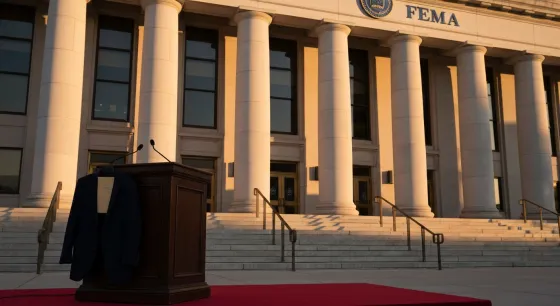
Politics has a funny habit of writing its own punchlines. Just over a year after being shown the door at FEMA, Cameron Hamilton has been invited back through it, this time with a presidential nomination tucked under his arm.
The plot twist nobody had on their bingo card
On 11 May 2026, Donald Trump nominated Hamilton, the former Navy SEAL who briefly ran the Federal Emergency Management Agency in an acting capacity, to lead it for real. The eyebrow-raising bit? Trump fired him from that same acting role on 8 May 2025, a day after Hamilton told a House Appropriations subcommittee that FEMA, in his view, should not be scrapped.
If you are wondering whether anyone in Washington keeps receipts, the answer is yes. Everyone does.
Who exactly is Cameron Hamilton?
Hamilton is not your typical Beltway appointee. He spent roughly a decade as a Navy SEAL with SEAL Team Eight, trained as a Navy hospital corpsman, and later did stints in State Department crisis response before becoming director of emergency medical services at the Department of Homeland Security. From January to May 2025, he was acting FEMA administrator.
It is a CV with a lot of grit. Whether it ticks the legal boxes for the top job, however, is a separate matter.
The awkward small print
Under federal law, specifically the Post-Katrina Emergency Management Reform Act, the FEMA administrator is supposed to have at least five years of executive leadership and management experience. Hamilton's record is impressive on paper, but his executive management years are arguably thinner than the statute envisages. Expect senators with a flair for theatre to wave that particular page around during confirmation hearings.
It is the sort of detail that could prove a flashpoint, or get politely waved through. Hard to say which, given the current mood music.
Why Trump changed his tune on FEMA
For months, the administration sounded keen on dismantling FEMA outright. Now it is nominating a permanent leader. That is not a subtle pivot, that is a handbrake turn.
The shift lines up with the recommendations issued on 8 May 2026 by Trump's own FEMA Review Council, which urged sweeping reforms rather than abolition. Many of those changes would require Congress to actually pass something, which is its own kind of optimism. Either way, the message is clear, FEMA is staying, and someone has to run it.
The fallout from Hamilton's first stint
Hamilton's acting tenure was not exactly a quiet warm-up lap. Several decisions taken on his watch still rankle inside the agency.
- Door-to-door canvassing of disaster survivors was halted, a move that frustrated frontline responders.
- A multibillion-pound resilience grant programme was cancelled, then, according to reporting, later restored by a federal court.
- DOGE, the cost-cutting outfit, gained access to internal FEMA networks containing survivors' private information, which is the sort of sentence that makes data protection lawyers reach for the kettle and a strong biscuit.
- Hamilton was reportedly given a polygraph by DHS over alleged leaks, which is a deeply 2020s career milestone.
None of that is fatal to a nomination, but it is the kind of baggage that gets unpacked in public, slowly, in front of cameras.
A department in flux
FEMA sits inside the Department of Homeland Security, currently led by Markwayne Mullin, who took the reins after the post-Noem reshuffle. According to the Associated Press copy underpinning most reporting, there was also a 75-day DHS shutdown that ended on 30 April 2026, though that specific claim has not, in our checks, been widely corroborated beyond the original wire story. Treat it as reported rather than gospel.
What is not in doubt is the scale of the organisation Hamilton hopes to run. FEMA employs more than 21,000 people and is the agency Americans turn to when hurricanes flatten coastlines, wildfires gut towns, or floods chew through the Midwest. It is one of the most consequential domestic jobs in the federal government, and it has had three temporary leaders in fairly quick succession, Hamilton among them.
Why this matters to readers in the UK
Fair question, why should anyone this side of the Atlantic care? A couple of reasons.
First, FEMA's posture shapes how the United States responds to climate-fuelled disasters, and Britain is increasingly tied to those storylines, whether through reinsurance markets, aid coordination or simply the cost of imported goods after a hurricane wipes out a port. Second, the politics of dismantling, then re-staffing, a major federal agency is a useful case study for anyone watching the wider trend of governments threatening to gut institutions before quietly rebuilding them.
Third, and rather more cynically, it is a reminder that being sacked in Washington is rarely the end of the story. It is more like an interval.
What to watch next
A few signposts worth keeping an eye on.
- Confirmation hearings. Senators will want to interrogate Hamilton's management experience against the statutory five-year benchmark, plus the resilience grant cancellation and DOGE data access.
- The Review Council's recommendations. Anything requiring congressional action will move at congressional speed, which is to say, slowly, with occasional bursts of drama.
- Hurricane season. Hamilton, if confirmed, could be tested early. Atlantic hurricane season runs from June, and FEMA's credibility tends to be made or unmade in the weeks after a major storm.
- Internal morale. An agency that has seen three temporary leaders, a polygraph saga and a contentious access decision is not exactly a serene workplace. Hamilton will need to rebuild trust, fast.
The verdict
This nomination is part redemption arc, part political climbdown, and part bet that a familiar face can steady an agency that has been jerked around for over a year. Hamilton's military and crisis-response pedigree is genuine. His statutory eligibility, his record during his acting stint, and the broader question of whether the administration actually believes in FEMA, all remain live issues.
If you like your politics tidy, look away. If you enjoy a good comeback story with footnotes, pull up a chair. Either way, expect the confirmation process to be anything but boring.
Read the original article at source.