
Trump's 25% Tariff Tantrum: European Cars in the Crosshairs Again
Trump has raised tariffs on European cars and trucks from 15% to 25%, blaming Brussels for breaking the Turnberry deal. Here's what it means.












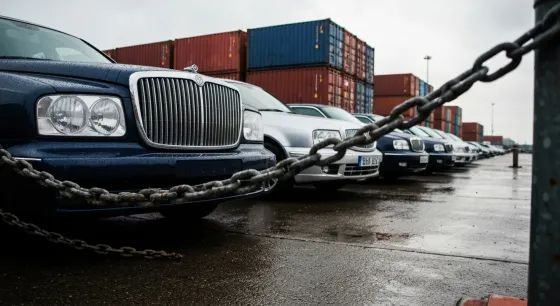
Just when European carmakers thought they could exhale, Donald Trump has reached for the tariff dial once more. On Friday 1 May 2026, the US president announced via Truth Social that tariffs on EU-built cars and trucks will leap from 15% to 25% next week, accusing Brussels of failing to honour the trade deal both sides shook hands on at his Turnberry resort last July.
If you're wondering what changed between then and now, join the club. Trump didn't say. Brussels, predictably, is scrambling to figure out what it has supposedly done wrong.
What Trump actually announced
The post was vintage Trump: punchy, light on detail, heavy on grievance. The headline figure is a 25% tariff on European cars and trucks landing on American shores, up from the 15% ceiling agreed under the so-called Turnberry deal. Vehicles assembled in US plants escape the hit entirely, which is rather the point.
Trump claimed that more than $100 billion is being poured into American auto and truck factories, a figure he offered without receipts. Take it with the usual pinch of salt reserved for round numbers shouted on social media.
A quick refresher on the Turnberry deal
Cast your mind back to July 2025. After months of bluster, threats and the famously branded "Liberation Day" tariffs (which started life at a far chunkier 30%), Trump and European Commission President Ursula von der Leyen met at his Scottish golf course and hashed out a compromise. Most EU goods entering the US would face a 15% tariff. In return, the EU pledged roughly $750 billion in American energy purchases, among other concessions.
It was never a deal that thrilled European leaders, but it was, crucially, a deal. Cars made up the most politically loaded slice of it, given how much German manufacturing in particular leans on the American market.
Why 25% genuinely stings
For UK readers watching from across the Channel, the immediate question is who actually bleeds here. The answer is the German big three: Mercedes-Benz, BMW and Volkswagen, all of which ship a meaningful chunk of their US-sold cars from European factories. Audi and Porsche fall in the same boat, and Porsche has essentially no US production to fall back on.
A 10-percentage-point jump might sound small. It is not. On a £60,000 saloon, that is a serious chunk of margin to either swallow, pass on to buyers, or partially absorb at the dealer level. None of those options is fun.
British carmakers are technically outside the EU these days, so this particular round does not hit Jaguar Land Rover or Mini in the same way. But UK-based component suppliers feeding European assembly lines will feel the chill, and any wobble in the wider European auto economy tends to reach the Midlands eventually.
But wait, didn't the Supreme Court strike down Trump's tariffs?
Good memory. The Supreme Court did indeed rule against the "Liberation Day" tariffs, on the basis that they had been imposed under the International Emergency Economic Powers Act (IEEPA), which the justices decided was a legal stretch too far.
Auto tariffs, however, ride on a different horse. They sit under Section 232, the national security provision that allows a US president to slap duties on imports deemed a threat to American defence or industrial capacity. It is a well-trodden legal route, and the Supreme Court ruling does nothing to weaken it. So while parts of Trump's tariff empire have been dismantled, the car levy is on firmer legal footing.
What's the EU supposed to have done wrong?
Officially, Trump says the bloc is "not complying with our fully agreed to trade deal". Unofficially, nobody outside Mar-a-Lago is entirely sure what he means.
There has been chatter, not yet independently confirmed, about ongoing wrangles over steel and aluminium, and reports that the European Parliament had a wobble earlier this year before eventually signing off on the deal. Whether any of that is the real trigger or a convenient excuse, only Trump knows. And possibly not even him.
How might Brussels respond?
The EU has form on retaliation. Last time round, it lined up tariffs on quintessentially American exports, from bourbon to Harley-Davidsons to denim. Expect a similar playbook if cooler heads do not prevail.
That said, Brussels has reason to tread carefully. A full-blown tariff tit-for-tat would land at a delicate moment for European industry, which is already wrestling with high energy costs, sluggish Chinese demand, and a painful shift to electric vehicles. Picking a fight with Washington is not exactly top of any sensible commissioner's wishlist.
What it means for UK consumers
Let us be honest: most British drivers will not notice this directly at the showroom. The tariffs target cars sold in the US, not the UK. But there are knock-on effects worth watching.
- European manufacturers may shift more production capacity to the US, leaving European factories underused and prices for UK buyers unpredictable.
- If margins tighten globally, expect fewer discounts and longer waits for the more desirable trims.
- The pound versus dollar dance always matters, and trade tantrums tend to wobble currencies.
There is also the broader political weather. A US that uses tariffs as a first resort rather than a last one creates a jumpier global economy, and jumpy economies are not kind to import-heavy Britain.
The bigger picture
This is the part that should worry European policymakers more than the tariff itself: the Turnberry deal is, on paper, less than a year old. If it can be unilaterally rewritten on a whim, it is not really a deal so much as a rolling negotiation with no end. That is a tough environment for any business trying to plan a five-year investment cycle.
It also raises the stakes for the EU's relationship with other trading partners. If Washington can rip up the rulebook, expect Brussels to look harder at deepening ties with the UK, with Mercosur, and with Asian partners. There is a reasonable case that Trump's tariff habit is the single best advert European integration has had in years.
The verdict
Is this a genuine policy shift or another bargaining chip pulled out mid-game? Probably the latter, dressed up as the former. Trump has spent his political life using tariffs as both weapon and prop, and EU cars are one of the most photogenic targets going.
European carmakers, especially the German ones, are right to be nervous. UK readers should treat this as a reminder that the post-Brexit landscape leaves Britain caught between two trading giants who keep changing the rules. Quietly, that might be both the danger and the opportunity.
Read the original article at source.