
Spirit Airlines Circles The Drain As Trump's $500m Bailout Goes Belly Up
Spirit Airlines is on the brink after a $500m Trump bailout fell apart. Here's why the deal collapsed and what it means for the budget carrier.












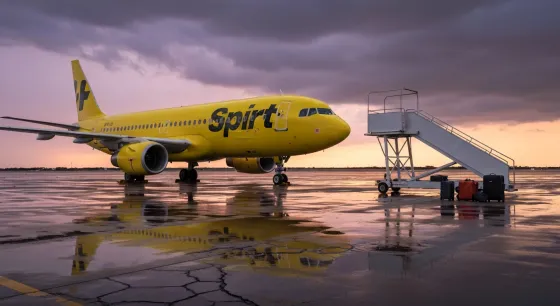
Well, that didn't fly. Spirit Airlines, the famously bare-bones American budget carrier with the bright yellow paint job and a reputation for charging you for the air you breathe, looks set to shut down after a proposed $500 million rescue package from the Trump administration collapsed in spectacular fashion.
What's Actually Happening
According to reporting from Bloomberg, CNBC, NBC News and others, Spirit has been unable to wrangle enough support from bondholders and government stakeholders to lock in the funding it needs to keep its planes in the sky. The deal would have handed Washington up to a 90% equity-like warrant stake in the airline, which is the sort of arrangement that makes Wall Street veterans choke on their espresso.
Translation for the rest of us: the US government would have effectively become Spirit's biggest shareholder, with creditors taking a haircut so severe it would qualify as a buzzcut. Predictably, the people holding those bonds were not thrilled.
Why The Deal Fell Apart
This wasn't a clean-cut political tussle. The objections came from all directions, which is impressive in a town where people normally can't agree on lunch.
Senior lenders, reportedly including Ken Griffin's Citadel, baulked at terms they argued would dilute their claims into oblivion. Inside the administration, Transportation Secretary Sean Duffy and FAA Administrator Bedford were said to oppose the bailout. Congressional Republicans piled on too, particularly after President Trump floated the rather memorable suggestion that the government could simply 'just buy' Spirit outright.
Turns out 'just buy a struggling airline' is not the slam-dunk political winner some hoped it would be.
How Did Spirit End Up Here?
For UK readers who've never had the dubious pleasure of a Spirit flight, think Ryanair without the charm, plus a longer queue at the boarding gate. The airline has spent years cutting costs to the bone, which worked beautifully right up until it didn't.
The numbers tell a grim story. Spirit has filed for Chapter 11 bankruptcy not once but twice in recent memory, in November 2024 and again in August 2025. The Independent reports cumulative losses of more than $2.5 billion since 2020, although that specific figure is harder to pin down across other independent sources, so treat it as the broad shape of the problem rather than a precise scoreboard.
Then came the fuel issue. Rising jet fuel prices, fuelled in turn by the war involving Iran and disruption around the Strait of Hormuz, have absolutely battered the airline's margins. J.P. Morgan reportedly estimated that at $4.60 a gallon, Spirit's full-year 2026 operating margin could collapse to around minus 20%, compared with the modest plus 0.5% baked into its restructuring plan. That's roughly $360 million in additional expenses for a company that doesn't have $360 million lying about.
There was also the small matter of $240 million in restricted cash that needed to be released by 30 April. Spoiler: the calendar kept moving.
Did Spirit Have A Plan B?
It did, briefly. After agreeing terms with creditors, Spirit had been hoping to exit bankruptcy by summer 2026 as a slimmer, leaner version of itself. The bailout was meant to bridge the gap between 'almost out of the woods' and 'safely back at base camp'.
Without it, the runway looks alarmingly short. Spirit hasn't officially confirmed liquidation, but when an airline can't secure financing and is openly described as 'preparing to shut down', the writing is usually on the fuselage.
Why Should UK Readers Care?
Fair question. You can't fly Spirit from Heathrow, and you wouldn't want to.
But this matters for a few practical reasons. First, if you're heading to the United States this year, particularly to Florida, the Caribbean or anywhere served heavily by ultra-low-cost carriers, expect fares to climb. When a major budget operator vanishes, the survivors quietly hike prices. American Airlines, Delta and United will not be holding a candlelight vigil.
Second, Spirit is a hub player at airports like Detroit Metro and Orlando. Reduced capacity there ripples outward, including on connecting flights that British travellers actually use.
Third, the broader story is a warning sign about the ultra-low-cost model. Spirit's collapse, if it sticks, will reshape the competitive landscape for carriers like JetBlue and Frontier. EasyJet and Ryanair will be watching with interest, even if their fundamentals are different.
The Politics Of It All
There's a slightly surreal quality to the whole episode. A Republican administration was prepared to take a near-90% stake in a private airline, which is the sort of move that would normally have certain commentators writing thunderous op-eds about creeping socialism. That it failed because of objections from within the administration, from Republican lawmakers, and from very capitalist hedge funds is the kind of plot twist you couldn't make up.
It also raises an awkward question for future cases. If Washington won't backstop Spirit, what happens when the next mid-size carrier wobbles? The implicit answer appears to be: don't count on a rescue.
What Happens Next?
In the immediate term, expect noise rather than clarity. Spirit may still try to find a last-minute buyer, restructure further, or sell off slots and aircraft to competitors. Each option is messy and none guarantees the brand survives in any recognisable form.
Customers holding tickets should keep a close eye on their bookings, check their travel insurance and assume nothing. Section 75 protection on credit cards is your friend if things go properly south.
And if you've ever paid Spirit for a carry-on bag at the gate, take comfort in this: that £45 is probably the most resilient thing about the whole airline.
The Bottom Line
Spirit Airlines was a particular kind of brilliant, in the way a discount supermarket trolley with one wonky wheel is brilliant. It got millions of Americans flying who otherwise wouldn't have bothered. Its likely demise is a genuine loss for budget travel, even if nobody quite enjoyed the experience.
But airlines need fuel, finance and at least a sliver of political goodwill. Spirit has run dangerously short on all three. Without a miracle, the yellow planes are about to become a footnote.
Read the original article at source.