
Trump Reckons He'd Make a Cracking Astronaut, Actually
Trump tells Artemis II crew he'd have 'no trouble' being an astronaut during an Oval Office meeting. Here's what actually happened.












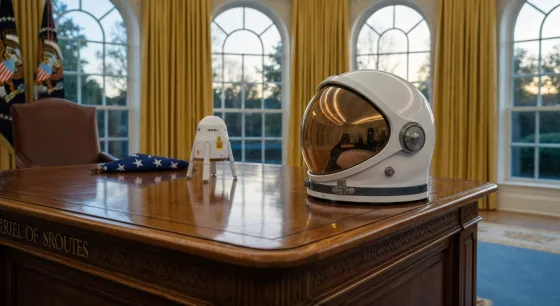
In the long and storied list of jobs Donald Trump believes he could do standing on his head, we can now add a new entry above plumber, brain surgeon and Premier League referee. The former (and current, depending on which calendar you're reading) US president has declared he'd have 'no trouble' becoming an astronaut.
The pronouncement came during an Oval Office gathering on Wednesday 29 April, held to honour the crew of the upcoming Artemis II lunar mission. What was meant to be a polite photo op with some of the most rigorously trained humans on the planet quickly veered, as these things tend to, into a meditation on Trump's own boundless capabilities.
What Actually Happened in the Oval Office
The meeting was supposed to be about the Artemis II crew, the four astronauts preparing for NASA's first crewed mission around the Moon in over half a century. It's a genuinely big deal. The mission is the next major step in America's plan to return humans to lunar orbit, paving the way for an eventual surface landing under the broader Artemis programme.
Trump, sat behind the Resolute Desk and surrounded by the crew, took a moment to muse aloud that he reckoned he'd have 'no trouble' doing what they do. Whether the astronauts' polite smiles concealed quiet horror or genuine amusement is, frankly, anyone's guess.
Who Are the Artemis II Crew?
The Artemis II mission is set to send four astronauts on a flyby of the Moon. They've spent years training for the trip, going through the sort of physical and psychological wringer that would have most of us reaching for a lie-down after the first centrifuge session. Becoming an astronaut isn't quite the same as opening a golf course, despite what the comments from the Oval Office might suggest.
The 'I Could Do That' School of Politics
There's a particular brand of political bravado that involves looking at any specialised profession and concluding, with the confidence of a man who has never tried it, that you'd be brilliant at it. Trump is something of a grandmaster in this discipline.
Over the years, he's offered his expert opinion on everything from epidemiology to military strategy to the inner workings of windmills. Adding 'astronaut' to the CV is, in fairness, on brand. The man does not lack for self-belief, and on a slow news day, that self-belief makes for excellent television.
The Reality of Astronaut Training
For anyone tempted to update their LinkedIn with 'aspiring astronaut' on the back of this, a quick reality check. NASA's astronaut candidates typically endure around two years of basic training before they're even considered for a mission. That's after being plucked from a pool of thousands of applicants, most of whom hold advanced degrees in engineering, science or medicine, alongside thousands of hours of flight experience.
Then comes the small matter of being strapped to a controlled explosion and flung beyond the Earth's atmosphere. Most people, when faced with the prospect, would describe it as something other than 'no trouble'.
Why This Matters (Beyond the Soundbite)
It's tempting to file this under 'Trump being Trump' and move on. But the comment, throwaway as it was, points to something a bit more interesting about how space exploration is being framed in the current political moment.
Artemis is the most ambitious crewed space programme the US has launched in decades. It involves enormous budgets, international partners, and serious questions about timelines and priorities. When the president of the country running it appears to treat the astronauts more as a backdrop for his own musings than as the central story, it tells you something about where space policy currently sits on the agenda.
What's at Stake for the Artemis Programme
The programme has faced delays, ballooning costs and ongoing debates about whether to prioritise the Moon or jump straight to Mars. Recent years have seen private companies, most notably SpaceX, take an increasingly central role in American spaceflight. The political backing for NASA's own programmes has waxed and waned, and public attention is a finite resource.
Moments like this Oval Office meeting are part of how that attention gets directed. When the headlines focus on a presidential quip rather than the mission's objectives, the astronauts themselves, or the science, it's a missed opportunity to remind people why this stuff is worth doing.
The British Take
For UK readers, all this might feel a bit distant. Britain doesn't have its own crewed space programme, though we do contribute to the European Space Agency and have produced our share of astronauts, Tim Peake being the most recent household name.
What's interesting from this side of the Atlantic is the sheer cultural difference in how leaders engage with science and exploration. It's hard to imagine a British prime minister sitting down with a returning ESA crew and casually announcing they'd fancy a go themselves. There would be a polite cough, a reference to having read a book about it once, and a swift change of subject.
A Different Style of Statesmanship
That's not necessarily a criticism of either approach. American politics has always had a more theatrical streak, and Trump has turned that streak into an art form. Whether you find it entertaining or exhausting tends to depend on how many news cycles you've already lived through that week.
So, Could He Actually Do It?
Let's indulge the hypothetical for a moment. Could Donald Trump, at his current age and with no prior aerospace training, become an astronaut?
The honest answer is no. NASA's age limits are not formally fixed, but the physical demands of spaceflight are considerable. Candidates need to pass rigorous medical assessments, including cardiovascular tests that would challenge people half his age. They also need to fit into the suits and the spacecraft, which are designed around fairly specific physical parameters.
Then there's the small matter of training, the crew dynamics and the years of specialised preparation. 'No trouble' is doing some heroic lifting in that sentence.
The Verdict on the Verdict
Of course, Trump wasn't really pitching himself for a Moon mission. It was the kind of off-the-cuff remark that has long been part of his speaking style, designed to amuse, provoke or simply fill the silence. Treating it as a literal job application would be missing the point.
Still, you can't help but notice that the actual astronauts, the people who've spent years preparing to do something genuinely extraordinary, ended up as supporting cast in their own ceremony. That's the bit worth reflecting on.
Final Thoughts
The Artemis II crew deserve their moment in the spotlight. They're about to do something most of us can barely imagine, and their training, expertise and courage are the real story. The presidential aside about how easy it all looks is a fun bit of footage, but it shouldn't be the headline.
If anything, it's a reminder that genuine expertise often goes underappreciated, while bold claims tend to grab the microphone. Whether you're picking an astronaut or a plumber, that's worth bearing in mind.
Read the original article at source.