
Russia Cancels the Tanks: Moscow's Victory Day Parade Gets a Drone-Shaped Trim
Moscow's 9 May 2026 parade goes ahead without tanks, vehicles or cadets as the Kremlin cites Ukrainian drone threats. Here's what's changed and why.








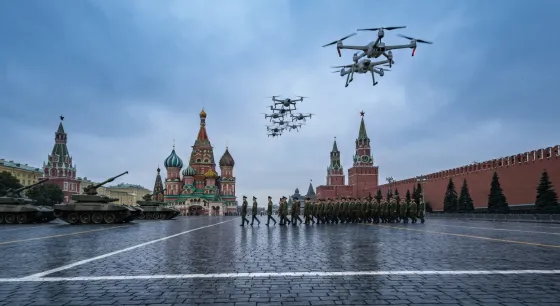
Spare a thought for the Kremlin's parade planners. For nearly two decades, 9 May in Red Square has been a thunderous showcase of tanks, missile launchers and crisply marching cadets, all designed to remind the world that Russia still does pomp on an industrial scale. This year, the script has been rewritten, and not by choice.
What's actually changing on 9 May 2026
Russia has confirmed that the 81st anniversary of the Soviet victory over Nazi Germany will go ahead in Moscow, but with a noticeably slimmer guest list of hardware. No military vehicles will rumble across the cobbles. No cadets from the Suvorov and Nakhimov schools will march past. The cadet corps are sitting this one out too.
For context, last year's 80th anniversary featured more than 11,500 troops and over 180 military vehicles, with upwards of 20 world leaders watching from the stands, Xi Jinping among them. This year, the optics will be rather different.
It is the first time the parade has gone ahead without heavy military hardware since Vladimir Putin revived that Soviet-era tradition back in 2008. Eighteen years of choreography, quietly shelved.
The Kremlin's official explanation
Kremlin spokesman Dmitry Peskov has blamed what he called a 'terrorist threat' from Kyiv, citing the 'current operational situation'. Translation, roughly, we cannot guarantee that something nasty will not buzz overhead while the cameras are rolling.
It is a striking admission. For years the Victory Day parade has been pitched as proof that Russia is unshakeable, a country so secure it can wheel its nuclear-capable launchers down the high street. Cancelling the rolling stock tells a rather different story.
Why the worry? Drones, drones and more drones
The decision lands against a backdrop of long-range Ukrainian drone strikes that keep popping up in awkward places. The Tuapse oil refinery on the Black Sea coast has been hit three times in roughly a fortnight, with the most recent strike on 28 April 2026. The site has been closed since 16 April after damage to its export port, and Novaya Gazeta Europe has reported an oil spill and so-called 'black rain' in the area, raising environmental and public-health alarms.
Even more eye-catching, a drone reportedly struck an oil pumping station near Perm in the Urals. That is roughly 1,500km, or about 930 miles, from the Ukrainian border. If your air defences are being tested in the Urals, parading an open-topped command car through Red Square starts to look less like a flex and more like a dare.
Pro-Kremlin military bloggers had reportedly been fretting about exactly this scenario. The optics of an air-raid alert mid-anthem do not flatter anyone.
What about Moscow itself?
According to BBC Russian, mobile internet restrictions are expected to be imposed in Moscow on 5, 7 and 9 May. That detail has been attributed to a telecoms source and has not been widely corroborated elsewhere, so treat it as plausible rather than confirmed. Such measures are commonly used in Russia to disrupt drone navigation and coordination, and Muscovites have grown wearily familiar with patchy signal on big political dates.
Ukraine's response
Mykhailo Podoliak, adviser to Ukraine's President Zelensky, has publicly ruled out any attack on the Victory Day parade itself. Whether you take that at face value or not, it is a tidy bit of diplomacy. By saying it out loud, Kyiv puts the responsibility for the scaled-back spectacle squarely on Moscow's shoulders.
If the parade is trimmed and nothing happens, the Kremlin still has to explain why the tanks stayed in the garage. If something does happen, well, the Kremlin has already telegraphed that it expected trouble.
Why this matters beyond the photo op
It is tempting to file 'parade gets smaller' under trivia. It is anything but. Victory Day is one of the most important dates in Russia's political calendar, a carefully curated piece of national mythology that fuses the genuine sacrifice of the Second World War with the Kremlin's modern military narrative. The hardware is the whole point.
Stripping out the tanks turns the broadcast into a parade of speeches and infantry, which is fine, but harder to sell as a display of unstoppable strength. Analysts are already reading the change as a tacit acknowledgement that Russia cannot reliably keep its own capital's airspace clean during a high-profile, pre-announced event.
That is a significant shift in tone. For the past few years, Russia has insisted that the war in Ukraine is going to plan, that sanctions are not biting, and that domestic life carries on as normal. A Victory Day without armour gently undermines all three claims at once.
The economic backdrop
There is also a broader pattern worth flagging. Ukraine has reportedly struck roughly a dozen Russian refineries in recent weeks, and global oil prices have been twitching in response. Tuapse alone is a meaningful node in Russia's export network, and prolonged closures have knock-on effects for revenues at a time when the war effort is anything but cheap.
For UK readers, that matters because Russian export disruption tends to filter through to global crude prices, which then turn up at the petrol pump. Even if Moscow's parade feels distant, the economic ripples are not.
Should we expect more of the same?
Probably yes. Drone warfare has flipped the cost equation. Ukraine can launch relatively cheap, long-range systems at high-value Russian targets, and even when most are intercepted, the ones that get through cause significant damage and even more significant headlines. That is not a problem you solve with one good speech and a tidy parade.
Expect more visible Russian security adjustments, more grumbling from pro-war commentators about 'optics', and more careful staging of public events. Expect Kyiv to keep poking, because every poke that lands tells a story about Russian vulnerability.
The verdict
A Victory Day without tanks is not the end of Russian power, and anyone treating it that way is overreaching. But it is a small, telling moment. The Kremlin has spent years insisting it has the situation under control. Quietly cancelling the centrepiece of its biggest annual show suggests otherwise.
If you are scoring this at home, mark it down as a win for Ukrainian deterrence by drone, and a rare unforced concession from a Kremlin that very rarely concedes anything in public.
Read the original article at source.