
Pump Pain in America: Petrol Hits $4.23 as Strait of Hormuz Stand-off Bites
American petrol prices surge to $4.23 a gallon as the Strait of Hormuz stand-off rattles oil markets. Here's what's driving the pain at the pump.












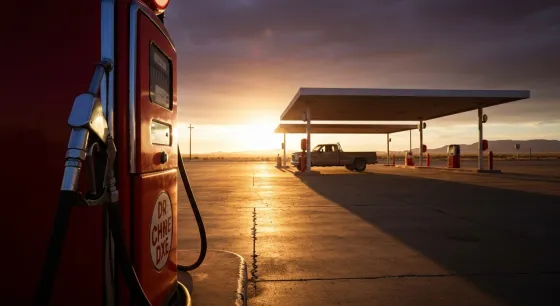
Spare a thought for the average American motorist. The price at the pump has just clocked in at $4.23 a gallon, according to AAA's figures for 29 April 2026, which makes it the priciest fill-up since Vladimir Putin rolled tanks into Ukraine back in April 2022.
For us in the UK, $4.23 a gallon sounds like a bargain breakfast (it works out to roughly 85p a litre, depending on the exchange rate you squint at). For Americans, who treat cheap petrol as a constitutional right somewhere between free speech and the second slice of pie, it's a full-blown crisis.
What's actually going on?
The short version: the Strait of Hormuz, that narrow sliver of sea between Iran and Oman that quietly handles around 20 per cent of the world's oil trade, is no longer doing its job quietly. The 2026 conflict between the US and Iran has disrupted shipping through the chokepoint, and global oil markets have responded with the subtlety of a foghorn at a funeral.
Brent crude has marched up toward the $114-a-barrel mark, with recent peaks closer to $118. The World Bank has warned of the biggest energy price surge since 2022, which, if you've been keeping a tally, is becoming a depressingly familiar benchmark.
The numbers behind the wince
Since late February 2026, when the wheels properly came off, the US national average has climbed by roughly 40 per cent, or about $1.25 a gallon. (You may see a figure of 150 per cent kicking around online. It appears to be a stray decimal or an over-caffeinated sub-editor; the more reliable reporting puts the rise at around 40 per cent.)
The pain is not evenly spread, mind you. San Diego County drivers are now staring down a county average of $6.037 a gallon, which is the sort of number that makes you reconsider whether the school run really needs to happen. Illinois has crossed $4.50 thanks to a refinery wobble piled on top of the wider crisis. Anywhere with a long pipeline and a short temper is feeling it.
Why this matters across the pond
You might be wondering why a Brit should care about Americans grumbling at the pump. Two reasons.
First, oil is a global commodity, and what shoves the US average to $4.23 also nudges UK forecourt prices up. If you've noticed your local Tesco station creeping back toward unpleasant territory, the Strait of Hormuz is a big part of why.
Second, the political fallout in Washington tends to ripple outwards. A jittery US economy is a jittery world economy, and the IMF has reportedly floated the possibility of recession risk if the disruption drags on, though specifics on that warning are thin enough that we'd file it under "watch this space" rather than gospel.
The political headache for Trump
Donald Trump won re-election in 2024 partly by hammering the Biden administration over inflation and petrol prices. The political irony of presiding over the highest pump prices since the Ukraine invasion is, shall we say, not subtle.
Reports cited in the original Independent piece put Trump's approval at 34 per cent in a Reuters/Ipsos poll, although we weren't able to independently verify that specific figure. What's harder to dispute is that polling generally has not been kind to incumbents who oversee $4-plus petrol, regardless of which party is holding the bag.
The White House has, according to reporting, hauled in oil and gas executives, including a meeting said to involve Chevron's Mike Wirth. The aim, presumably, is to be seen Doing Something. Whether anyone in that room can magic up extra barrels while the Strait of Hormuz remains a maritime obstacle course is another matter entirely.
Midterms loom, and Republicans are sweating
Here's the thing about voters and petrol prices: they are an unusually direct, unusually visible economic signal. Most people couldn't tell you the current rate of CPI inflation, but they can tell you, to the penny, what they paid to fill the tank last Tuesday.
If $4.23 sticks, or worse, climbs further, the 2026 midterms could turn into a referendum on whether the party that promised cheaper fuel can actually deliver it. The Republicans ran in 2024 on competence and the cost of living. Running in 2026 with petrol prices at war-era highs is a tougher pitch, particularly when your own base is the one filling up the F-150.
Will it get better any time soon?
Honestly, nobody knows, and anyone telling you otherwise is selling something. The price of crude is essentially a bet on geopolitics. If the Strait of Hormuz reopens to normal traffic, prices could ease quickly. If the conflict deepens, or if a tanker goes up in flames at an inconvenient moment, $4.23 could start to look like the cheap days.
Domestic US production can help at the margins, but it cannot replace what flows through Hormuz. Strategic reserves can blunt the worst of a spike, but they're not infinite, and tapping them is the political equivalent of eating the emergency biscuits.
The bottom line
$4.23 a gallon is a number with consequences. It squeezes household budgets, hammers small businesses with delivery routes, feeds back into food prices, and sets the political weather in Washington. For UK readers, it's a reminder that the global oil market remains, to use the technical term, a bit of a mess, and that the cost of filling up here is hostage to events thousands of miles away.
If there's a useful takeaway, it's this: keep an eye on the Strait of Hormuz, not just because it sets the petrol price, but because it sets the mood of an entire American election year. And in 2026, that's a mood worth watching.
Read the original article at source.