
Powell's Last Stand: Four Things to Take From the Fed Chair's Final Rate Verdict
Jerome Powell held rates in a fractious 8-4 vote. Here's what the Fed chair's likely final decision means for inflation, markets and UK readers.






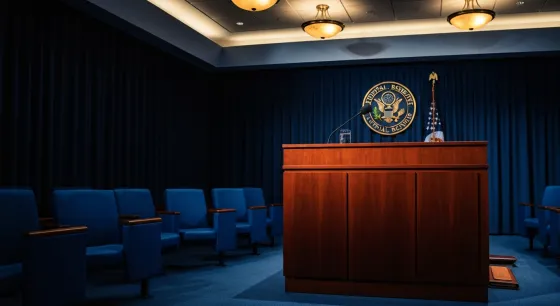
Jerome Powell walked into what looks set to be his last rate decision as Fed chair and, in true central banker fashion, did absolutely nothing. Rates held. Markets shrugged. And yet the press conference that followed was anything but boring, taking in war in the Middle East, sticky inflation, a White House that has spent months trying to shove him out the door, and the small matter of who replaces him.
For UK readers wondering why any of this matters from across the Atlantic, the short answer is this: when the world's most important central bank starts wobbling on its independence, your mortgage rate, your pension, and the price of petrol on the forecourt all eventually feel it. Here are the four takeaways that actually mattered.
1. Rates held, but the Fed is plainly at war with itself
The headline number is straightforward enough. The Federal Open Market Committee kept the federal funds rate target in a range of 3.5% to 3.75%, exactly where it has been sitting. No cut, no hike, no drama on the surface.
Dig a layer deeper, however, and the picture gets spicier. The decision came with four dissents, an 8-4 split that is reportedly the most fractious vote in decades. That is not a polite difference of opinion at the coffee machine. That is a committee tearing itself in two over what to do next, and it is a detail the bare headline numbers tend to bury.
Why the row? Because the Fed is being pulled in opposite directions by two very loud forces. On one side, an economy that needs a bit of relief. On the other, inflation that simply will not go quietly.
2. Inflation is back, and oil is the awkward guest at the party
Powell was blunt about the sticky bit. Inflation has crept back up, and according to the figures cited in the original BBC piece, the March reading hit 3.3%, described there as the highest since May 2024. Other reporting frames it more cautiously as a two-year high, so take the precise comparison with a pinch of salt, but the direction of travel is clear: prices are not behaving.
The chief culprit is not hard to spot. Oil prices have rocketed roughly 50% since late February 2026, driven largely by the US-Israel conflict with Iran and the American blockade of Iranian ports. When crude jumps, everything that moves on a lorry, sails on a ship, or runs on a generator gets more expensive. That feeds straight into headline inflation.
For the Fed, this is a horrible scenario. Cut rates to support growth and you risk pouring petrol on the inflation fire. Hold rates and you squeeze households who are already feeling the pinch from energy costs. Powell, predictably, chose to hold and to wait.
One analyst quoted in the original coverage, Samuel Tombs of Pantheon Macroeconomics, suggested cuts might now slip into 2027. We have not been able to independently verify that exact line, but the broader logic stacks up: if oil keeps climbing, rate cuts will keep retreating into the distance.
3. Powell is leaving the chair, but not the building
Powell's term as chair ends on 15 May 2026, and barring something extraordinary, this was his final rate meeting in the top job. What he is not doing, however, is packing his desk and disappearing into a lucrative speaking circuit.
His term as a Fed governor runs until 2028, and he has confirmed he intends to stay on until the Department of Justice probe targeting him is, in his own words, 'well and truly over'. He also explicitly said he is 'literally staying because of the actions that have been taken' by the Trump administration. That is not the language of a man gracefully retiring. That is a man digging his heels in.
At the same time, he has promised a 'low profile' and pledged not to act as a 'shadow chair'. Translation: he will not be holding rival press conferences or briefing against his successor. Whether the markets believe that is another matter entirely. A former chair sitting on the board, watching his replacement, is an awkward dynamic at the best of times.
4. Kevin Warsh is the heir apparent, and the politics are toxic
The succession picture is becoming clearer. Kevin Warsh, who served on the Fed Board between 2006 and 2011, has been advanced by the Senate Banking Committee on a 13-11 party-line vote. The full Senate is expected to vote the week of 11 May 2026, conveniently just before Powell's chair term expires.
The vote was unlocked when Senator Thom Tillis dropped his block after the DOJ dropped its probe against Powell. Whether that probe could be revived under a different prosecutor, with names like Jeanine Pirro floated in some reporting, is the kind of speculation we should flag rather than treat as fact.
Democrats are not pretending to be polite about Warsh. Senator Elizabeth Warren has gone so far as to suggest he could end up a 'sock puppet' for Trump, which is colourful even by Warren standards. Powell himself described the legal attacks on the Fed as 'unprecedented in our 113-year history', a line that should make anyone who cares about central bank independence sit up.
Why this matters for UK readers
It is tempting to file all of this under 'American problems'. Resist that temptation. The Fed sets the tone for global borrowing costs. If the new chair is seen as politically pliable, the dollar wobbles, gilts react, and the Bank of England's job gets harder. Throw in oil at elevated levels and you have a recipe for stickier UK inflation, slower rate cuts at home, and mortgage rates that refuse to behave.
The verdict
Powell's final act as chair was less a triumphant farewell and more a holding pattern in turbulent skies. Rates unchanged, committee divided, inflation grumbling, war driving oil, and a successor lined up under a political cloud. If you were hoping for a tidy ending, you came to the wrong central bank.
The real test starts on 16 May 2026, when someone else takes the chair and the markets find out, in real time, just how independent the Fed still is.
Read the original article at source.