
Goodbye 5,000: Trump Trims US Troops in Germany as the Merz Spat Boils Over
The US is pulling 5,000 troops from Germany as tensions with Chancellor Merz grow. What is changing, what is staying, and why Ramstein is untouchable.










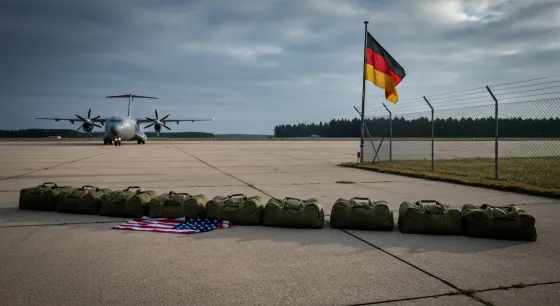
Right, so the transatlantic relationship is having one of its moments again. The US is pulling 5,000 troops out of Germany, and the timing is about as subtle as a brass band at a library. Defence Secretary Pete Hegseth has signed the order, the Pentagon has confirmed the plan, and Berlin is being told to expect the drawdown over the next six to twelve months.
If you are wondering whether this is purely about military strategy or partly about a bruised ego in Washington, you are asking the right question.
What is actually happening
The headline numbers, courtesy of the Pentagon and confirmed across outlets like CBS, NBC and the Washington Post, are these. Around 5,000 American personnel will leave Germany. That still leaves more than 36,000 active duty troops in country, based on Defense Manpower Data Center figures from December 2025 showing 36,436 personnel. So it is a trim, not a shave.
The reduction reportedly affects one brigade combat team. A long-range fires battalion that had been earmarked for Germany is being reassigned elsewhere. Pentagon spokesman Sean Parnell says the move will be wrapped up within six to twelve months, which in military scheduling terms is practically next Tuesday.
One thing being carefully ring-fenced is Ramstein Air Base. According to reporting from Breaking Defense and others, Ramstein is staying put because it is doing rather a lot of heavy lifting on US operations against Iran, including drone coordination, missile defence, satellite links and data crunching. Translation: the Pentagon is happy to make a political point, but not at the cost of switching off the lights at one of its most important nerve centres.
The Merz factor
Now for the bit that gives this story its bite. German Chancellor Friedrich Merz has not exactly been mincing his words about the Trump administration's Iran policy. In a recent university speech, picked up by Al Jazeera and Time among others, Merz said the Americans 'clearly have no strategy' and that the nation had been 'humiliated' by the Iranian leadership.
That is the diplomatic equivalent of telling your mate his haircut is a disaster on his wedding day. It went down in Washington exactly as well as you would expect.
The White House has not formally linked the troop cut to Merz's comments, but the choreography is doing the talking. Allies row in public, troops move in private, and everyone pretends the two are unconnected.
Why it matters to you
If you are sitting in Manchester, Cardiff or Glasgow wondering why a few thousand American soldiers leaving Bavaria should be on your radar, here is the short version. NATO posture in Europe is the scaffolding that holds up an awful lot of UK security planning. When the Americans rearrange the furniture, everyone else has to shuffle around it.
The BBC's reporting puts roughly 10,000 US troops in the UK and around 12,000 in Italy, although those approximate figures have not been independently re-verified here. Germany still hosts the largest US contingent in Europe by a comfortable margin, with only Japan hosting more US personnel globally. So a wobble in Germany is, by definition, a wobble in the wider Western defence picture.
Trump, troop cuts and a sense of deja vu
If this all feels familiar, that is because it is. Back in 2020, the first Trump administration tried to yank 12,000 troops out of Germany. Congress blocked it, and Joe Biden reversed the decision once he took office. The new 5,000 figure is therefore both smaller in scale and more politically achievable, which is probably the point. It is a cut Trump can actually deliver without triggering a full-blown legislative punch-up.
There is also chatter, reported across US outlets, that Trump has floated pulling troops out of Italy and Spain too, frustrated by their reluctance to sign up for operations around the Strait of Hormuz. Whether that becomes policy or remains presidential venting is anyone's guess.
Not everyone in Washington is thrilled
It is not just European capitals raising eyebrows. Some congressional Republicans and Eastern European NATO members have already voiced concerns about a broader European drawdown, particularly with Russia continuing to loom large in the security conversation. Reducing the US footprint in Germany while Moscow is doing what Moscow does is, at the very least, a bold bit of timing.
That is the awkward thing about troop cuts. They look like savings on a spreadsheet and like signals on a map.
Germany's defence spending answer
Berlin's not-so-subtle response has been to point at its chequebook. Germany has been ramping up military spending considerably under Merz, having spent years being told off for sitting under the NATO 2 percent of GDP target. The BBC has cited a projected German defence budget of around €105.8bn in 2027, equivalent to about 3.1 percent of GDP. That specific figure has not been independently re-verified in this round of research, so treat it as indicative rather than gospel, but the direction of travel is clear.
Germany is essentially saying: if you are going to take your soldiers home, fine, we will buy more of our own.
The bigger picture: a slow Indo-Pacific pivot
This is not a one-off tantrum. The US has been gradually reweighting its forces away from Europe and towards the Indo-Pacific for years. Last year saw a reduced US presence in Romania as part of that same pivot. Viewed in that light, Germany's 5,000 is less a thunderbolt and more another notch on a long-running rebalancing act.
The Trump-Merz row may be the spark, but the kindling has been stacked up for the better part of a decade.
Verdict: a calculated jab, not a divorce
So is this the beginning of the end for the US-Germany alliance? Almost certainly not. With more than 36,000 troops staying, Ramstein humming away and intelligence cooperation continuing, the structural relationship is intact. What has changed is the temperature.
For UK readers, the takeaway is twofold. First, expect more visible turbulence between Washington and major European capitals while Trump is in office. Second, watch how London plays the middle. Britain has spent decades being the bridge between Europe and America, and bridges tend to creak loudest when both ends are pulling in different directions.
This troop cut is not a strategic earthquake. It is a calculated nudge, dressed up in fatigues, with a side order of presidential pique.
Read the original article at source.