
Germany's Deepfake Porn Scandal: How One TV Star's Allegations Sparked a National Reckoning
TV star Collien Fernandes' deepfake allegations have sparked a national reckoning in Germany, pushing new laws to criminalise AI-generated pornographic images.












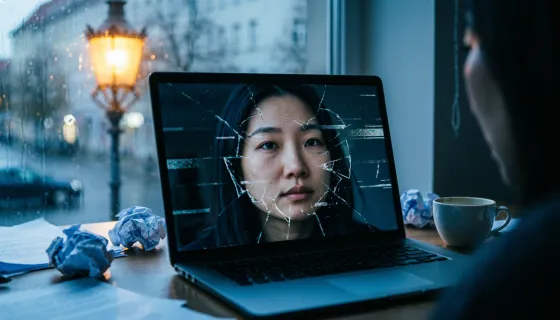
When AI Meets Abuse
Germany is having a moment. Not the fun kind involving beer festivals and efficient public transport, but the sort that forces an entire country to confront a deeply uncomfortable question: what happens when artificial intelligence is weaponised to create fake pornographic images of real women?
The catalyst? TV presenter and former Deutsche Welle host Collien Fernandes, 44, who has accused her ex-husband, actor and comedian Christian Ulmen, of spreading AI-generated pornographic images of her online. The allegations, first reported by Der Spiegel in mid-March 2026, landed like a grenade in German public life. Ulmen has categorically denied the claims and is pursuing legal action against the publication. His lawyer, Christian Schertz, has called the accusations false.
But regardless of where the truth lands in this particular case, the fallout has been seismic.
A Legal Framework That Is Playing Catch-Up
Here is the rather jaw-dropping bit: under current German law, creating a deepfake pornographic image is not actually a criminal offence. Only distributing such material is potentially punishable. If that feels like a gaping hole in the legislation, you are not alone in thinking so.
Federal Justice Minister Stefanie Hubig clearly agrees. On 25 March, she announced draft legislation that would criminalise both the creation and distribution of pornographic deepfakes, carrying penalties of up to two years in prison. The proposed law would also cover secretly taken photographs in places like saunas and changing rooms, and make it easier for victims to identify anonymous account holders. Better late than never, one might say.
250 Women, 10 Demands, and 25,000 Signatures
Fernandes has not been content to let the legal system do its thing quietly. She appeared at a Hamburg protest and has been vocal about the need for reform, building on work she began in a 2024 ZDF documentary entitled Deepfake Porn: Digital Abuse.
More than 250 prominent women from politics, business and culture released an open letter containing 10 demands, including the criminalisation of deepfakes. A supporting petition gathered roughly 25,000 signatures within hours. On Sunday 23 March, over 10,000 protesters assembled at Berlin's Brandenburg Gate. ProSieben also pulled Ulmen's show Jerks from its platform following the allegations.
The issue has even gained a European dimension, with Renew Europe, the EU Parliament group, calling for bloc-level action to close loopholes around AI-generated abuse material.
The Wider Context Is Grim
This scandal has not emerged in a vacuum. Germany's 2024 police crime statistics paint an alarming picture: 265,942 domestic violence victims were recorded, an all-time high. Some 308 women and girls were killed, and 53,451 female victims of sexual offences were documented.
Chancellor Friedrich Merz waded in during a Bundestag session on 25 March, describing an 'explosion' of violence and attributing a 'considerable portion' to immigrant groups. His remarks drew applause from both CDU and AfD benches, but sharp criticism from others. Clara Buenger of the Left party accused Merz of reflexively pointing to immigration rather than addressing the structural problem. It is worth noting that official statistics categorise dual nationals as German and do not record migration background, which complicates any sweeping claims.
The Legal Battle Continues
Fernandes filed a criminal complaint in Germany in November 2024 against persons unknown. An investigation by the Itzehoe prosecutor's office was initially discontinued last June due to a lack of leads but has since been reopened. She has also initiated legal proceedings in Mallorca, Spain, where the couple previously lived, citing the country's stronger gender-based violence laws.
Whatever the outcome of the Fernandes-Ulmen dispute, Germany's deepfake reckoning is well underway. The question now is whether the law can move as fast as the technology it is trying to regulate. Spoiler: it probably cannot. But at least it is finally trying.
Read the original article at source.