
Fertiliser, Iran And Your Sunday Roast: Why A Strait You've Never Heard Of Could Bin Ten Billion Meals A Week
Yara's boss warns the Iran conflict could wipe 10 billion meals a week off global tables. Here's why a closed strait matters for your shopping bill.











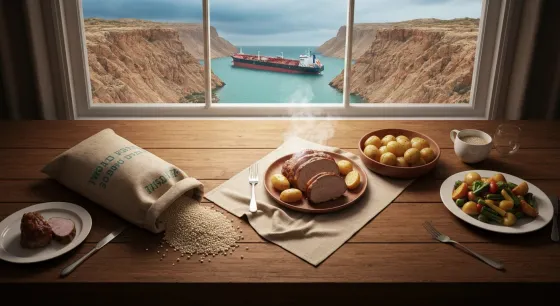
If you thought the cost of a weekly shop couldn't get any sillier, brace yourself. The boss of Norwegian fertiliser giant Yara, Svein Tore Holsether, reckons the war in Iran could knock as many as 10 billion meals a week off the global dinner table. That is not a typo. Ten. Billion. A week.
So What On Earth Has Iran Got To Do With My Spuds?
More than you'd think. Since the US and Israel launched strikes on Iran on 28 February 2026, the Strait of Hormuz has effectively been shut for business. That narrow stretch of water is one of those geopolitical pinch points nobody pays attention to until it stops working, and then suddenly everyone is an armchair expert.
According to the Carnegie Endowment and Bloomberg, roughly a third of the world's seaborne fertiliser trade squeezes through Hormuz. Around 49% of global urea exports and 30% of ammonia exports are exposed to the conflict. Translation: the stuff farmers spread on fields to make crops grow is suddenly stuck on the wrong side of a warzone.
The Holsether Warning, In Plain English
Holsether told the BBC that up to 500,000 tons of nitrogen fertiliser is currently not being produced globally because of the disruption (a figure he has used repeatedly, though we'll be honest, we couldn't find it independently corroborated elsewhere, so treat it as his own estimate rather than gospel).
His headline figure of 10 billion meals a week is striking, and worth a small footnote: in a separate CNBC interview he reportedly used the figure 20 billion. The maths clearly depends on which assumptions you plug in, so think of it as a back-of-the-envelope warning rather than a precise forecast. Either way, the direction of travel is grim.
Why Fertiliser Is The Quiet Hero Of Your Plate
Nitrogen fertiliser is not glamorous. Nobody puts it on Instagram. But take it away and yields can collapse by up to 50% in the first season, according to analyses from IFPRI and CSIS. That is not a rounding error. That is half a harvest, gone.
And because farming is one of those industries where you can't simply 'try again next week', a bad season ripples for years. Less grain means dearer bread. Dearer feed means dearer meat and dairy. Dearer everything means a tetchier shopper at the self-checkout.
Prices Are Already On The Move
Fertiliser prices have shot up 80% since the start of the US/Israel war on Iran, with granular urea jumping from roughly $400-490 a ton to around $700, according to CNBC. Yara, ironically enough, has had a rather good time of it. Bloomberg reports its Q1 profits beat expectations as European production filled the gap and prices climbed. There is a slightly awkward truth here: when the world's fertiliser supply gets squeezed, the firms still producing it tend to do quite nicely.
Holsether's framing of a 'bidding war' is the bit that should worry everyone. When supply tightens, deeper-pocketed buyers win. UN News, IFPRI and CSIS have all flagged that import-dependent countries in sub-Saharan Africa, South Asia and Latin America are likely to be the ones priced out first. That is where the meal-loss numbers really start adding up.
What This Means For UK Shoppers
The Food and Drink Federation has already revised its UK food inflation forecast upwards. Its official guidance is 'at least 9%' by the end of 2026, although the BBC and several other outlets are now rounding that up to nearly 10%. Either way, it is not the sort of number you want greeting you at the till.
And here's the catch most coverage glosses over: the FDF's forecast assumes the Strait of Hormuz reopens within two or three weeks and that oil, gas and fertiliser sites get back to normal within a year. If those assumptions wobble, the 10% figure could end up looking optimistic.
Where You'll Notice It First
- Bread, pasta and cereals, because grain crops are heavy nitrogen users.
- Meat and dairy, because livestock feed is mostly grain.
- Fresh veg, because field-scale growers depend on synthetic fertiliser to keep yields up.
- Anything processed, because input costs eventually find their way onto the back of a packet.
Is There A Plan B?
Sort of, but not a quick one. European producers like Yara can ramp up to fill some of the gap, which is exactly what's happening. Farmers can also try to stretch existing stocks by being cleverer with application, using cover crops, or leaning on organic alternatives. None of that scales fast enough to plug a 500,000-ton hole, though.
Governments could intervene with subsidies, strategic reserves, or trade agreements that prioritise food-vulnerable nations. Whether they will is, frankly, anyone's guess. Crisis politics tends to favour the loudest voices, not the hungriest ones.
The Bigger Picture
It is tempting to file this under 'distant geopolitics' and move on. Don't. Modern food systems are wildly interconnected, and a chokepoint thousands of miles away can absolutely turn up in your weekly shop. The Iran war is a reminder that food security is not just about farms and weather. It's about shipping lanes, gas pipelines, factory output and diplomatic phone calls.
The Verdict
Holsether's warning is dramatic, but the underlying mechanics are real. Hormuz is genuinely choked, fertiliser is genuinely scarcer, and prices are genuinely climbing. Whether the worst-case 10 billion meals figure lands or not, UK shoppers should expect food inflation to keep biting through 2026, and policymakers should probably stop treating fertiliser as a boring industrial footnote.
If nothing else, the next time someone moans about the price of a loaf, you'll have a much more interesting answer than 'inflation, innit'.
Read the original article at source.