
Zelensky's Gulf Charm Offensive: Trading Drone Know-How for Air Defence Deals
Ukraine offers Saudi Arabia and Gulf allies battle-tested counter-drone tech at a fraction of US costs, as Washington eyes diverting arms to the Middle East.












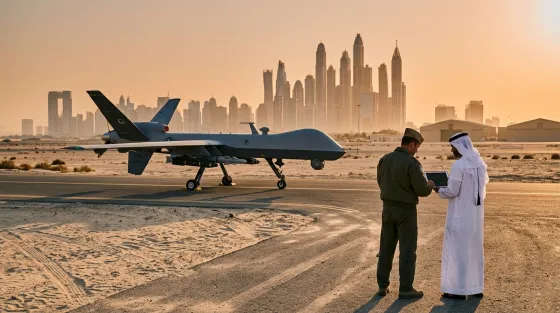
A Wartime President Goes Shopping in the Desert
Volodymyr Zelensky touched down in Saudi Arabia on 26 March 2026 with one of the more unusual sales pitches in modern diplomacy: buy our drones, and we will teach you how to swat enemy ones out of the sky for a fraction of what the Americans charge.
The unannounced visit comes at a moment of genuine urgency. With Washington pivoting its military attention towards Iran following its attack launched on 28 February, the Pentagon is reportedly considering diverting weapons originally earmarked for Ukraine to the Middle East. The Washington Post broke that story the same day, and President Trump did little to calm nerves, offering a characteristically breezy confirmation: "We do that all the time. Sometimes we take from one, and we use for another."
Not exactly the reassurance Kyiv was hoping for.
The Pitch That Actually Makes Sense
Here is where it gets interesting. Ukraine is not begging for charity. It is offering something the Gulf states desperately need: battle-tested counter-drone expertise at prices that make American alternatives look like a bad joke.
Consider the maths. A Ukrainian interceptor drone runs roughly $3,000. A US ballistic interceptor can cost up to $10 million. Both are designed to neutralise Iranian Shahed drones that cost around $50,000 each. You do not need an economics degree to spot the better deal.
Ukraine has already put skin in the game, too. Approximately 228 Ukrainian anti-drone specialists have been deployed across five Middle Eastern countries, including Saudi Arabia, the UAE, Qatar, Kuwait, and Jordan. Reports suggest Zelensky may sign a formal sky-protection cooperation agreement with Riyadh during this visit, which would deepen that relationship considerably.
The Defence Industry Steps Up
Two Ukrainian companies are at the centre of this push. Kvertus, a well-established electronic warfare firm that has produced over 20,000 EW units, has reportedly been approached by Saudi Arabia and Kuwait. The company's CEO is believed to be Yaroslav Filimonov, though independent confirmation of that detail remains elusive.
Then there is TAF Industries, a major FPV drone manufacturer led by CEO Volodymyr Zinovskyi, who took the reins in January 2026. The BBC reports that TAF has fielded interest from representatives of Saudi Arabia, Qatar, the UAE, and Kuwait, though those specific approaches have not been independently verified beyond the BBC's own reporting.
What is verified is that Ukraine's defence industry is reportedly running at only half capacity due to funding constraints. Gulf contracts would not just help the war effort diplomatically; they would keep factories humming and engineers employed.
Playing Every Card at Once
Zelensky was busy on multiple fronts the same day. He beamed into the Joint Expeditionary Force summit in Helsinki via video message, offering Ukraine's drone expertise to the 10-nation military framework led by the UK. In a separate interview with Le Monde, he made the case that Middle Eastern states should supply air defence missiles that Ukraine desperately lacks. He even claimed the US itself had asked Ukraine for help protecting its bases in the region.
That last detail is particularly telling. If accurate, it means Ukraine has gone from being an aid recipient to a security provider in barely a few months. Whether you find that inspiring or slightly absurd probably depends on how closely you have been following this war.
The Bottom Line
Zelensky is doing what any leader would do when their biggest ally starts looking the other way: diversifying. The Gulf states need affordable drone defence yesterday, Ukraine needs money and diplomatic leverage today, and the result is a deal that genuinely makes strategic sense for both sides. Whether it actually materialises into signed contracts remains to be seen, but the logic is hard to argue with.
Read the original article at source.