
Mojtaba Khamenei's 'Gulf Without America' Warning: Iran Doubles Down as Trump's Patience Wears Thin
Iran's new supreme leader Mojtaba Khamenei issues a defiant 'Gulf without America' message as the war grinds on and oil prices spike.









Just when you thought the Persian Gulf could not get any frostier, Iran's wounded new supreme leader has popped up with a fresh sermon for Donald Trump, and the gist is not exactly an invitation to tea.
The headline you cannot scroll past
Ayatollah Mojtaba Khamenei, 56, the son of the late Ali Khamenei and Iran's freshly minted supreme leader, has issued a statement timed to National Persian Gulf Day on 30 April. The message? The Gulf's future will be, in his words, 'free of America', with Americans belonging 'in the depths of its waters'.
Subtle, it is not.
According to multiple outlets, including CBS, NPR and the BBC, the younger Khamenei is reportedly gravely injured but mentally sound, passing messages through senior security officials rather than appearing in public. He has not been seen or heard since the Assembly of Experts elevated him in March, after his father was killed in the opening salvos of the war on 28 February 2026.
How on earth did we get here?
A quick recap for anyone who has been admirably ignoring the news. On 28 February 2026, US and Israeli strikes hit Iranian targets and killed Ali Khamenei, who had ruled Iran for 37 years. His son Mojtaba was confirmed as supreme leader in March, inheriting a country at war, a blockaded Strait of Hormuz, and a US Navy cordon parked across the Gulf of Oman.
Two months on, the war is still grinding. The Pentagon's tab, according to ABC reporting, sits at roughly 25 billion dollars. Oil prices have spiked to levels not seen since 2022, which UK drivers will already have clocked at the pumps.
Why a 'Gulf without America' actually matters
It would be tempting to file this under 'angry rhetoric, ignore'. That would be a mistake.
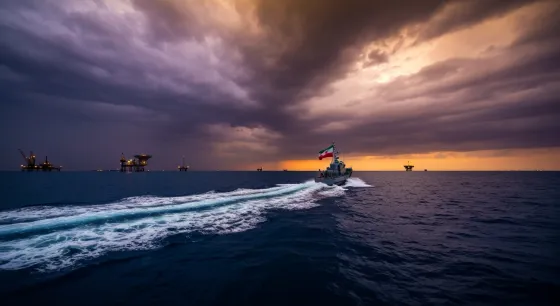
The Strait of Hormuz is the artery through which a fifth of the world's seaborne oil passes. Iran's blockade is choking that flow, and every Khamenei statement about a Gulf 'free of America' is read by traders as a signal that Tehran is in no rush to climb down.
For UK households, the knock-on is straightforward and unwelcome. Higher crude prices feed into petrol, diesel, heating bills, food deliveries and, eventually, your weekly shop. The Bank of England has spent two years trying to wrestle inflation back into its box. A prolonged Gulf squeeze does not make that job easier.
Who is actually running Iran right now?
This is the bit that should make policy nerds and oil traders nervous in equal measure.
Mojtaba Khamenei has not been seen since March. CNN's reporting, and a steady drumbeat from Iran International and the Times of Israel, suggests power is being exercised through a kind of de facto council. Names that keep cropping up include former intelligence chief Hossein Taeb, veteran politician Mohsen Rezaei, and parliament speaker Mohammad Bagher Ghalibaf, with IRGC generals reportedly taking the operational reins.
One source quoted in The New York Times, Abdolreza Davari, reportedly described Khamenei as 'managing the country as though he is the director of the board'. We have not been able to independently verify that exact quote in open sources, so treat it as reported rather than confirmed. The broader picture, though, is consistent across outlets: a wounded supreme leader, a committee in the shadows, and generals with very strong opinions.
That is not a structure built for nimble diplomacy.
Trump's two-week ceasefire that was not
Earlier in April, Trump announced what he billed as a two-week ceasefire after Iran briefly agreed to reopen Hormuz. It did not stick. Talks collapsed almost immediately over Iran's nuclear programme, with Tehran demanding the war end and the strait reopen while parking nuclear discussions for later. Washington, per CNBC's reporting, was unenthusiastic, and that is putting it generously.
Mediation attempts by Pakistan and Oman, NPR reports, have so far gone nowhere. Both capitals have plenty of reasons to want this resolved, but neither has been able to bridge the gap between an Iranian leadership that wants relief without concessions, and a US administration that wants concessions before relief.
The view from London
For Britain, this is uncomfortable on several fronts.
- Energy: the UK still imports significant volumes of refined product, and Gulf disruption pushes wholesale prices up across the board.
- Shipping: Royal Navy assets in the region are stretched, and insurance premiums for tankers transiting the area have climbed sharply.
- Diplomacy: the UK is a signatory to the original nuclear framework and has historically tried to play honest broker. With talks dead, that lane is closed for now.
- Domestic politics: any prolonged spike in fuel costs will land squarely on whichever party is trying to convince voters the cost of living is improving.
None of which is to say Britain has obvious leverage. It does not. But the consequences will arrive whether or not Westminster has a strategy for them.
What to actually watch next
Three things worth keeping an eye on, in rough order of importance.
1. Whether Mojtaba Khamenei is seen in public
A photograph or video would calm a lot of nerves. Continued silence will deepen the suspicion that real authority sits with the IRGC and a handful of clerical operators, which makes any deal harder to land and harder to enforce.
2. Hormuz traffic data
Forget the statements. Watch the tankers. If volumes through the strait start ticking up, something is moving behind the scenes. If they keep falling, expect another leg up in oil prices and another round of hand-wringing in European capitals.
3. Trump's tone
The president has oscillated between 'we will end this in a fortnight' and 'we will finish them off'. Which version shows up at the next press gaggle will tell you more about the next month than any official communique from Tehran.
The verdict
Mojtaba Khamenei's Persian Gulf Day broadside is theatre, but it is theatre with consequences. A supreme leader who cannot or will not appear, a council ruling by proxy, generals doing the actual fighting, and a US president whose patience visibly thins by the week. None of that is a recipe for a swift, clean resolution.
For UK readers, the honest takeaway is this: keep your expectations for a quick deal low, your tolerance for fuel price wobbles high, and a healthy scepticism for any headline that promises a breakthrough. We have had several already in 2026, and none of them have outlived the news cycle that announced them.
Read the original article at source.