
Trump Says the Iran War Is Nearly Over. The 2,500 Fresh Marines Disagree.
Trump claims the Iran conflict is winding down, but 2,500 fresh Marines heading to the Middle East tell a different story. The numbers do not add up.












If you want to know how the US-Israel war on Iran is going, it depends entirely on which White House statement you read first.
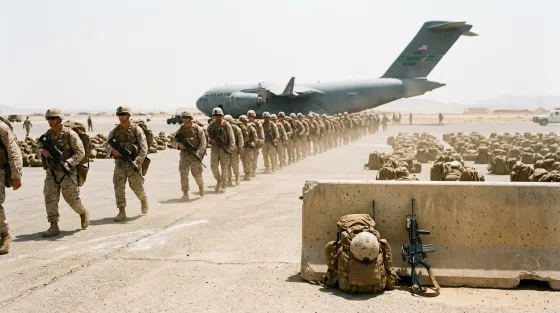
On one hand, President Trump took to Truth Social to muse about "winding down" military efforts. On the other, the Pentagon quietly redirected 2,500 Marines from the Pacific to the Middle East, joining the 50,000-plus US troops already stationed in the region. For a conflict that is supposedly wrapping up, it has a funny way of getting bigger.
The Story So Far
The war began on 28 February 2026 with a surprise US-Israeli strike campaign targeting Iran's military and nuclear infrastructure. Supreme Leader Ali Khamenei was killed in the opening salvo, along with Defence Minister Aziz Nasirzadeh and IRGC commander Mohammad Pakpour. The timing raised eyebrows globally: the strikes came less than 48 hours after the third round of Omani-mediated nuclear talks in Geneva, where progress had reportedly been made.
Three weeks in, the numbers paint a grim picture. US-Israeli forces have hit more than 7,800 targets across 8,000-plus combat missions. In Iran, over 1,400 people have been killed, including at least 204 children, with more than 18,000 civilians injured. In Lebanon, Israeli bombing has killed over 1,000 people and displaced more than a million. Thirteen US soldiers and at least 18 Israelis have also lost their lives.
The Contradiction Problem
Here is where it gets properly absurd. The White House, through Press Secretary Karoline Leavitt, predicted the mission would take four to six weeks. Trump himself floated the idea of scaling back. And yet, in the same breath, his administration requested $200 billion from Congress for war funding. That is a lot of money for something that is nearly finished.
Meanwhile, Israeli Defence Minister Katz publicly vowed to increase strike intensity, which is not exactly the language of a coalition on the same page. Trump even rebuked Israel after its forces struck Iran's South Pars gas field, claiming he had no prior knowledge of the operation. When your closest ally in a joint military campaign surprises you with a major strike on critical energy infrastructure, "crossroads" might be putting it mildly.
The Economic Fallout
The Strait of Hormuz, which carries roughly a fifth of the world's oil and liquefied natural gas, has ground to a near-total halt. Oil prices have surged around 45% since the war began, with crude topping $110 a barrel. In a remarkable policy reversal, the US temporarily lifted some Iranian oil sanctions through 19 April 2026 in a bid to cool prices. Sanctioning a country while simultaneously needing its oil to flow is the kind of contradiction that writes itself.
Where Does This Actually End?
That is the question nobody in Washington or Tel Aviv seems able to answer convincingly. Iran's ballistic missile launches have dropped roughly 90%, from 350 on the first day to about 25 by day fifteen, and 120 Iranian naval vessels have been damaged or destroyed. But Tehran's "mosaic doctrine" of decentralised warfare means the regime retains capacity for prolonged attrition. Mojtaba Khamenei, the late Supreme Leader's son and a noted hardliner, has been appointed as the new leader.
DNI Tulsi Gabbard has acknowledged that the Iranian regime remains "intact but largely degraded," conceding that surviving regimes tend to rebuild. Analysts from CSIS, King's College London, and ACLED all flag the same central risk: there is no clear endgame.
CNN polling suggests only 49% of Republicans and 47% of 2024 Trump voters strongly support the President's handling of Iran. When you are losing your own base on a war you started, "crossroads" starts to look more like "dead end."
Read the original article at source.