
Hormuz Heats Up Again: UAE Says Iran Has Restarted Its Drone and Missile Show
UAE intercepts Iranian missiles and drones, a fire rages at Fujairah oil port, and the April ceasefire looks shakier than ever. Here's what we know.











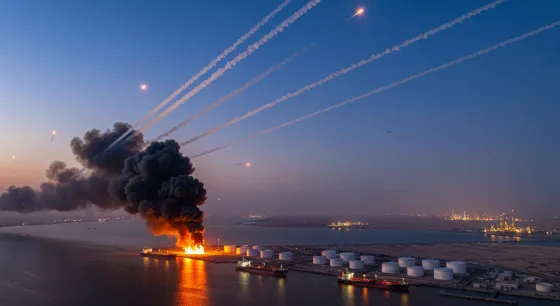
Just when everyone hoped the Gulf might enjoy a quiet spring, the Strait of Hormuz has decided otherwise. The UAE says Iran has launched a fresh wave of drones and missiles, a thumping fire is raging at the Fujairah oil port, and the fragile April ceasefire is looking less like a peace deal and more like a polite suggestion.
What actually happened
Emirati air defences had a busy night, engaging what officials describe as 12 ballistic missiles, three cruise missiles and four drones. That is 15 missiles and four drones in total, depending on how you like your maths. Most were reportedly intercepted, but not before a serious blaze took hold at the port of Fujairah, the UAE's main oil terminal sitting just outside the largely blocked Strait of Hormuz.
Three people were injured at Fujairah. According to The National, all three are Indian nationals working at the port. Omani state media also reported two people injured in Bukha after a residential building was hit, although that detail has been harder to corroborate elsewhere, so treat it as still developing.
Boats, bangs and a bristling US Navy
While the UAE was busy swatting things out of the sky, the US Navy was doing some swatting of its own at sea level. American forces struck seven Iranian fast boats in the Strait of Hormuz, a figure President Trump confirmed publicly. Early reports had pegged the number at six, which goes to show that in the fog of war, even the maths needs a second pass.
Iran, predictably, sees it differently. Tehran denies attacking any boats and says it merely fired warning shots at a US warship that, in its telling, strayed somewhere it should not have been. Iran's parliamentary National Security Commission has also warned that any further US interference would tear up what is left of the truce.
Why Fujairah matters more than you think
Fujairah is not just any port. It sits on the Gulf of Oman side of the UAE, deliberately positioned beyond the choke point of Hormuz so that oil can be loaded onto tankers without having to thread the needle through the strait itself. In other words, it is the bypass valve when Hormuz gets clogged. A serious fire there is bad news for global energy markets, and worse news for anyone hoping the region was on the mend.
For context, the Strait of Hormuz handles roughly 20 per cent of the world's oil and liquefied natural gas, according to the US Energy Information Administration. Closing it, even partially, is the geopolitical equivalent of pulling a thread on a very expensive jumper.
Stranded ships and rattled markets
One US-flagged vessel, Maersk's Alliance Fairfax, did manage to slip out of the strait under American military escort, which suggests the route is not entirely shut, just extremely unfun to use. Trump claimed around 20,000 seafarers on 2,000 ships are stranded by the standoff, though that figure has not been independently verified and should be taken with a generous pinch of sea salt.
The BBC reports that Brent crude pushed past 115 dollars a barrel, up more than five per cent. That number has not been mirrored across the search results we checked, so it is worth confirming against live market data before you start panic-buying petrol on the M25. Either way, the direction of travel is clear: prices up, nerves frayed, and energy traders on their fourth coffee of the morning.
How we got here
If you have lost the thread, here is the short version. The current conflict kicked off in late February 2026 with US and Israeli air strikes on Iran. Tehran responded by effectively closing the Strait of Hormuz, sending shockwaves through global shipping. A ceasefire was signed on 8 April 2026, brokered with much fanfare, and for a few weeks it almost looked like things might calm down.
That truce is now on the ropes. Whether this is a full collapse or a particularly nasty wobble depends on what happens in the next few days, and frankly, on whether anyone in Tehran or Washington feels like blinking first.
What the rest of the world is saying
The international reaction has been swift, if predictably split. French President Emmanuel Macron called the strikes unjustified and unacceptable. UK Prime Minister Sir Keir Starmer pledged continued defence support to Britain's Gulf partners, which is diplomatic shorthand for, we are watching this very closely indeed. Qatar condemned the tanker attack and called for the unconditional reopening of the strait, which is the sort of statement everyone agrees with and almost no one can deliver.
Why this matters to you in the UK
You might be tempted to file this under faraway problems, but the Gulf has a way of arriving on British doorsteps via the petrol pump and the gas bill. If Hormuz stays choked and Fujairah keeps burning, expect energy prices to twitch upward, expect supermarkets to mutter about supply chains, and expect ministers to look tense in front of select committees.
For ordinary households, the practical impact will likely show up first in fuel costs, then in the wider squeeze on inflation that the Bank of England has been trying so patiently to wrestle down. None of that is good news heading into summer.
What to watch next
Three things are worth keeping an eye on. First, whether the ceasefire is formally declared dead or quietly resuscitated. Second, whether the US escalates beyond strikes on fast boats. And third, whether Fujairah's port can resume normal operations quickly, because every day of disruption ratchets up the pressure on global oil markets.
The Gulf has been here before, of course. The region has a habit of pulling back from the brink at the last moment, often through quiet back-channel diplomacy rather than televised handshakes. Whether that pattern holds this time is anyone's guess.
The bottom line
The UAE accusing Iran of renewed attacks, a fire at Fujairah, US strikes on Iranian boats, and a ceasefire creaking at the seams. It is a lot for one news cycle, and the consequences will not stay neatly inside the region. If you fill up your car this week and wince at the price, now you know who to blame, or at least who to mutter about.
Read the original article at source.