
Trump's European Troop Trim: What Britain Should Make of the Pentagon's Big Pull-Back
Trump pulls 5,000 US troops from Germany with more cuts promised. Here's what the Pentagon's European drawdown means for the UK and NATO.







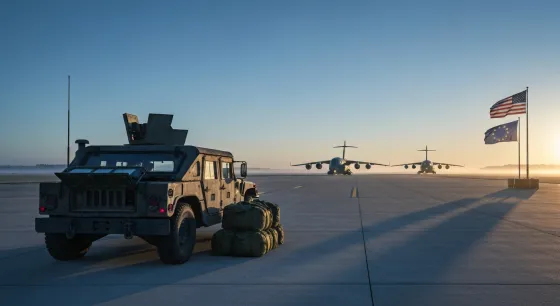
Donald Trump has decided that Uncle Sam's boots in Europe are looking a touch heavy, and he is reaching for the laces. The Pentagon confirmed on Friday 1 May 2026 that 5,000 American troops will leave Germany over the next six to twelve months. The very next day, Trump told reporters the cuts would go, in his own words, 'a lot further.' Cue much eyebrow-raising in Berlin, Brussels and, yes, Whitehall.
So what does this actually mean for the bigger picture, and why should anyone in the UK care? Pull up a chair.
The headline numbers
Roughly 80,000 to 100,000 US troops are typically stationed across Europe at any given moment, according to US European Command (EUCOM). Germany alone hosts more than 36,000 of them. Italy has around 12,000. The UK sits on roughly 10,000. So when 5,000 walk out of Germany, that is not the entire ballgame, but it is a sizeable chunk of one country's contingent and a clear signal of intent.
For context, EUCOM has been around since 1947, covering some 50 countries and acting as the backbone of America's transatlantic security posture. Shrinking it is not a minor administrative tweak. It is the kind of thing historians end up writing chapters about.
Why Germany, and why now?
Germany is, on paper, the obvious target. It hosts Ramstein Air Base, the Landstuhl Regional Medical Centre (where wounded American personnel from across the world get treated), and the headquarters for both US European Command and US Africa Command. If you wanted to flex muscle in Europe, Germany was the gym.
But politics is rarely tidy. Trump and German Chancellor Friedrich Merz have been openly feuding, particularly over the ongoing US conflict with Iran, dubbed 'Operation Epic Fury'. Merz reportedly described feeling 'humiliated' by aspects of the relationship, and Trump is not famous for letting that sort of remark slide.
Whether the drawdown is a strategic recalibration or a presidential nudge in the ribs is, frankly, anyone's guess. Probably a bit of both.
The nuclear question nobody likes asking
Here is a detail that tends to get glossed over in news bulletins. According to the Federation of American Scientists' March 2026 estimate, around 100 US nuclear bombs are stored at European bases across Belgium, Germany, Italy, the Netherlands and Turkey. Reducing conventional troop numbers is one thing. Anything that nudges the wider nuclear-sharing arrangement is quite another, and so far there is no suggestion that the warheads are going anywhere. Still, it is worth keeping an eye on.
Congress is not entirely on board
Here is where it gets interesting for anyone who assumed the President can just pluck troops out at will. The 2026 National Defense Authorization Act reportedly sets a statutory floor of around 75,000 to 76,000 US troops in Europe. In other words, Congress has put a fence around just how dramatic any drawdown can get without legislative blessing.
Republican heavyweights are pushing back too. Senate Armed Services chair Roger Wicker and his House counterpart Mike Rogers have argued that troops should be shifted eastward, deeper into Eastern Europe, rather than packed off home. Their reasoning is straightforward: with the war in Ukraine still grinding on, a visible American retreat is exactly the sort of optics Vladimir Putin would frame and hang on the Kremlin wall. They have also claimed the Pentagon cancelled a planned deployment of an Army long-range fires battalion to Germany, although that specific claim has not been independently confirmed by the Pentagon in the sources currently available.
What about NATO and the 5% target?
NATO members have been digesting the alliance's commitment to 5% of GDP on defence spending, cited in the US National Defense Strategy published in January 2026. That is a chunky figure by any measure, and it is the financial backdrop to all of this. The American argument, broadly, is that Europe needs to carry more of its own weight. Trimming US numbers is one way of forcing the issue.
Germany is already moving. The 100 billion euro special fund (the Sondervermögen, around $117bn) was set up in 2022, and the Merz government has announced plans to expand the Bundeswehr to 260,000 personnel from roughly 180,000. Ambitious, certainly. Quick, no. Building an army is not like ordering more printer paper.
What this means for the UK
Britain sits in a slightly awkward seat. We are NATO's most reliable European partner in American eyes, we host roughly 10,000 US troops, and we have skin in every game from Ukraine to the Indo-Pacific. A smaller US footprint on the continent puts more pressure on UK forces to plug gaps, particularly in air policing, intelligence sharing and rapid-response readiness.
It also raises a slightly uncomfortable question. If Washington is willing to thin out Germany over a political spat, what guarantees the UK's special status if a future row goes sideways? Not a comfortable thought, but a fair one.
Operation Epic Fury looms over everything
It is impossible to talk about troop levels in Europe without acknowledging that the US is currently fighting Iran. Resources are finite. Even the Pentagon, with its astronomical budget, has to decide where the priorities are. Pulling some forces out of Germany, on paper, frees up bandwidth elsewhere. Whether those troops actually redeploy to the Middle East, return stateside, or quietly get reallocated remains to be seen.
General Alexus Grynkewich, the current commander of US and NATO forces in Europe, will be the one stitching the practicalities together. Spare a thought for him. Logistics on this scale are a thankless slog.
The verdict
Is this the start of a genuine American retreat from Europe, or a calculated jab to make allies sit up straight? Probably the latter, with a side order of the former. Trump tends to negotiate by removing things and seeing who flinches.
For European NATO members, including the UK, the message is clear enough. The American security umbrella is still open, but the handle is getting a little wobbly, and it would be wise to start carrying your own brolly. Berlin is already trying. London should be paying very close attention.
Read the original article at source.