
Project Freedom: Trump Sends the US Navy to Babysit Tankers Through the Strait of Hormuz
Trump launches Project Freedom, sending 15,000 sailors and guided-missile destroyers to escort stranded tankers through the Strait of Hormuz.









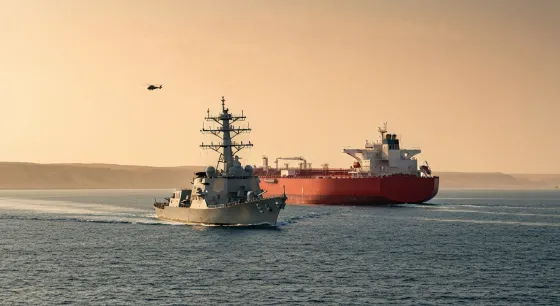
Right then. If you fancied a quiet Monday morning, the Pentagon has other ideas. Donald Trump has announced that the US Navy will start escorting stranded commercial vessels through the Strait of Hormuz, in an operation cheerfully branded Project Freedom. Because nothing says 'calm shipping lane' quite like 15,000 sailors, a fleet of guided-missile destroyers and over 100 aircraft turning up to chaperone your oil tanker.
What Trump Actually Announced
The headline is straightforward enough. Starting Monday, US warships will 'guide' merchant vessels that have been stuck in the Gulf since the war with Iran kicked off back in February. CENTCOM has confirmed the numbers: 15,000 personnel, more than 100 land and sea-based aircraft, and guided-missile destroyers doing the heavy lifting.
The BBC reports that roughly 20,000 sailors have been trapped in the region, although that figure hasn't been independently corroborated by other outlets. Either way, it's a lot of people who'd quite like to go home, and a lot of cargo that the global economy would quite like to keep moving.
Why the Strait of Hormuz Matters (Yes, Even to You)
If you've never given the Strait of Hormuz a second thought, allow me to ruin your morning. Roughly 20% of the world's oil and liquefied natural gas squeezes through this narrow stretch of water between Iran and Oman. That's a long-standing estimate from the US Energy Information Administration, and it's been broadly accepted across the industry for years.
Translation for the UK reader: when something goes sideways in the Strait, your petrol pump and your gas bill both feel it. The cost of filling up the family hatchback in Birmingham is, irritatingly, tied to a waterway most Brits couldn't find on a map.
Project Freedom: The Numbers
- 15,000 US service members involved
- 100+ land and sea-based aircraft
- Guided-missile destroyers providing the muscle
- ~20% of global oil and LNG flows through the strait
- ~20,000 sailors reportedly stranded (per the BBC, not independently verified)
It is, by any measure, a hefty deployment. And it is, by any measure, an enormous escalation in a region that was already running hot.
The Tanker That Got Hit
The timing is no accident. Late Sunday, the UK Maritime Trade Operations centre (UKMTO) reported that a tanker had been struck by an 'unknown projectile' in the strait. 'Unknown' is doing rather a lot of heavy lifting in that sentence, but renewed attacks on commercial shipping have set markets twitching and given the White House a convenient justification for sending in the cavalry.
Iran's 14-Point Plan: Thanks, But No Thanks
Meanwhile, on the diplomatic track, things are moving. Sort of. Iran has submitted a 14-point peace proposal via Pakistan, which has been the go-to intermediary throughout this whole mess. It's a response to a US 9-point plan that suggested a two-month ceasefire.
Tehran's counter-offer? End the war in 30 days. Plus, while we're at it: lift the sanctions, release the frozen assets, cough up reparations, guarantee no future aggression, and set up a new governance mechanism for the Strait of Hormuz itself.
Trump's reaction, delivered to Israel's Kan News, was that the proposal is unacceptable. Which is diplomatic shorthand for 'absolutely not, next.'
The Sticking Point Nobody's Talking About Loudly
Here's the bit that should make everyone nervous: Iran's foreign ministry has explicitly ruled out nuclear negotiations as part of these talks. Given that Iran is the only non-nuclear-armed state to have enriched uranium close to weapons-grade levels, that omission isn't a minor footnote. It's the entire reason Washington has been losing sleep for the better part of two decades.
Tehran's Warning Shot
Senior Iranian lawmaker Ebrahim Azizi has warned that any 'American interference' in the strait would breach the existing (fragile, increasingly theoretical) ceasefire. Translation: park your destroyers somewhere else, or we'll have words.
So here we have it. The US is sending in a small navy. Iran is threatening to treat it as a ceasefire violation. And the diplomatic offers from both sides currently sit somewhere between 'optimistic' and 'pure fantasy.'
What This Means for the UK
For everyday Brits, the immediate concern is at the petrol pump. If shipping in the strait gets disrupted, oil prices spike, and the cost-of-living squeeze that the UK has been wrestling with for years gets another unwelcome tightening. The pound at the pump tracks Brent crude with depressing reliability.
Beyond fuel, there's the LNG question. The UK has been increasingly reliant on liquefied natural gas imports since the great pivot away from Russian energy. A serious wobble in Hormuz traffic feeds straight into household energy bills, just as everyone was hoping for a quieter winter on the heating-cost front.
The Honest Verdict
Project Freedom is, on paper, a sensible move: stranded sailors deserve a route home, and global trade needs the strait open. In practice, it's a 15,000-person military deployment into a war zone where one side has just told you to sod off and the other has dismissed your peace plan out of hand.
The optimistic read: the show of force pushes Iran back to the table on terms Washington can stomach.
The pessimistic read: an 'unknown projectile' becomes a known incident very quickly, and the ceasefire that was already wheezing on life support flatlines entirely.
Watch the oil markets on Monday. They'll tell you which way the wind is blowing long before any official statement does.
Read the original article at source.