
Tanks for Nothing: Why Moscow's Stripped-Back Victory Day Parade Speaks Volumes
Russia's 2026 Victory Day parade has no tanks, no missiles, no armour. Here's what Moscow's stripped-back show really says about the war in Ukraine.








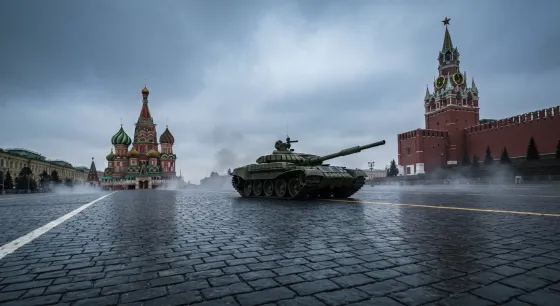
Every year on 9 May, Red Square turns into a rolling showcase of Russian military muscle. Tanks rumble across the cobbles, missile launchers crawl past the Kremlin walls, and the cameras drink it all in. It is choreography as propaganda, and Vladimir Putin has rarely missed the chance to star in it.
This year, though, something is missing. Quite a lot of things, actually.
A parade without the parade bits
For the first time in nearly twenty years, Saturday's Victory Day parade in Moscow will feature no tanks, no missile systems, no armoured vehicles of any kind. Just soldiers, marching in formation, presumably hoping nobody asks where the hardware has gone.
It is a striking absence. Victory Day is the holiest date on Russia's civic calendar, the moment the state reminds itself of the 27 million Soviet citizens lost in the Great Patriotic War of 1941 to 1945. Stripping out the heavy metal is not a casual decision. You do not accidentally forget the tanks.
So where are all the tanks?
The official line is logistical. The unofficial reality is that a great deal of Russia's serviceable kit is currently busy in Ukraine, getting blown up, broken down, or quietly cannibalised for spare parts. Wheeling a tank through Red Square is harder when the tank in question is a smouldering wreck somewhere near Pokrovsk.
There is also the small matter of security. Which brings us to the other reason this parade looks a little nervous.
Drones over Moscow
On Monday, a Ukrainian drone slammed into Dom na Mosfilmovskoy, a luxury high-rise roughly six kilometres from the Kremlin. The 36th floor took the hit. Mayor Sergei Sobyanin reported no casualties, which is fortunate, but the symbolism is hard to scrub off. A drone reaching the heart of the capital, in the week of the country's biggest patriotic celebration, is not the optics the Kremlin had in mind.
The day after, things turned considerably grimmer in Cheboksary, around 600 kilometres east of Moscow. A combined drone and missile strike killed two people and wounded more than thirty. Cheboksary is home to JSC VNIIR-Progress, which produces components for Russia's high-precision weapons. Ukraine, increasingly, is striking the supply chain rather than just the front line.
The retaliation rhetoric
Russia's defence ministry has warned of a 'retaliatory, massive missile strike' on Kyiv if Moscow is attacked on 9 May. That threat sits awkwardly alongside the Kremlin's own unilateral declaration of a Victory Day ceasefire from 8 to 10 May. Volodymyr Zelensky responded by suggesting a longer truce, which the Kremlin has, predictably, not embraced with open arms.
It is the diplomatic equivalent of offering someone a biscuit while threatening to break their windows.
A war that has outlasted its own myth
Here is the detail that probably stings most in the Kremlin. In January, the war in Ukraine passed a quiet but devastating milestone. It has now lasted longer than the Soviet Union's fight in the Great Patriotic War itself.
Think about that for a moment. The conflict the parade exists to commemorate, the founding myth of modern Russian identity, ran from 1941 to 1945. Putin's 'special military operation', launched in February 2022, has now overtaken it. The hardware that once defeated the Wehrmacht cannot be paraded through Red Square because too much of its modern equivalent is stuck in a war that was supposed to last three days.
Cracks in the public mood
Reports from inside Russia suggest Putin's domestic approval ratings have softened in recent polling, although readers should treat any numbers from state-aligned agencies with a healthy pinch of salt. What is harder to spin is the daily friction. Mobile internet shutdowns have become routine across Russian cities, ostensibly to disrupt drone navigation, and they are quietly grating on a public that quite likes being able to order a taxi or check the football scores.
Putin himself has been notably less visible in 2026 than he was in late 2025. Make of that what you will.
Why this matters for British readers
You might reasonably wonder why a scaled-back parade in Moscow should register on a Tuesday morning in Manchester or Cardiff. A few reasons.
- Energy markets twitch every time the war escalates, and that filters into household bills.
- NATO posture, including UK deployments to eastern Europe, depends on how the conflict trends.
- The longer the war drags on, the more pressure builds on Western governments to keep funding Ukraine, which is increasingly a domestic political question rather than a distant foreign one.
A parade without tanks is not, on its own, a turning point. But it is a tell. Authoritarian regimes are usually very good at pageantry, because pageantry is cheap and morale-boosting. When the pageantry starts shrinking, it tends to mean the underlying balance sheet is in worse shape than the official communiques suggest.
The verdict
Putin built a great deal of his political identity on the imagery of Victory Day. Marching infantry past the mausoleum without a single tank in sight is not a flex. It is a concession to reality, dressed up in dress uniforms. The drones overhead and the strikes deeper into Russian territory are doing the talking that the parade no longer can.
Whether this leads anywhere quickly is another question. Wars rarely end because of a thin parade. But the Kremlin has just provided, on its own most carefully stage-managed day, an unintended admission that the script is not going to plan.
Read the original article at source.