
Pay Iran A Toll, Lose Your Insurance: Washington's Latest Shipping Squeeze
OFAC warns shippers and insurers that paying Iran for Strait of Hormuz transit risks sanctions. Here's what it means for UK prices and supply chains.










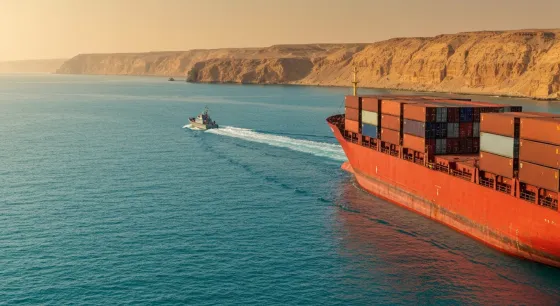
If you fancied a quiet life running a container ship through the Strait of Hormuz this spring, tough luck. The US Treasury has just told the global shipping industry, in so many words, that slipping a few quid to Iran for safe passage is now a fast track to the sanctions list.
What actually happened
On Friday 1 May 2026, the Office of Foreign Assets Control (OFAC) issued a fresh alert warning shipping firms, insurers and financial institutions that paying Iranian tolls to transit the Strait of Hormuz could trigger US sanctions. The Treasury also sanctioned three Iranian foreign currency exchange houses the same day, just to underline that this is not a polite suggestion.
The alert is unusually specific. It is not only cash that counts. OFAC says payments include digital assets, offsets, informal swaps, in-kind goods, charitable donations and even quiet drop-offs at Iranian embassies. Anyone hoping to be clever with a bit of crypto or a barrel of fuel-for-favours has been put on notice.
Why this matters to you in the UK
The Strait of Hormuz is the narrow stretch of water between Iran and Oman through which roughly a fifth of the world's oil normally trickles. Around 3,000 commercial ships pass through every month in calmer times. Right now, according to CNN's visual tracking, that has fallen to a handful per day.
That has knock-on effects on petrol prices, on the cost of just about anything shipped from Asia, and on aid budgets. The UN refugee agency says delivering aid to Sudan now costs roughly twice as much, because ships are being rerouted around the Cape of Good Hope, adding up to 25 days to the journey. British supermarkets, British insurers at Lloyd's, and British drivers all sit somewhere on that chain.
How we got here
For readers who have wisely been ignoring the news, a quick recap. On 28 February 2026, the United States and Israel launched strikes on Iran. Iran's Supreme Leader, Ali Khamenei, was killed. His son, Mojtaba Khamenei, was elevated to succeed him, although awkwardly he has not been seen in public for more than seven weeks. Nobody is quite sure who is actually running the place.
A two-week ceasefire, brokered by Pakistan, began on 8 April 2026. That truce is now wobbling like a Jenga tower in a pub.
On 13 April, the US navy started enforcing a blockade on Iranian ports. Since then, CENTCOM says 45 commercial ships have been told to turn around. Iran's oil and condensate loadings have collapsed from 2.1 million barrels per day to about 567,000 bpd. A White House official told CNBC that Tehran is haemorrhaging roughly 500 million dollars a day.
Iran's clever wheeze
Cut off from selling its oil through the front door, Iran appears to have got creative at the side door. Tehran has reportedly started charging shipping firms a toll simply to pass through the Strait of Hormuz, the same waterway it does not technically own outright but very much sits next to.
Iran's deputy parliament speaker, Hamidreza Haji Bababei, claimed the first toll revenue had already been deposited at the Central Bank. The BBC, sensibly, notes it could not independently verify this, and only Iranian state-aligned outlets are pushing the line. Take it with a generous pinch of salt.
Investigative reporting by Al Jazeera also suggests Iran is leaning on a shadow fleet of vessels with fake flags, shell company ownership and disabled tracking transponders to keep oil flowing under the radar. None of which is new for Iran, but the scale appears to have ramped up significantly.
Trump's mood: not exactly chuffed
Iran sent a fresh peace proposal to Pakistani mediators on Thursday night. President Trump's reaction can be politely summarised as underwhelmed.
Trump said he was "not excited" by the offer, and reportedly told aides he was "not satisfied" with what Tehran had put on the table.
Translation: do not expect a breakthrough by Sunday lunch. The OFAC alert and the new currency-house sanctions look very much like Washington tightening the screws while talks limp on.
The trap for shipping firms
Here is where it gets messy. A non-US shipping company that pays an Iranian toll might shrug and say it is not bound by US law. The catch is that almost every commercial vessel afloat is insured, financed or chartered by someone with US exposure. London marine insurers, European banks, and reinsurers all have to think hard before touching anything that smells of Iranian payment.
OFAC has explicitly waved the secondary sanctions stick. If a non-US firm's payment causes a US person, say a New York bank or an American insurer, to fall foul of sanctions, the non-US firm itself can be hit. That is the same mechanism that has frozen plenty of European companies out of Iran-related business since 2018.
For UK-flagged or UK-insured ships, the maths is unforgiving. Pay the Iranian toll and risk being cut off from the dollar, from US ports, and possibly from your own insurance. Refuse to pay, and you may simply not sail through the strait at all.
The constitutional itch
There is also a domestic American wrinkle. Trump is now bumping up against a War Powers Act deadline that, in theory, requires him to seek congressional approval for continued military operations against Iran. Whether he will, whether Congress will agree, and whether either side cares about the law as written, is a separate drama. But it adds another layer of uncertainty to anyone trying to plan a shipping route six months out.
Our take
This OFAC alert is a smart, targeted bit of economic warfare. By making the global insurance and finance industry the enforcement arm, Washington can choke off Iran's toll scheme without firing another shot. It is also faintly elegant, in a grim sort of way. Iran sets up a tollbooth on a public highway, and the US quietly tells everyone that paying it will cost more than driving the long way round.
The risk is the squeeze on consumers. Higher shipping costs do not stay on a balance sheet in Geneva. They land on UK forecourts, on supermarket shelves, and on aid budgets for places like Sudan that can least afford the delay. Diplomacy, such as it is, had better start producing results soon, because the bill for this stand-off is not being paid by Tehran or Washington. It is being paid by everyone whose stuff arrives by boat.
Read the original article at source.