
Thirteen Dead in Southern Lebanon Strikes: The Ceasefire That Isn't
Israeli strikes killed 13 in southern Lebanon on 1 May 2026, including women and a child. What's left of the 2024 ceasefire and why it matters.












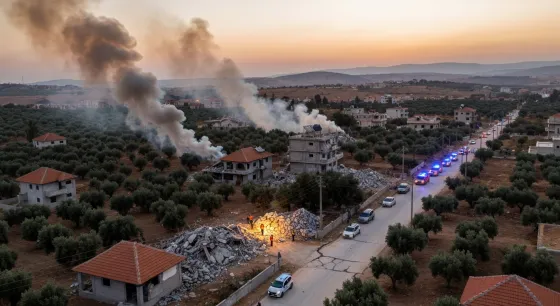
If you blinked this week, you might have missed the latest reminder that the Israel-Lebanon ceasefire is doing a lot of heavy lifting in the word 'ceasefire'. On Friday 1 May 2026, Israeli air strikes killed at least thirteen people across southern Lebanon, according to the Lebanese health ministry. Among the dead are four women and a child. So much for the quiet.
What actually happened
The Lebanese health ministry says thirteen people were killed and thirty-two injured in a wave of strikes on Friday. The Israel Defense Forces (IDF) confirmed it carried out roughly fifty strikes across southern Lebanon in the past twenty-four hours, which is a fairly enthusiastic interpretation of a truce, by anyone's reckoning.
The casualties broke down across three areas. Eight people were killed in Haboush, in the Nabatieh district, including two women and a child. Four were killed in Zrarieh, in the Sidon district, two of them women. One person was killed in Ain Baal, near Tyre. These are not abstract numbers. These are villages, families and ordinary Friday afternoons cut short.
Hold on, isn't there a ceasefire?
Technically, yes. Practically, it depends on how loosely you define the term. The original truce ending the previous round of fighting was agreed back in November 2024. That held, more or less, until the world tilted on its axis earlier this year.
On 28 February 2026, the United States and Israel launched a joint attack on Iran that killed the country's supreme leader, Ali Khamenei. Whatever your politics, you can probably agree that 'killing the supreme leader of Iran' is the sort of event that tends to ripple outward. Hezbollah, Iran-backed and never one to miss a cue, fired rockets and drones into Israel on 2 March in retaliation. Israel responded by resuming heavy bombardment of southern Lebanon. The 2024 ceasefire, in any meaningful sense, ended that week.
Since then, attempts to glue the truce back together have produced two notable moments. The first was a ten-day pause announced on or around 16 April after talks in Washington, reportedly the first high-level discussions between Israel and Lebanon since 1993. The second was a three-week extension announced by President Trump on 23 April. Hezbollah, charmingly, called the extension 'meaningless'. Friday's strikes suggest they may have had a point.
The grim running total
Since fighting resumed in early March, the Lebanese health ministry says 2,586 people have been killed in Lebanon, including 103 healthcare workers and emergency responders. The IDF, for its part, says seventeen Israeli soldiers have been killed in Lebanon over the same period, alongside two Israeli civilians killed by Hezbollah attacks. Both sets of figures come from the parties to the conflict and have not been independently audited, so treat them as official-but-not-gospel.
One incident worth flagging: on 29 April, a so-called 'double-tap' strike reportedly killed three rescue workers, the kind of attack pattern that hits a target, waits for first responders to arrive, then hits again. If the reports are accurate, that helps explain why the body count among emergency staff has climbed so steeply.
Why is Israel still in Lebanon?
Good question, and one Lebanese officials keep asking. The BBC reports Israel continues to occupy roughly ten kilometres of Lebanese territory in the south, although other outlets describe the footprint differently, with some referring to it as a percentage of Lebanese territory rather than a strip of a fixed depth. However you measure it, Israeli troops are still there, and that is the rock on which any wider diplomatic deal keeps splitting.
Lebanese officials have made clear that a trilateral meeting, presumably involving the US, is unlikely while Israel remains on Lebanese soil and the strikes continue. Hard to negotiate the future of the border when bits of it are being rearranged by airpower in real time.
Why this matters for UK readers
You might be wondering why a story about southern Lebanon belongs in your feed between the football and the council tax bill. A few reasons.
First, the British government is one of several Western capitals invested in keeping the eastern Mediterranean from sliding into a wider war. Royal Navy assets operate in the region, and UK diplomatic posture on Israel, Iran and Lebanon shapes everything from sanctions policy to refugee flows.
Second, this conflict sits inside the much larger story of what happened after the US and Israel struck Iran in February. The killing of Khamenei did not end the Iran question. It opened a different one. Hezbollah, the Houthis, Iraqi militias and Iran's own fragmented leadership are all still in the picture, and Lebanon is where the smoke is currently thickest.
Third, oil prices, shipping insurance rates and inflation in the UK all have a habit of twitching whenever the Middle East does. If you have noticed your weekly shop creeping up again, this is part of the wallpaper.
What to watch next
A few things to keep an eye on over the coming weeks.
- Whether the Trump-brokered three-week extension survives in any form, or whether Friday's strikes have already finished it off in practice.
- Any movement on Israeli withdrawal from the southern strip. Without that, Beirut's diplomats have nothing to take to a negotiating table.
- Hezbollah's response. They have called the extension meaningless, but a verbal shrug is one thing and rocket fire is another. The Lebanese government has very limited leverage over what they actually do.
- Casualty figures. The thirteen dead reported on Friday came after earlier wire reports cited a smaller toll. Numbers tend to climb as rescue teams reach buried sites, so the figure may yet move.
The honest verdict
Calling this a ceasefire is generous. Calling it a war is, technically, also disputed. What it actually is, on the ground, is a slow-motion bombardment punctuated by diplomatic press releases. Civilians in southern Lebanon are paying for it in the most literal way, and Israeli soldiers and civilians are not exempt either.
If there is a hopeful read here, it is that the parties are still talking at all, and that Washington is still investing political capital in a deal. If there is a pessimistic read, it is that none of the underlying drivers, the post-Khamenei vacuum in Iran, Hezbollah's calculations, Israel's territorial position in the south, have actually changed. Until they do, expect more Fridays like this one.
Read the original article at source.