
Orban's Pipeline Power Play: How a Busted Pipe Is Blocking EUR 90 Billion for Ukraine
Hungary's Viktor Orban is blocking a EUR 90 billion EU loan to Ukraine over a damaged oil pipeline. But with elections looming, the real motive looks political.










There is a certain audacity in agreeing to something, then pretending you never did. Viktor Orban appears to have perfected the art.
Hungary's Prime Minister is currently blocking a EUR 90 billion EU loan to Ukraine, a package designed to cover two years of military and economic support as Russia's war grinds into its fifth year. His stated reason? A damaged oil pipeline. His actual reason? Well, there is an election on 12 April, and the polls are not looking brilliant.
The Pipeline Problem
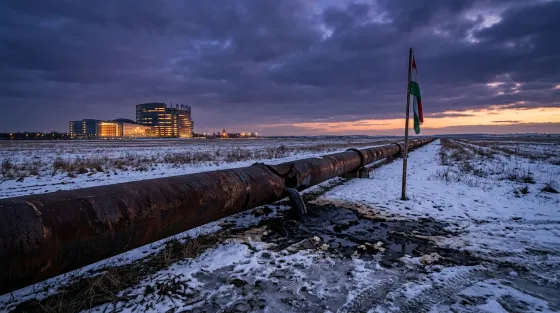
On 27 January 2026, a Russian drone strike hit infrastructure near the Brody pumping station in western Ukraine, knocking out a section of the Druzhba pipeline. For the uninitiated, Druzhba (which rather ironically translates to "friendship") has been pumping Russian crude into central Europe for decades. Hungary and Slovakia depend on it heavily.
Ukraine declared force majeure and oil stopped flowing. Hungary immediately cried foul, with Foreign Minister Peter Szijjarto claiming the whole thing was a coordinated "political game" between Kyiv and Brussels.
Ukraine, for its part, pointed out the rather obvious fact that Russia bombed the thing.
The Loan Standoff
Here is where it gets properly absurd. All 27 EU member states endorsed the EUR 90 billion loan at a summit in December 2025. Orban included. He agreed. Then he un-agreed, conditioning his support on restoring oil flows through Druzhba.
"If there's no oil, there's no money," Orban declared in a social media video, delivering the sort of one-liner that plays well domestically but leaves fellow EU leaders reaching for the paracetamol.
The EU offered a reasonable solution: technical and financial support to repair the pipeline. Ukraine's President Zelenskyy accepted, estimating repairs would take roughly six weeks, provided Russia does not bomb it again. A fair caveat, you would think.
Not good enough for Budapest. At the EU summit on 19 March 2026, Hungary, joined by Slovakia, refused to lift the veto, leaving the loan in limbo.
The Election-Shaped Elephant in the Room
Multiple EU leaders have been refreshingly blunt about what is really going on. German Chancellor Friedrich Merz called it a "gross act of disloyalty." Finland's PM Petteri Orpo said Orban is "using Ukraine as a weapon in his election campaign." Dutch PM Rob Jetten labelled the veto "unacceptable."
Orban is trailing opposition leader Peter Magyar of the Tisza Party in the polls ahead of Hungary's 12 April vote. Playing the strongman who stands up to Brussels while keeping energy prices down is a well-worn playbook for the Hungarian PM. Whether voters buy it this time remains to be seen.
What Happens Next
European Commission President Ursula von der Leyen has stated the EU will deliver the loan "one way or the other," hinting at mechanisms to bypass Hungary's veto entirely. Croatia has offered an alternative oil route. And with the EU already planning a permanent ban on Russian oil expected in spring 2026, Hungary's dependence on Druzhba crude is looking increasingly like a problem of its own making.
Meanwhile, Slovakia has escalated matters by halting emergency power supplies to Ukraine, European Council President Antonio Costa has declared that "nobody can blackmail" EU institutions, and oil prices remain above $100 per barrel thanks to wider Middle East volatility.
The bottom line is this: a pipeline that Russia bombed is being used by Hungary to block aid to the country Russia is bombing. If that sentence makes your head spin, welcome to EU diplomacy in 2026.
Read the original article at source.