
Land, Livestock and Lethal Politics: Inside Nigeria's Deadliest Conflict You Have Never Heard Of
Over 19,000 killed since 1999 in Nigeria's farmer-herder violence. Why this crisis outpaces Boko Haram in casualties yet barely makes the news.











The Conflict Nobody Talks About
Here is a number that should stop you mid-scroll: more than 19,000 people have been killed in farmer-herder violence across Nigeria since 1999. In 2018, these clashes were six times deadlier than Boko Haram. Yet somehow, this crisis rarely commands the same front pages. Funny how that works.
The violence tearing through Nigeria's Middle Belt, particularly Benue and Plateau states, is driven by a toxic cocktail of shrinking land, wandering cattle, ethnic identity and a government that seems content to watch from a comfortable distance. Understanding it requires looking past the simplistic "farmers vs herders" label and into a much uglier picture of governance failure.
Climate Change With a Body Count
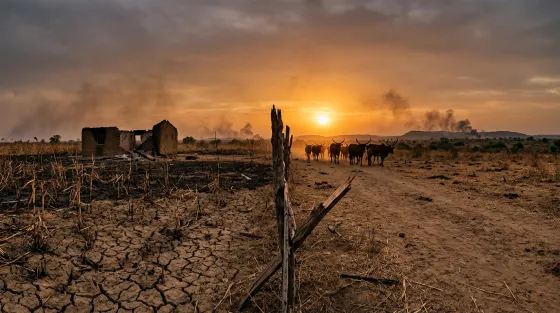
The root cause is depressingly straightforward. Desertification in northern Nigeria is pushing Fulani herders, predominantly Muslim, steadily southward in search of grazing land. They are moving into territory farmed by predominantly Christian communities who, unsurprisingly, are not thrilled about cattle trampling their crops.
What begins as a land dispute quickly escalates along ethnic and religious fault lines. The result is not occasional scuffles. It is sustained, organised violence on a staggering scale. Think of it as a climate crisis with AK-47s.
The Numbers Are Devastating
In June 2025, an attack on Yelwata village in Benue State killed over 100 people according to Amnesty International, though figures range from 45 confirmed by the governor's office to over 200 cited by the LSE Africa blog. That sort of discrepancy tells its own story about how little attention and access the region actually receives.
Since 2023 alone, Amnesty International estimates around 10,000 people have been killed across Benue and Plateau states. Benue has borne the worst of it, with over 6,800 murdered between 2023 and May 2025. Plateau accounts for another 2,600 or more in the same period. Close to half a million people have been displaced in Benue, and across the wider region, 2.2 million have been forced from their homes since 2019.
For broader context, between 2001 and 2018, roughly 60,000 people were killed and over 300,000 displaced across four Nigerian states. This is not a new problem. It is an old one that keeps getting bloodier.
A Law That Pleased Precisely Nobody
Benue State tried to act. In 2017, it passed an anti-open grazing law requiring herders to use ranches instead of roaming freely. Research from the University of Ibadan found it did reduce crop destruction. It also deepened mistrust and exclusion of herding communities. So, one problem swapped for another. Classic.
The Miyetti Allah Cattle Breeders Association claims over 500 herders have been killed in the past year and thousands of cattle stolen, though this figure has only been reported by a single outlet and lacks independent verification. What is beyond doubt is that both sides feel targeted, and neither trusts the security forces to protect them. Hard to build peace when nobody believes the referee is impartial.
A Crisis of Language
How you label this conflict matters enormously. The Nigerian government prefers "herder-farmer clashes," which makes it sound like a neighbourhood dispute that got slightly out of hand. Local leaders in affected communities describe it as ethnic cleansing. Genocide Watch has classified it as genocide since 2022. Pope Leo XIV called the June 2025 Benue attacks "a terrible massacre."
Analysts at the SAIS Review argue the farmer-herder framing itself is part of the problem, obscuring what is fundamentally a failure of political will. When the state cannot or will not protect its citizens, people organise along the lines they know best: ethnicity, religion, community. Violence becomes self-perpetuating, and the cycle spins faster with every attack.
Where Peace Actually Stands
The phrase "peace is a gradual thing" implies movement in a direction. Right now, the trajectory in Nigeria's Middle Belt points firmly the wrong way. Without genuine investment in justice, land reform and security that communities actually trust, the killing will continue. And the rest of the world will continue scrolling past.
Read the original article at source.