
Kostiantynivka on the Brink: Russia's Push at Ukraine's Fortress Belt and the Victory Day Truce Nobody Asked For
Russian troops near Kostiantynivka, drone strikes on Odesa and Kherson, and Putin's three-day ceasefire that Zelensky has firmly rejected.





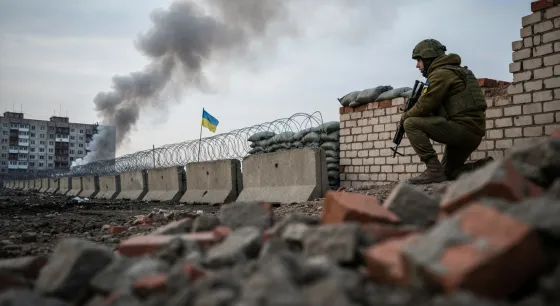
If you blinked over the bank holiday weekend, here is the catch up: Russian troops are now nudging the outskirts of Kostiantynivka, Vladimir Putin has dangled a three day ceasefire that smells suspiciously of a photo opportunity, and Volodymyr Zelensky has politely (well, firmly) told him where to shove it.
Why Kostiantynivka matters more than the name suggests
Kostiantynivka is not just another hard to pronounce dot on the map. It is a key link in Ukraine's so called fortress belt across Donetsk, the chain of fortified towns that has chewed through Russian assaults for years. Lose it, and the road towards Kramatorsk and Sloviansk gets a great deal shorter.
According to DeepState mapping, cited by Reuters, Russian forces are now roughly one kilometre (about 0.6 miles) from the city's southern outskirts. That is uncomfortably close range for a town that has spent the war as a logistics hub for Ukrainian troops further east.
Ukraine's commander in chief, Oleksandr Syrskyi, said counter sabotage operations are in full swing, with small Russian infiltration groups being intercepted before they can dig in. He also reported that Russian forces have launched 83 assaults on the Kostiantynivka sector since Monday. Eighty three. In a few days. Read that twice and have a strong cup of tea.
Drones, minibuses and a kindergarten
The civilian toll keeps stacking up in the way that, depressingly, no longer makes the front pages it should.
- In Odesa, an overnight drone barrage injured at least 20 people, according to the Kyiv Post, with a kindergarten among the damaged buildings. Other outlets put the figure between 14 and 16, but the picture is the same: a city hit while children were meant to be sleeping.
- In Kherson, a Russian drone struck a minibus, killing two and wounding seven, according to regional head Oleksandr Prokudin.
- The Russian Ministry of Defence claims its air defences shot down 505 drones overnight, a figure that has not been independently verified and which, frankly, deserves a raised eyebrow.
Russia's MoD also says it has taken Myropillia in Sumy region and Novodmytrivka just north of Kostiantynivka. Reuters could not independently verify the Myropillia claim, so treat it with the usual pinch of salt that comes with battlefield press releases from Moscow.
The Victory Day truce: olive branch or stage prop?
Kremlin spokesperson Dmitry Peskov has confirmed that Russia will observe a temporary ceasefire around the 9 May Victory Day commemorations, regardless of whether Ukraine reciprocates. How generous.
Zelensky's response was, in essence, no thanks. He has dismissed the short truce as theatre and called instead for a longer term ceasefire, which is the diplomatic equivalent of saying, if you actually want peace, prove it for more than a long weekend.
It is worth noting that the Kremlin has reportedly scaled back this year's Victory Day parade in Moscow over security concerns about potential Ukrainian long range drone strikes. A truce that conveniently coincides with that parade is, shall we say, a curious coincidence.
Eyes on Belarus, again
On 1 May, Zelensky flagged what he described as unusual activity along the Ukraine Belarus border. He stopped short of saying a fresh northern offensive is imminent, and so will we, but Kyiv is clearly not taking chances. Belarus has been a launchpad for Russian troops before, and any troop movements there will keep Ukrainian planners awake.
Zelensky takes a swing at home: the Bohdan sanctions
Domestic politics has had its own fireworks. On 2 May, Zelensky signed decree 358/2026, slapping 10 year sanctions on Andriy Bohdan, his former head of the President's Office, with state honours stripped indefinitely.
For those who lost the thread, Bohdan ran the President's Office from May 2019 to February 2020 before being replaced by Andriy Yermak. He now reportedly lives in Austria, which presumably has better coffee than the political reception he is getting back home.
The timing is striking. The sanctions land just days after leaked conversations involving Timur Mindich, named as the alleged ringleader in a corruption case, and former defence minister Rustem Umerov, surfaced on 28 April. Whether the two are formally connected is a question for Ukrainian prosecutors, but the optics speak for themselves.
The bigger picture for British readers
It is tempting, especially in the UK, to read another Ukraine war update and switch over to the football. Resist that urge for a moment, because three threads here matter for life on this side of the Channel.
1. Energy and fuel prices
Ukraine has been hammering Russian oil refineries with long range drones. Normally that would push global fuel prices higher. The recent Iran related disruption has already done a lot of that heavy lifting, which has, perversely, softened the immediate impact at British forecourts. Do not mistake softened for solved.
2. NATO's eastern flank
Any sign of fresh activity from Belarus reverberates through Poland, the Baltics and, by extension, UK defence planning. The Royal Air Force's air policing rotations and the Army's commitments in Estonia are not abstract; they are tied to exactly the kind of border twitchiness Zelensky just flagged.
3. The credibility of ceasefire offers
If a three day Victory Day truce becomes the template for what counts as peacemaking, expect a long and frustrating year of diplomacy. British officials watching the Trump administration's approach to Kyiv will be reading the runes carefully.
What to watch next
- Kostiantynivka: whether Ukrainian counter sabotage holds the southern approaches or Russian forces consolidate inside the city limits.
- 9 May: whether the truce actually holds, on either side, and what Moscow does the moment the candles are blown out.
- Belarus border: any escalation from unusual activity to actual troop concentration.
- Ukrainian politics: whether the Bohdan sanctions are a one off or the first move in a wider purge tied to the Mindich leaks.
The verdict
The headline is grim but not new: Russia is grinding forward at enormous human cost, Ukraine is bleeding to hold a line that matters strategically and symbolically, and the diplomacy on offer is, so far, not serious. A 72 hour truce around a parade is not peace. It is a press release with fireworks.
Kostiantynivka will tell us a lot in the coming weeks. If the fortress belt holds, the war's eastern map looks much like it does today. If it cracks, the conversation in London, Berlin and Washington gets a great deal more uncomfortable.
Read the original article at source.