
Dishes in the Dark: Inside the Underground Squad Sneaking Starlink into Iran
How smugglers, activists and diaspora donors are sneaking Starlink dishes past Iran's borders to break a 1,000-hour internet blackout.












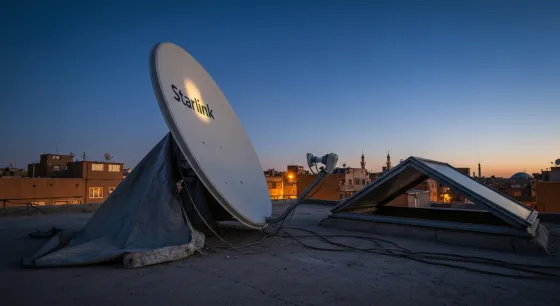
When a country pulls the plug on the internet, someone, somewhere, starts soldering. In Iran's case, that someone is a loose web of smugglers, activists and diaspora donors quietly shipping Starlink dishes past the border guards, the morality police and a government that would quite like a word.
The BBC World Service has been speaking to one of them. He goes by Sahand, which is almost certainly not what's on his passport, and he says his job is simple, if not exactly safe. He gets satellite kit into Iran so ordinary people can show the world what's actually happening, rather than the tidy version Tehran prefers to broadcast.
Why the lights went out
On 28 February 2026, US and Israeli airstrikes hit Iran, and the regime did what authoritarian governments tend to do when things get awkward. It pulled the plug. NetBlocks clocked national connectivity collapsing to about 4% of normal levels, later dropping to roughly 1% of pre-war traffic. According to Tom's Hardware, the blackout has now stretched past 1,000 hours, making it the second-longest national internet shutdown ever recorded.
For Iranians, that means no WhatsApp to ring your mum, no banking app to pay the bills, no way to upload a video of what just landed on the next street. For the government, it means a lovely, quiet information vacuum. For the economy, it means haemorrhaging cash. An Iranian minister admitted in January that the shutdown was costing the country at least 50 trillion rials a day, somewhere around £28 million in money you and I would recognise.
Enter the dish
Starlink, SpaceX's satellite internet service, is the obvious workaround. Plonk a pizza-box-sized terminal on a roof, point it at the sky, and you're online. The Iranian government, unsurprisingly, hates this idea. Elon Musk activated Starlink over Iran in 2022 after the Mahsa Amini protests, and ever since, terminals have been quietly trickling in.
By January 2026, the campaign group Witness reckoned there were around 50,000 Starlink terminals inside Iran. That's a lot of contraband Wi-Fi. Sahand says his particular operation, run via a Telegram channel called NasNet, has shifted around 5,000 of them over the past two and a half years. He insists his funding comes from Iranians abroad rather than any government, although other reporting suggests the Trump administration has covertly helped move roughly 6,000 terminals into the country during the current blackout. Make of that what you will.
The penalty for owning a pizza box
This is not a low-stakes hobby. Iranian law puts up to two years in prison on the table simply for using or selling a Starlink terminal. Import more than ten and you are looking at up to a decade behind bars. Some outlets, including Tom's Hardware, note that possession can also be charged as espionage, which under Iranian law can carry the death penalty.
One unnamed digital rights group told the BBC that at least 100 people have already been arrested for having a terminal. Sahand says he tries to keep his couriers and customers as anonymous as possible, but he is under no illusions about what would happen if the wrong person knocked on the wrong door.
Tehran fights back, badly
If you cannot stop the dishes coming in, you can at least try to stop them working. Iran is now actively jamming Starlink signals. The Times of Israel, Tom's Hardware and IEEE Spectrum all report packet loss running anywhere from 30% in calmer areas to a brutal 80% in zones where the jamming is heaviest. That is the difference between a wobbly video call and a frozen screen with a spinning wheel of doom.
Activists have got creative in response. Some are repurposing old satellite TV downlinks as a one-way data pipe, beaming news bulletins, software updates and circumvention tools straight onto rooftops. It's not the internet as you and I know it, but when your government has cut the cable, even one-way information starts to feel like a luxury.
The regime, meanwhile, is offering its own consolation prize. A scheme called Internet Pro, flagged by government spokesperson Fatemeh Mohajerani, grants limited online access to approved businesses. In other words, the economy gets a sip; everyone else stays parched.
The bigger picture for everyday users
For UK readers, this is more than a faraway human rights story. Access Now reportedly logged 313 internet shutdowns across 52 countries in 2025. Pulling the plug is no longer a freak event. It is becoming a standard tool of statecraft, used in elections, protests, exam seasons and conflicts.
Starlink, for all its founder's chaotic energy, has quietly become a piece of geopolitical infrastructure. Whether that is healthy in the long run, given how much depends on the whims of one company and one billionaire, is an entirely different debate worth having on a separate evening with a stiff drink.
The numbers worth knowing
- 50,000 estimated Starlink terminals in Iran (Witness, January 2026)
- ~5,000 terminals shifted via Sahand's NasNet Telegram channel
- At least 100 people arrested for terminal possession
- £28 million daily economic cost of the blackout
- 1,000+ hours of blackout, the second-longest on record
- 30 to 80% packet loss caused by Iranian jamming
Sahand's gamble
The BBC piece also references HRANA figures of more than 6,500 protesters killed and 53,000 arrested. Those numbers are notably higher than HRANA's previously published tallies and were not independently corroborated in our checks, so treat them with caution until the group confirms.
What is not in doubt is the basic shape of Sahand's bet. He believes that even a few thousand working dishes can puncture a state-sized information blackout, and that the risk to him and his couriers is worth it if the outside world gets to see the real picture. Published, fittingly, around World Press Freedom Day on 3 May, his story is a reminder that journalism in 2026 sometimes arrives by satellite, in the boot of a car, with a prison sentence attached.
Read the original article at source.