
Iran Scores Direct Hits on Dimona and Arad as Israeli Air Defences Fail to Intercept
Iranian ballistic missiles score direct hits on Dimona and Arad, wounding 180 people. Israeli air defences failed to intercept, raising serious questions about missile shield reliability.












When Interception Fails, Reality Hits Hard
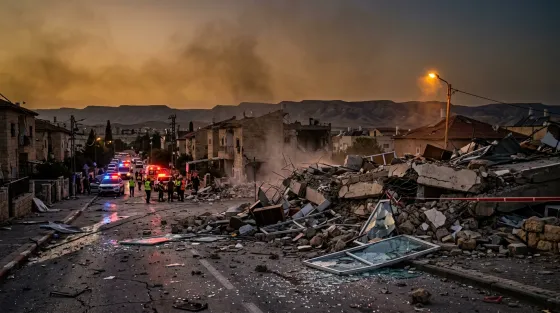
There is something deeply unsettling about the phrase "direct hit" when it refers to a ballistic missile landing in a residential neighbourhood. On 21 March 2026, the towns of Dimona and Arad in southern Israel discovered exactly what that phrase means, as Iranian missiles slammed into civilian areas with warheads weighing hundreds of kilograms.
The BBC's Sebastian Usher reported from Dimona in the aftermath, and the picture he painted was grim. Three separate impact sites. A three-storey building reduced to rubble. Apartment blocks teetering on the edge of collapse. This was not a near miss or a controlled interception. This was what happens when air defence systems, for all their vaunted capability, simply do not work.
The Numbers Tell a Stark Story
Approximately 180 people were wounded across both towns. In Arad, 116 people sustained injuries, with seven in serious condition and 15 moderate. Dimona saw 64 wounded, including one person seriously hurt. Soroka Medical Center treated 175 casualties in total, with 36 still in hospital as of the morning of 22 March.
Among the wounded were children. A 12-year-old boy in Dimona and a 5-year-old girl in Arad were counted among the seriously injured. That detail alone strips away any abstraction from the statistics.
Remarkably, nobody died. Israeli Prime Minister Benjamin Netanyahu was blunt about why: luck. Not technology, not preparedness. Luck. That is a sobering admission from a wartime leader three weeks into a conflict.
Air Defence: A Very Public Failure
The Israeli Defence Forces did not mince words either. An IDF spokesman confirmed that air defence systems "operated but did not intercept the missile." Firefighters on the ground were equally direct, stating that interceptors "failed to hit the threats."
For a country that has built much of its security narrative around the reliability of missile defence, this was an uncomfortable moment. Iran has been deploying cluster munitions carrying between 20 and 80 submunitions, weapons that IDF spokesman Lt Col Nadav Shoshani described as "very difficult to stop." That difficulty was on full display in Arad and Dimona.
The Broader Context
These strikes did not happen in a vacuum. Iran framed them as direct retaliation for an Israeli strike on its Natanz nuclear facility earlier that same day. The conflict, now in its fourth week, has already claimed 14 Israeli lives from Iranian missile attacks, nine of them in a single devastating strike on Bet Shemesh earlier in the war.
The proximity to the Dimona nuclear research centre raised obvious concerns, but the IAEA moved quickly to confirm that the facility sustained no damage and radiation levels remained normal. Small mercies, perhaps, but significant ones given what sits at that site.
At least 10 apartment buildings in Arad sustained extensive damage, with three reportedly in danger of collapsing entirely. In Dimona, the collapsed three-storey building stood as the most visible symbol of the strike's force.
What Comes Next
Netanyahu visited the affected areas on 22 March, vowing to target IRGC leaders in response. That kind of rhetoric is expected from any leader surveying missile damage in their own towns, but it signals a further escalation in a conflict that shows no signs of cooling.
The honest takeaway from Dimona and Arad is uncomfortable for everyone involved. Iran demonstrated it can land missiles on Israeli soil with devastating effect. Israel's defences proved fallible against weapons specifically designed to overwhelm them. And the people caught in the middle, the families in apartment blocks, the children now in hospital, bear the consequences of decisions made far above their heads.
Zero fatalities from a strike of this magnitude is genuinely remarkable. But relying on luck is not a defence strategy, and 180 wounded civilians is not a victory. It is a warning.
Read the original article at source.