
HS2 Might Slow Down Before It Even Speeds Up, Because Of Course It Will
HS2 trains may launch at 200 mph, not the promised 248 mph. Yet another speed cut on Britain's costliest rail project as the budget spirals past £100 billion.












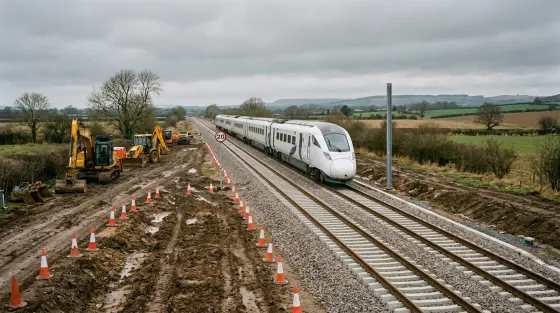
In a twist that surprises absolutely nobody who has been following Britain's most expensive infrastructure project, HS2 trains could run slower than planned when the line finally opens. The reason? To save money on a project that has already consumed over £40 billion and counting. You genuinely could not make this up.
The Need for Speed (Or Lack Thereof)
HS2 was originally designed to hit a blistering 248 mph, making it a genuine high-speed rail contender on the European stage. That figure was quietly trimmed to 225 mph once train manufacturing contracts were awarded. Now, HS2 Ltd CEO Mark Wild has proposed opening the London to Birmingham line at roughly 200 mph, a further reduction that is being pitched as part of a broader cost-control 'reset'.
To put that in perspective, the railway that was sold to the British public as a transformative leap in speed has now been downgraded twice before a single passenger has boarded. It is still quick, granted, but the gap between the original promise and the emerging reality keeps widening.

A Brief History of Budget Chaos
When Parliament approved HS2 back in 2012, the estimated cost sat at £32.7 billion in 2011 prices. The current prediction? North of £100 billion, with £81 billion confirmed in 2019 prices before inflation adjustments push the figure even higher. By April 2025, some £40.5 billion had already been spent.
The route has been butchered along the way too. What was once a 330-mile Y-shaped network linking London, Birmingham, Manchester, and Leeds is now a shadow of its former self. The Leeds leg was scrapped in 2021 and the Manchester extension followed in 2023. What remains is essentially a very expensive railway between London and Birmingham.
Wild's 'Fundamental Reset'
Mark Wild, who took the top job at HS2 Ltd in December 2024, has not been shy about the scale of the problem. In a letter to Transport Secretary Heidi Alexander in March 2025, he proposed opening at reduced running speeds and removing automatic train operation as part of an 18-month reset designed to establish a realistic cost and schedule baseline by 2026.
Wild has also floated reducing train frequency from 18 to 14 trains per hour, which would mean losing capacity equivalent to around 8,800 peak passengers. The 2020 Oakervee Review reportedly estimated that abandoning 'super high speeds' could save up to 10% of building costs, though that precise figure has not been independently confirmed against the review's full text.
It is worth noting that the 14-trains-per-hour idea is not exactly fresh thinking. It was first suggested back in 2019 and endorsed by the Oakervee Review, making it a long-standing proposal that is only now being seriously entertained.
When Will It Actually Open?
The original plan had trains running by late 2026. That target now looks almost comical. A July 2025 parliamentary report stated bluntly that there is 'no route by which trains can be running by 2033 as previously planned.' Independent analysis suggests 2036 at the earliest, with 2039 looking more realistic.
On the plus side, over 70% of the 32-mile tunnel network has been completed, so there is tangible progress buried beneath the headlines. The construction is happening. It is just happening slowly and expensively.
Political Finger-Pointing
Transport Secretary Heidi Alexander described previous management of HS2 as 'no less than a litany of failure,' which is the kind of phrase that writes itself in Parliament. Shadow Transport Secretary Gareth Bacon, to his credit, acknowledged that the Conservatives made 'mistakes' in their handling of the project, a rare moment of cross-party honesty on a file that has embarrassed governments of every stripe.
The Verdict
HS2 remains a masterclass in how not to deliver a megaproject. Slowing the trains down to save money feels deeply symbolic of the wider malaise: a project that keeps getting smaller, slower, and more expensive. Whether the 'reset' delivers genuine savings or simply delays the next round of bad news remains to be seen. For now, Britain's high-speed railway is looking increasingly medium-speed, and the bill keeps climbing.
Read the original article at source.