
Hormuz Hot Air: Tehran Says It Hit a US Warship, Pentagon Says Pull the Other One
Iran says missiles struck a US warship in the Strait of Hormuz on 4 May 2026. CENTCOM flatly denies it. Here's what we know about Project Freedom.









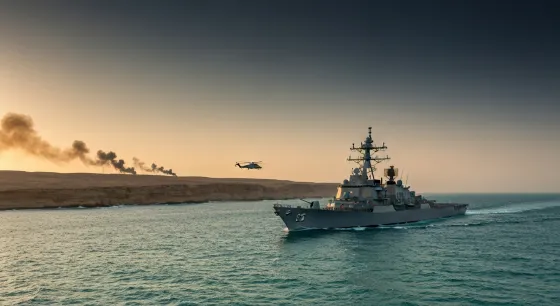
If you fancy a slice of geopolitical theatre with your Monday morning cuppa, the Strait of Hormuz is serving up a fresh helping. Iran's semi-official Fars news agency claimed on 4 May 2026 that two missiles slammed into a US warship trying to nose its way through the waterway near Jask island, forcing the vessel to turn tail and scarper. The US military's response? A polite but very firm: nope, didn't happen.
The claim, the denial, and the eyebrow-raising in between
According to Fars, the strike was a triumphant rebuff to American naval ambitions in the region. Iran's Revolutionary Guard navy reportedly took credit for sending the ship packing. Stirring stuff, if true.
US Central Command (CENTCOM) was unimpressed by the storyline. In a flat denial, it confirmed that no US Navy ship had been hit, no American hardware was bobbing wounded in the Gulf, and frankly nothing of the sort had taken place. Two narratives, one waterway, and a credibility gap you could sail an aircraft carrier through.
For readers trying to work out who to believe, the boring answer is the usual one: independent verification is thin on the ground, and wartime propaganda travels at the speed of a tweet. There are reports that a separate tanker was hit by projectiles around the same time, which may explain how the wires got crossed in Tehran's telling.
What on earth is Project Freedom?
The backdrop here is Donald Trump's freshly launched 'Project Freedom', a US-led operation that kicked off on Monday 4 May 2026. Its stated aim is straightforward enough: shepherd commercial ships through the Strait of Hormuz, which has been effectively bottled up since the Iran war flared in February.
According to CENTCOM, the operation is no small affair. It involves guided-missile destroyers and more than 100 land and sea-based aircraft. Translation: this is not a token gesture with a couple of patrol boats and a stern letter.
Tehran is, predictably, livid. Iranian officials view Project Freedom as a brazen breach of the ceasefire and have warned that any foreign armed forces, with the US at the top of the list, will be attacked if they so much as paddle into the Strait. The Iranian threat plus the disputed strike claim makes for a combustible cocktail.
Why this matters beyond the headlines
The Strait of Hormuz is not just another stretch of saltwater. Roughly a fifth of the world's oil passes through it on a normal day, and it is the only sea route from the Persian Gulf to the open ocean. When it gets blocked, things get expensive in a hurry, from petrol pumps in Bristol to cargo costs everywhere in between.
Right now, an estimated 20,000 seafarers are stuck in limbo, waiting for safe passage. That is a small city of crew members sitting on tankers and container ships, eating into supplies and patience in equal measure. Their employers are losing money. Insurers are sweating. And the global supply chain, which has not exactly been having a quiet decade, is bracing for another knock.
The wider war you may have lost track of
If you have been a touch fuzzy on the timeline, here is the short version. The US and Israel launched air strikes on Iran in late February 2026. Iran has been squeezing the Strait of Hormuz ever since, with foreign vessels effectively unable to transit safely. A patchy ceasefire has held in fits and starts, but the definition of 'ceasefire' appears to vary depending on which capital you ask.
Project Freedom is being framed in Washington as a humanitarian and economic necessity. In Tehran, it is being framed as a provocation, possibly the next chapter of the war rather than a footnote to it.
The 'positive discussions' wrinkle
Trump has reportedly described his exchanges with Iran as 'very positive discussions' about a potential deal. We say reportedly because the rhetoric coming out of Tehran does not sound especially positive. Iran calling your shipping operation a ceasefire violation is generally not a thumbs-up emoji.
Take the optimism with a hefty pinch of sea salt. Diplomatic mood music tends to be the first casualty when warships, missiles and oil prices are in the same sentence.
What to watch next
A few things will tell you which way the wind is blowing in the Gulf over the coming days.
- Whether commercial shipping actually resumes in any meaningful volume under Project Freedom, or whether captains decide it is still too risky.
- Whether Iran follows through on its threats with anything verifiable, rather than claims that crumble under scrutiny.
- What happens to oil prices. The market is a brutal lie detector for this sort of brinkmanship.
- Whether either side allows independent journalists or observers near enough to confirm what is, and is not, going boom.
The bottom line
For now, the smart money says Iran's missile strike claim is more political theatre than verified incident. CENTCOM's denial is unambiguous, and no credible independent reporting has surfaced any wreckage, casualties or hard evidence to back Tehran's version. That does not mean the Strait is safe. It very much is not.
Project Freedom is an enormous, deliberately visible flex of American naval muscle. Iran's response, whether bluster or buildup, will shape whether global shipping limps back to normality or whether the Gulf becomes the next flashpoint in a war that has already done plenty of damage. Either way, expect more headlines, more denials, and probably another round of finger-pointing before the week is out.
Read the original article at source.