
From Warzone to Tech Export: Why Ukraine is Teaching the Middle East About Drone Warfare
The Ultimate Tech Pivot: From Importing Weapons to Exporting Expertise It is not every day that a country in the middle of a gruelling existential conflict...











The Ultimate Tech Pivot: From Importing Weapons to Exporting Expertise
It is not every day that a country in the middle of a gruelling existential conflict turns around and starts offering tech support to the rest of the world. Yet here we are. Ukrainian President Volodymyr Zelensky recently revealed that Kyiv has been sending specialist drone teams to the Middle East. Why? Because allied nations have actually started asking Ukraine for help in countering drone threats. Zelensky noted it was a rather good feeling to be the one providing assistance for a change. Honestly, you cannot blame the man for enjoying the moment. It is the geopolitical equivalent of the IT intern suddenly teaching the senior developers how to code.
For those of us who follow the global tech sector closely, this development is both fascinating and entirely logical. Over the past two years, Ukraine has essentially become the world's most intense, high stakes testing ground for unmanned aerial vehicles and electronic warfare. They have taken off the shelf consumer tech, modified it in basements, and turned it into a formidable defence network. Now, that hard won expertise is becoming a highly sought after export.
Necessity is the Mother of Drone Invention
Let us talk about the hardware. Before this conflict, military drones were largely seen as massive, highly expensive assets like the US Reaper or the UK Protector. They required runways, massive satellite uplinks, and a team of highly trained pilots sitting in air conditioned bunkers thousands of miles away. Ukraine flipped that script entirely. When you do not have the budget of the Pentagon, you have to get incredibly creative.
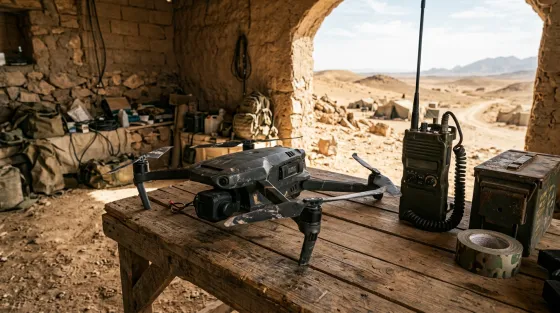
Ukrainian engineers started strapping explosives to commercially available quadcopters. We are talking about the sort of gadgets you might buy on the high street for a few hundred quid to film your holiday in Cornwall. Suddenly, these cheap pieces of plastic and lithium ion batteries were taking out armoured vehicles worth millions. It is the ultimate asymmetrical warfare, and it has completely changed the global tech landscape.
The Economics of Modern Warfare: Pennies vs Pounds
But it is not just about flying drones into things. The real tech marvel, and the reason Middle Eastern allies are knocking on Zelensky's door, is the counter drone technology. If you can build a cheap drone, your enemy can too. Russia has been deploying Iranian designed Shahed drones by the thousands. These are essentially flying mopeds packed with explosives. They are slow and noisy but incredibly dangerous because they are deployed in massive swarms.
Shooting down a twenty thousand pound Shahed drone with a two million pound Patriot missile is terrible economics. It is a mathematical equation that will bankrupt any nation, even the wealthiest ones. This is a concept we in the UK need to pay close attention to, especially given the current state of our public finances and the ever present cost of living concerns. We simply cannot afford to throw millions of pounds of taxpayers money at cheap, disposable threats.
Ukraine realised this economic trap early on. Instead of relying solely on expensive interceptor missiles, they developed a multi layered, highly digitised approach to air defence. They crowd sourced acoustic detection networks using thousands of smartphones mounted on poles to listen for the distinctive buzz of incoming drones. They developed sophisticated electronic warfare systems that scramble GPS signals, causing enemy drones to blindly crash into empty fields. They even created mobile fire groups, using pickup trucks equipped with heavy machine guns and thermal optics, guided by bespoke tablet software that tracks incoming targets in real time.
The Tech Toolkit: What Exactly Are They Exporting?
When we talk about Ukrainian drone expertise, we are not just talking about flying remote controlled aeroplanes. We are looking at a comprehensive, highly digitised ecosystem of modern combat tech. Here is a breakdown of what makes their approach so highly valued:
Acoustic Detection Networks: Instead of relying entirely on expensive radar, they use networks of microphones to detect the audio signature of incoming threats.
Bespoke Electronic Warfare: Portable jamming devices that can sever the connection between a drone and its operator or spoof GPS coordinates.
Agile Software Development: Apps that provide real time situational awareness, integrating intelligence from satellites, drones, and ground troops into a single interface.
First Person View Tactics: Perfecting the art of using cheap, fast, highly manoeuvrable drones to neutralise threats efficiently.
Why the Middle East Needs Ukrainian Tech
This brings us to the Middle East. The region is currently a tinderbox, and the skies are increasingly filled with the exact same types of cheap, disposable drones that Ukraine has spent the last two years fighting. State and non state actors alike have realised that you do not need a traditional air force to project power anymore. You just need a shipping container full of kamikaze drones and a launch catapult.
Allied nations in the Middle East are looking at Ukraine's playbook and realising they need that exact software and tactical know how. When a swarm of cheap drones is heading towards critical infrastructure or shipping lanes in the Red Sea, you need a cost effective way to swat them out of the sky. Ukraine has the beta tested, battle proven algorithms and the operational experience to do exactly that.
What the UK Can Learn from This
So, what does this mean for us back in Blighty? The UK Ministry of Defence needs to take a long, hard look at our own procurement processes. Historically, British defence procurement has been painfully slow, bogged down by red tape, and obsessed with gold plated, overly complex systems that take a decade to deliver. By the time a new system is rolled out, the technology is already obsolete.
We need to adopt the Ukrainian mindset of rapid iteration and agile development. The UK tech sector is brimming with talent, particularly in fields like artificial intelligence, machine learning, and software engineering. We have brilliant startups in places like Cambridge and London that could be developing the next generation of electronic warfare and drone countermeasures. However, they need a government that is willing to buy fast, test in the real world, and iterate quickly to ensure value for money.
The recent successful tests of the UK DragonFire laser weapon are a step in the right direction. A laser that costs less than a tenner per shot to fire is exactly the sort of asymmetrical countermeasure we need to defeat cheap drone swarms. But hardware is only half the battle. The software, the integration, and the tactical deployment are where Ukraine currently leads the world.
The Verdict: A New Era of Defence Tech
It is genuinely impressive to see how quickly innovation happens when survival is on the line. Zelensky is right to feel proud of his tech sector. They have taken the absolute worst circumstances imaginable and forged a highly advanced, globally recognised expertise in the future of warfare.
The days of measuring military strength solely by the number of fighter jets or aircraft carriers a nation possesses are rapidly coming to an end. The conflicts of tomorrow will be decided by algorithms, radio frequency jamming, and swarms of cheap, intelligent machines. Ukraine has already lived in that future for two years, and now, the rest of the world is paying them for the tutorial.
Ultimately, this story highlights a massive shift in global technology dynamics. We are used to seeing Silicon Valley dictate the pace of hardware and software innovation. Seeing Kyiv emerge as a primary consultant for advanced electronic warfare in the Middle East is a plot twist few analysts predicted. It serves as a stark reminder that true innovation does not always come from well funded corporate labs. Sometimes, it comes from absolute necessity, a soldering iron, and a refusal to give up.
Read the original article at source.