
DoorDash Now Pays Gig Workers to Film Themselves Doing Chores, and Yes, It's as Dystopian as It Sounds
DoorDash's Tasks app pays couriers to film household chores like washing dishes and folding laundry. The footage trains AI robots that could eventually replace them.












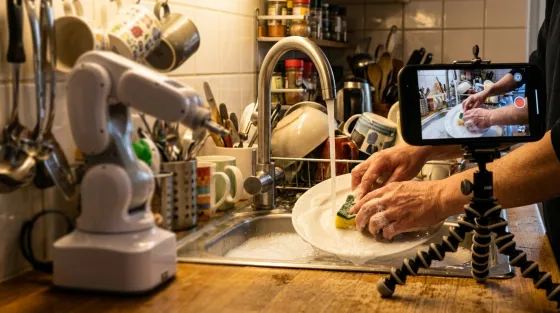
Welcome to the Future: You're Training Your Robot Replacement
DoorDash has launched a standalone app called Tasks, and it might just be the most grimly on-the-nose development in the gig economy yet. The premise? Pay your army of delivery couriers to film themselves doing household chores like washing dishes, folding laundry, and scrambling eggs. The footage then gets fed into AI models. You know, the ones powering the robots that will eventually do those jobs instead.
Launched on 19 March 2026, the Tasks app is available to DoorDash's roughly 8 million registered Dashers across the US, with some notable exceptions. California, New York City, Seattle, and Colorado are all excluded, which is surely just a coincidence and absolutely nothing to do with those regions having stricter gig worker protections. Nothing to see there.
What the Tasks Actually Involve
The work itself ranges from mundane to mildly surreal. Dashers can pick up assignments like filming themselves loading a dishwasher (body-worn camera pointed at hands, scrubbing at least five dishes, holding each clean one steady in frame), making beds, folding clothes, or even recording unscripted conversations in Spanish.
Pay reportedly varies quite a bit. According to secondary reporting, simple household filming tasks pay around $5 (roughly £4), while shelf-scanning gigs fetch about $16, and Spanish conversation recordings go for $20. DoorDash hasn't officially confirmed specific rates, so take those figures with a pinch of salt.
Since 2024, Dashers have completed more than 2 million of these tasks. That is an enormous volume of real-world training data, captured in actual homes by actual people going about actual routines.
Who Gets the Data?
Here's where it gets properly interesting. The footage isn't just for DoorDash's own AI ambitions. The company confirmed that data collected through Tasks feeds into models for external partners across retail, insurance, hospitality, and technology. DoorDash general manager Ethan Beatty framed it as leveraging a decade of delivery logistics experience to help other businesses. Which sounds rather more palatable than "we're monetising footage of people doing their washing up."
DoorDash CTO Andy Fang was more candid, calling the initiative "huge for building the frontier of physical intelligence." Given that DoorDash unveiled its own delivery robot, Dot, back in September 2025, a 350-pound, nearly five-foot-tall machine that trundles around Greater Phoenix at up to 20 mph carrying six pizzas, the "physical intelligence" bit lands with a certain irony.
DoorDash Isn't Alone in This
The broader trend is unmistakable. Uber launched a similar scheme through its AI Solutions Group, now operating in 30 countries, where drivers upload photos, record voice clips, and photograph restaurant menus. Instawork has recruited workers in Los Angeles to wear phone-mounted headbands while filming themselves cleaning homes. And Sunday Robotics has shipped over 2,000 "skill capture gloves" to more than 500 US households, collecting around 10 million routines to build its foundation model.
Then there's the Waymo door-closing pilot in Atlanta, where DoorDash pays a Dasher to walk up to a robotaxi and close the door. One Reddit screenshot showed the total payout at $11.25 for that single action. That task is now classified under the Tasks ecosystem, meaning autonomous vehicle support is already part of the gig.
The Uncomfortable Bit
Critics have been quick to point out the central tension: gig workers are, in effect, generating the training data that could eventually make their roles obsolete. DoorDash frames Tasks as supplemental income, a way to earn between deliveries. And to be fair, unlike some AI training controversies, workers here are being directly compensated for their contributions.
But questions remain. DoorDash hasn't published details on consent frameworks, data retention policies, or what rights workers have over footage filmed inside their own homes. As Universal Robots VP Anders Beck has noted, companies need distributed real-world data because lab-collected training data simply doesn't cut it for real deployment. That makes gig workers' homes and kitchens the new AI training ground.
The Verdict
Tasks is a fascinating, slightly uncomfortable glimpse at where the gig economy is heading. For cash-strapped Dashers, it is genuinely easy money for low-effort work. But the longer-term implications are worth watching closely, especially for anyone who thinks the phrase "training your own replacement" is just a figure of speech.
Read the original article at source.