
Canterbury Has No Meningitis Restrictions. So Why Does It Feel Like 2020 Again?
Two deaths, 34 cases and a city on edge. Canterbury has no official meningitis restrictions, but locals say it feels like 2020 all over again.











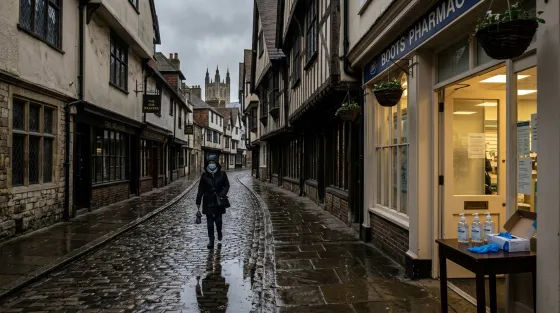
There are no official restrictions in Canterbury. The Health Secretary has said so. UKHSA has said so. Life, we are told, should carry on as normal. And yet, if you wander through the city's medieval streets right now, "normal" is the last word that comes to mind.
Two young people are dead. Thirty-four cases of meningitis B have been recorded, with 23 confirmed and 11 still under investigation. Over 11,000 antibiotic doses have been handed out. Nearly 6,000 vaccines have gone into arms. But officially? No restrictions. Carry on.
It is a peculiar kind of limbo, and longtime residents say it carries an unmistakable whiff of early 2020.
The Club Chemistry Connection
The outbreak traces back to Club Chemistry, a Canterbury nightclub where approximately 4,800 people passed through across three nights between 5 and 7 March. Within days, cases began surfacing. The first death, Juliette Kenny, an 18-year-old sixth-former from Faversham, came on 14 March, less than 24 hours after she first fell ill. A 21-year-old University of Kent student also lost their life.
Club Chemistry has since closed voluntarily. Owner Louise Jones-Roberts has said she plans to reopen when it is safe to do so. The strain responsible is group B meningococci, sequence type 485. Crucially, the Bexsero vaccine covers this strain, but the routine MenACWY jab given to teenagers does not. Juliette Kenny's family are now calling for broader MenB vaccine access, a campaign that feels grimly overdue.
A City That Has Lost Its Appetite
Here is where the "no restrictions" line starts to feel slightly absurd. Local food truck owner Daow Coombes reportedly sold just 10 meals one Thursday, against a typical 200. Staff at the Burgate Coffee House report takings down roughly 40 per cent. Local rugby matches and parkrun events have reportedly been cancelled, not by government order, but by organisers and participants who quietly decided that "carry on as normal" does not quite sit right.
The Step into Spring arts festival pressed ahead, but with modifications: its cafe shut and its lecture hall capped at half capacity. Nobody told them to do this. They just did.
It is the unspoken lockdown that nobody officially called.
The Show Must Go On (Apparently)
Not everything has ground to a halt. The installation of Archbishop Sarah Mullally at Canterbury Cathedral on 25 March is proceeding as planned. It is, after all, rather difficult to postpone the appointment of the 106th Archbishop of Canterbury because of a nightclub.
Health Secretary Wes Streeting has maintained that the risk to the wider population is "extremely low," a phrase that roughly 5,000 University of Kent students queueing for vaccinations might find less than reassuring. UKHSA has also faced criticism over alleged delays in issuing public alerts, though the agency denies this. One detail that raised eyebrows: Club Chemistry's owner reportedly first learned of a case via an Instagram DM from a UKHSA staff member. Not exactly the gold standard of official communication.
What Happens Next?
The Easter holidays loom, and with them the prospect of students scattering across the country. The ECDC has assessed the risk to the wider EU and EEA as very low, but domestically, there are legitimate questions about whether Canterbury's outbreak stays contained.
With 34 cases and climbing, a city that feels hollowed out despite zero formal mandates, and a vaccine policy gap that a grieving family is fighting to close, Canterbury finds itself in a strange and uncomfortable position. No rules have been broken. No mandates issued. And yet something has clearly shifted.
Sometimes you do not need a lockdown to feel locked down.
Read the original article at source.