
Ceasefire On A Knife-Edge: Washington Waits, Tehran Stews, And Bahrain Rounds Up The Usual Suspects
A fragile US-Iran ceasefire holds after tanker strikes, while Bahrain arrests 41 over alleged Revolutionary Guard links. Here's what it means.
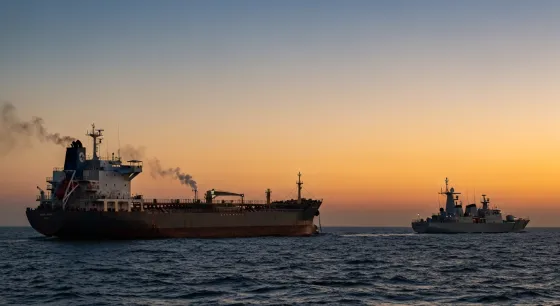
If you fancied a quiet weekend, the Gulf clearly didn't get the memo. A jittery ceasefire is just about clinging on after the US reportedly clobbered two Iranian oil tankers, and over in Bahrain, the authorities have been busy with the handcuffs. Grab a brew, this one's a tangle.
What's Actually Going On?
According to reporting carried by The Independent (originally an AP wire), a fragile ceasefire between the United States and Iran appeared to be holding into Saturday. The pause follows a US military operation that reportedly disabled two Iranian oil tankers said to be trying to slip through an American blockade.
Meanwhile, Bahrain, which hosts the US Navy's Fifth Fleet in Manama, says it has arrested 41 people it alleges are linked to Iran's Revolutionary Guard. That's the headline figure, and it's worth flagging that the number is currently single-sourced to the original wire copy.
The Ceasefire: Holding, But Only Just
"Fragile" is doing some heavy lifting here. The US and Iran are reportedly several weeks into a conflict that, according to the article, kicked off on 28 February 2026. We've not been able to independently verify the timeline or the specifics of the strikes, so treat the finer details with the appropriate pinch of salt.
What we can say with more confidence is the geography. The Strait of Hormuz, the watery bottleneck that Iran sits next to, carries roughly a fifth of the world's seaborne oil. Anything that twitches in that stretch of water tends to send petrol prices wobbling on UK forecourts within days. So even a far-off skirmish has a habit of turning up on your weekly shop receipt.
Bahrain's Big Round-Up
Bahrain's Ministry of Interior says the 41 detained individuals were allegedly affiliated with Iran's Revolutionary Guard Corps. The kingdom has long accused Tehran of trying to stir up trouble among its population, and that accusation comes with a thorny political backdrop.
Bahrain is ruled by a Sunni monarchy but the majority of its population is Shia. Human rights groups have, for years, raised concerns about how Manama handles dissent, particularly during periods of regional tension. Whether these arrests are a genuine security operation, a political tidy-up, or some unhappy mix of the two, will depend on evidence that hasn't yet been made public.
Why Bahrain Matters To Washington
Bahrain is not just any Gulf state. It's home to US Naval Forces Central Command, the Fifth Fleet's headquarters. If the Americans need to project power into the Gulf, the Strait of Hormuz, or the wider Indian Ocean, this is the launchpad. Any wobble in Bahrain's internal stability is therefore a wobble in US military posture across the entire region.
The Tanker Incident
Per the original report, US forces disabled two Iranian tankers trying to breach the blockade. An Iranian judiciary-affiliated news agency, cited in the article, reported that at least one sailor was killed and ten were injured aboard a cargo vessel. Those casualty figures have not been independently confirmed and should be treated cautiously.
If accurate, this is the sort of incident that historically inflames things rather than calms them. Iran tends not to shrug off losses at sea, and Tehran's response, when it comes, will be the next big tell on whether this ceasefire has any real legs.
A Word On Tehran's Leadership
The original article refers to "Supreme Leader Mojtaba Khamenei." That would be a seismic development. For decades, Iran's Supreme Leader has been Ali Khamenei, in post since 1989. His son Mojtaba, a cleric, has long been whispered about as a possible successor, but a formal handover would be one of the biggest political stories of the decade.
Until that succession is independently confirmed by multiple credible outlets, it's safer to treat any reference to Mojtaba as Supreme Leader as a claim attributable to the article rather than an established fact. We'd want a lot more sourcing before sticking it in the history books.
What The Diplomats Are Saying
The diplomatic phone lines are, predictably, glowing red. Iranian foreign ministry spokesperson Esmail Baghaei has been the public voice for Tehran. Pakistan's Prime Minister Shehbaz Sharif, Qatar's senior diplomat Sheikh Mohammed bin Abdulrahman Al Thani, and Egypt's Foreign Minister Badr Abdelatty have all reportedly been involved in the regional shuttle to keep the ceasefire intact.
Qatar in particular has form here. Doha has positioned itself as the Gulf's go-to mediator over the last few years, and a quiet word from the Qataris has previously taken the heat out of moments that looked, on paper, much worse than this one.
Why Should A Reader In Britain Care?
Three reasons, all very practical:
- Petrol pumps. Any serious disruption near the Strait of Hormuz tends to lift global oil prices, and that filters through to UK forecourts surprisingly quickly.
- Energy bills. Wholesale gas markets are jumpy at the best of times. A Gulf flare-up rarely helps, even with the UK importing relatively little oil from the region directly.
- Defence commitments. The Royal Navy maintains a presence in Bahrain too, at HMS Juffair. If things escalate, expect British assets to be in the frame, and expect uncomfortable questions in the Commons not long after.
What To Watch Next
A few things to keep an eye on over the coming days:
- Whether Tehran responds militarily to the tanker incident, or sticks to rhetoric.
- Whether Bahrain releases any evidence to back up the Revolutionary Guard allegation, or whether the 41 arrests quietly fade from headlines.
- Whether Gulf mediators, particularly Qatar and Oman, can convert this brittle ceasefire into something a bit more grown-up.
- Any independent confirmation, or otherwise, of the leadership claims around Mojtaba Khamenei.
The Honest Bottom Line
Right now, this is a story stitched together from a single wire report and not much else. The big-ticket claims, the war's start date, the tanker strike, the Bahrain arrests, the leadership reference, all need more independent sourcing before anyone should be writing them in stone.
What we do know is that the region is on edge, the diplomatic phones are ringing, and the ceasefire is holding by its fingernails. Whether it survives the next news cycle is anyone's guess, but the cost of it failing would be felt well beyond the Gulf, including in the UK.
Read the original article at source.