
Putin's Shrunken Victory Day: Fewer Tanks, Louder Grievances, and a Ceasefire That Barely Lasted Lunch
Moscow's 2026 Victory Day parade ditched tanks and missiles, hosted North Korean troops, and saw Putin's ceasefire collapse almost immediately.


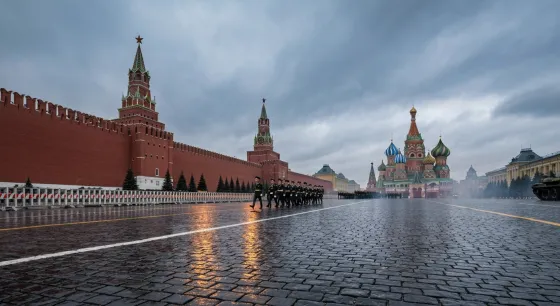
Moscow's Victory Day parade is usually a thunderous flex of armoured kit and choreographed patriotism. This year? Think less military spectacular, more awkward family gathering with a guest list that fits comfortably on one A4 page.
A parade on a diet
For the first time in nearly two decades, no tanks rumbled across Red Square and no ballistic missiles loomed over the cobbles. The whole show clocked in at roughly 45 minutes, which is a brisk affair by Kremlin standards. With more than four years of grinding war in Ukraine chewing through hardware, perhaps it was easier to leave the heavy metal in the workshop.
What did march? Russian troops, of course, alongside soldiers from a handful of friendly nations. The most eyebrow-raising contingent: North Korean servicemen, taking part in the parade for the first time. Given that Kyiv and Seoul reckon Pyongyang has sent more than 10,000 troops to fight on Russia's side, their presence in Red Square felt less like ceremony and more like a thank-you note set to brass band.
Putin's speech: the same hymn sheet
The Russian president used his annual address to rail against Nato, accusing the alliance of propping up an 'aggressive force' in Ukraine. It was, in essence, a recycled justification for what the Kremlin still insists on calling a 'special military operation', despite said operation now being well into its fifth year.
He leaned heavily, as ever, on the memory of the Great Patriotic War and the staggering 27 million Soviet citizens who died defeating Nazi Germany. Fusing that sacred history to the current war in Ukraine has long been Putin's rhetorical bread and butter, and he wasn't about to switch recipes now.
The guest list: short, slightly embarrassing
Last year's 80th anniversary bash reportedly drew 27 foreign leaders, including China's Xi Jinping and Brazil's Lula. This year's turnout was, by comparison, modest enough to make Kremlin protocol officers wince.
Confirmed attendees included:
- Belarusian president Alexander Lukashenko, ever the loyal sidekick
- Kazakhstan's Kassym-Jomart Tokayev
- Uzbekistan's Shavkat Mirziyoyev
- Malaysia's Sultan Ibrahim
Slovakia's prime minister Robert Fico made the trip too, though it's worth flagging a detail some early reports muddled: Slovak officials said Fico planned to meet Putin and lay flowers at the Tomb of the Unknown Soldier, but skip the Red Square parade itself. Either way, his presence as the lone EU figure willing to break ranks tells you plenty about where Bratislava sits on the European political map.
About that ceasefire
Looming over the parade was a three-day truce, announced by Donald Trump on Friday after a phone call with Putin. The deal reportedly included a 1,000-prisoner exchange, which sounds promising until you remember Ukraine had proposed a far longer 30-day truce starting on 6 May, only for Moscow to wave it away.
The brief ceasefire didn't even survive the celebrations. Russia's defence ministry accused Ukraine of breaching it within hours of the parade ending, and Kyiv has lobbed similar accusations back. Diplomatic theatre, it turns out, has a shorter run than a Red Square march-past.
The internet went dark
Spare a thought for ordinary Russians, many of whom spent Victory Day staring at dead phone screens. Authorities reportedly shut down mobile data and internet across swathes of the country as a security measure against Ukrainian drone strikes. Vladivostok, around 9,000km from Moscow and well outside drone range, was apparently affected too. So much for a unifying national celebration when half the country can't load the live stream.
Why this matters for British readers
You could be forgiven for filing this under 'distant geopolitics', but a few threads tug at UK interests directly.
First, the Nato framing. Putin pinning the war on the alliance is not just rhetoric for domestic ears. It feeds the political climate in which decisions about UK defence spending, support for Kyiv, and our posture on the eastern flank get made. The more Moscow paints Nato as the aggressor, the harder the negotiating room becomes.
Second, the North Korean angle. A nuclear-armed pariah state openly contributing troops to a European war is a genuinely new and uncomfortable development. It also raises questions about what Pyongyang gets in return: missile tech, food, hard cash? None of those answers are reassuring.
Third, the ceasefire that wasn't. Anyone hoping the Trump administration's involvement would unlock a quick fix should probably temper expectations. A three-day truce that collapses on day one is not the stuff of breakthrough diplomacy.
Reading the optics
If a Victory Day parade is meant to project strength, this one projected something more interesting: a Kremlin still capable of staging a show, but increasingly reliant on a shrinking circle of allies and unable to flex the same hardware it once did. Hauling out North Korean troops to march alongside Russian soldiers is not a gesture of confidence. It's a gesture of necessity.
Putin's speech tried to paper over that with the usual blend of historical grandeur and Nato-bashing. The visuals told a different story.
The bottom line
The 2026 parade will be remembered less for what it showed and more for what it didn't. No tanks. No missiles. Few foreign heavyweights. A ceasefire that barely outlasted the closing fanfare. And a North Korean detachment lending a deeply awkward symbolism to the whole affair.
For Putin, Victory Day remains a vital piece of political theatre. But theatre needs an audience, and this year's was noticeably thinner. Whether that registers in the Kremlin or simply gets folded into the next round of grievance-laden speeches is anyone's guess. Don't bet on the latter.
Read the original article at source.