
Tanks for Nothing: Putin's Slimmed-Down Victory Day Parade Rolls Into a Jittery Red Square
No tanks, tight security and a half-offline Moscow: why Putin's 2026 Victory Day parade looks smaller, twitchier and tells its own story.




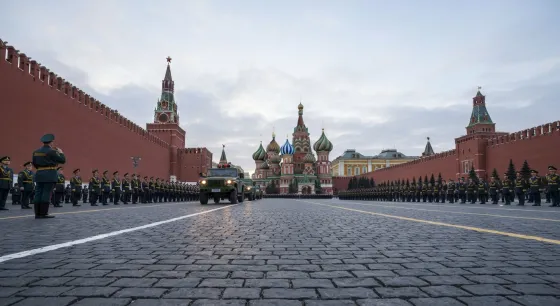
Moscow is dusting off its medals, polishing its boots and bracing for a Victory Day that looks rather different to the chest-thumping spectacles of years gone by. On Saturday, Vladimir Putin will stand on Red Square to mark the 81st anniversary of the defeat of Nazi Germany, but the parade behind him will be a noticeably trimmer affair, the security cordon noticeably thicker, and the mood noticeably twitchier.
A Parade With the Heavy Stuff Left in the Garage
For the first time in nearly two decades, no tanks, missile launchers or other lumbering hardware will rumble across the cobbles. A flyover is still on the cards, but the ground show has been stripped back to soldiers on foot. Depending on which outlet you read, you have to go back to either 2007 or 2008 to find a Red Square parade this light on heavy metal.
The official line nods to logistics and security. The unspoken subtext is harder to ignore. With the war in Ukraine grinding into its fifth year and a front line stretching more than 1,000 kilometres, Russia's military hardware is rather busy elsewhere. Wheeling it through central Moscow for the cameras is a luxury the Kremlin apparently cannot, or will not, afford this year.
Tight Security and a City Half Offline
If you happen to be in Moscow this weekend trying to send a WhatsApp, good luck. Authorities have clamped down on mobile internet and SMS across swathes of the capital, leaving millions effectively offline. It is the digital equivalent of pulling the curtains and bolting the door.
The reason is not exactly subtle. Ukraine has spent recent months proving that its drones can fly deep into Russian territory, with confirmed ranges of 1,000 kilometres and beyond. In the days leading up to the parade, dozens of drones were launched towards Moscow, forcing repeated airport closures and a fair bit of nervous sky-watching. Cutting off mobile signals is a crude but effective way to disrupt drone navigation and any awkward live streams from the ground.
A Ceasefire That Nobody Quite Trusts
Hovering over the whole occasion is a three-day ceasefire announced by Donald Trump, running from Saturday to Monday. Russia has framed it as a unilateral Victory Day truce covering 8 to 10 May, paired with a prisoner exchange.
The catch? Both Moscow and Kyiv have already accused each other of breaching it, which is roughly what happened to the previous attempts at a pause in fighting. Treat the word ceasefire here with the caution you would treat a meal deal at a motorway service station: technically real, rarely satisfying.
Volodymyr Zelensky, never one to miss a rhetorical jab, issued a tongue-in-cheek decree 'permitting' Russia to hold its parade and declaring Red Square temporarily off-limits for Ukrainian strikes. The sarcasm was thick enough to spread on toast, but the underlying message was serious: Ukraine is choosing where and when it pushes back.
The Guest List: Short, and Pointedly So
Putin's foreign guest list reads less like a global summit and more like a regional get-together. Belarusian strongman Alexander Lukashenko is in. Kazakhstan's Kassym-Jomart Tokayev and Uzbekistan's Shavkat Mirziyoyev have been listed too, although Central Asian attendance has wobbled in the run-up. Sultan Ibrahim of Malaysia and Laos President Thongloun Sisoulith round out the more notable names.
Slovak Prime Minister Robert Fico is doing a diplomatic two-step: meeting Putin and laying flowers, but skipping the parade itself. By several accounts, this year's foreign turnout is the thinnest in modern Russian history, which says rather a lot about Moscow's current standing on the world stage.
For added flavour, Russia reportedly yanked foreign press credentials at the last minute, and several regional Victory Day parades across the country have been quietly trimmed or cancelled altogether on security grounds.
Why Victory Day Still Matters in Russia
It is easy, from a UK sofa, to view all this as theatre. For many Russians, though, 9 May is genuinely sacred. The Soviet Union lost an estimated 27 million people during the Great Patriotic War of 1941 to 1945, a figure that touches almost every family tree in the country. Grandparents, great-uncles, neighbours: the loss is woven into the fabric of national memory.
That is precisely why the Kremlin treasures the day. Victory over Nazi Germany is the rare piece of Soviet legacy that unites Russians across politics, generations and geography. Wrapping the current war in Ukraine in that same flag is a deliberate, and frankly cynical, political move. Putin, now more than a quarter of a century into his grip on power, leans on the parade as both legitimacy and emotional shield.
The Threats and the Theatre
The Kremlin has not exactly been subtle about consequences. Officials have warned of a 'massive missile strike on the centre of Kyiv' if the parade is disrupted, and reportedly advised foreign diplomats to leave the Ukrainian capital. The EU's response was a polite version of 'no thanks' — diplomats stayed put.
So you have a parade without its usual hardware, a city with the internet half switched off, a ceasefire neither side trusts, a guest list of mostly close allies, and threats of retaliation flying in both directions. Calling it a celebration feels generous. It is more like a high-stakes piece of stagecraft, performed under floodlights and surveillance drones.
What It Means for the Rest of Us
For UK readers, the parade is a useful temperature check on the war. A scaled-down show suggests Russian forces and equipment are stretched. The mobile blackout and the airspace jitters underline how vulnerable even Moscow now feels to long-range Ukrainian drones. The shrunken VIP list hints at how isolated the Kremlin has become beyond a small circle of friendly capitals.
None of that means the conflict is winding down. If anything, the symbolism cuts the other way: a regime so anxious about its own showpiece event that it pulls the tanks, throttles the networks and threatens missile strikes is not a regime feeling secure.
The Verdict From Red Square
Victory Day 2026 will still deliver the music, the medals and the flag-waving. But the gaps in the parade tell their own story. Less hardware on the cobbles, fewer leaders on the dais, and a city holding its breath for any sign of trouble overhead.
Putin will get his speech, his cameras and his moment. Whether he gets the unshakeable image of strength he wants is another matter entirely.
Read the original article at source.