
How the US Postal Service Spent 30 Years Sending People to the Internet's Worst Website
For over 30 years, the USPS funnelled millions of Americans to MyMove, a site with 98% one-star reviews on Trustpilot. Here is the full story.












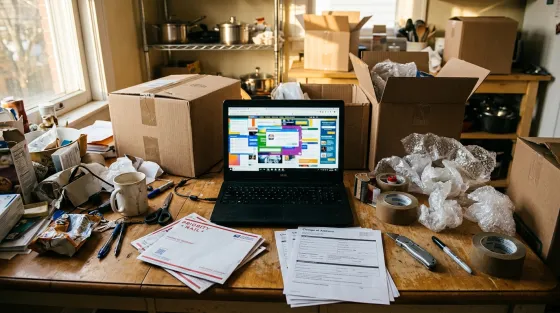
Imagine you are moving house. You have got boxes everywhere, a questionable amount of bubble wrap, and a to-do list longer than your arm. Naturally, you need to update your postal address. Simple enough, right? Pop over to the US Postal Service website, fill in a form, job done.
Except it is not done. Not even close. Because for more than three decades, the USPS has been funnelling millions of Americans towards a website called MyMove, a platform so aggressively stuffed with dark patterns and unwanted "deals" that it currently boasts a spectacular 1.3 out of 5 on Trustpilot, with 98% of its reviews sitting at one star. That is not a typo. Ninety-eight percent.
Welcome to what might genuinely be the worst government-adjacent website on the internet.
A Brief History of a Very Bad Idea
The story begins in 1992, when a company called Targeted Marketing Solutions, founded by Brett Matthews and Virginia Salazar, pitched the USPS on a novel concept: let us build a platform that helps people change their address online, and we will monetise it by connecting movers with relevant services. The postal service agreed to a pilot, and by 1995 it had become a national contract.
Here is the truly delicious bit. In 1997, Vice President Al Gore actually gave the company a Hammer Award for "reinventing government." The initiative was meant to modernise public services and save taxpayers money. In hindsight, it reinvented government in roughly the same way that putting a racing stripe on a skip reinvents waste management.
The website reportedly launched around 2001, and since then, the USPS has been processing roughly 24 million change-of-address requests every year. A staggering number of those people have been directed straight into MyMove's waiting arms.
Follow the Money (It Is Quite a Trail)
The ownership history of this operation reads like a corporate pass-the-parcel game. In 2005, Pitney Bowes snapped up Imagitas (the company behind the platform) for $230 million. Then in 2015, Red Ventures purchased it for $310 million. Someone was clearly making good money from all those movers.
How good? Well, in 2023, Red Ventures and MyMove paid $2.75 million to settle a whistleblower allegation that they had defrauded the USPS. The whistleblower, former director of operations Marcos Arellano, had filed his complaint back in 2020. The settlement included no determination of liability, which is standard legal language for "we are paying you to go away without admitting anything."
Dark Patterns: The Internet's Favourite Dirty Trick
So what actually happens when you land on MyMove? According to UX experts and a mountain of user complaints, the site deploys what are known as dark patterns: manipulative design choices engineered to trick you into doing things you did not intend to do. Think pre-ticked boxes, confusing opt-out processes, and an endless carousel of "special offers" that sit between you and the simple task of updating your address.
Research from the University of Chicago, published in the Journal of Legal Analysis in 2021, found that aggressive dark patterns can nearly quadruple unwanted sign-up rates, producing a 371% increase compared to a control group. That is not subtle nudging. That is digital arm-twisting.
The irony is that the actual USPS change-of-address process is straightforward. You can do it directly on USPS.com for a $1.25 identity verification fee. But the journey there has historically involved being routed through MyMove's labyrinth of promotional content first. It is rather like being told the exit is just through this gift shop, except the gift shop is the size of an aircraft hangar and someone has hidden the door.
MyMove even offers a voter registration feature. Sounds civic-minded, does it not? Except it ultimately just tells you to print a form and post it in yourself. Genuinely helpful stuff.
The Regulators Are (Finally) Paying Attention
The good news is that dark patterns are increasingly landing companies in seriously expensive trouble. The FTC secured a $2.5 billion settlement with Amazon in 2025 over dark pattern practices, and hit Epic Games with $245 million in 2023 specifically for dark patterns that tricked users into unwanted purchases (part of a $520 million total penalty). The message from regulators is getting louder: design your website to deceive people, and it will cost you.
Whether this will eventually reach MyMove with any real force remains to be seen. But the precedent is being set, one billion-dollar settlement at a time.
Meanwhile, in Britain: We Have Got Our Own Problems
Before anyone on this side of the Atlantic gets too smug, the UK has its own flavour of this particular mess. We do not have an official government partner funnelling people into a dark pattern maze, but we do have a thriving ecosystem of copycat government websites that charge people between £50 and £100 for services available entirely free on GOV.UK.
Which? found that rip-off "checking" firms appear in 73% of driving licence renewal searches. Over 1,200 complaints have been lodged with the DVLA since 2020 about people paying these copycat sites for services that cost nothing through official channels. One fraudster running copycat government sites was actually jailed. The key difference is that these UK copycats are unauthorised, while MyMove has the USPS's official blessing. It is hard to say which is worse.
Then there is the Capita civil service pension portal, which launched in December 2025 to manage a £239 million contract for the Civil Service Pension Scheme. It arrived with broken links, placeholder dummy text, unrecognised logins, and navigation that went in circles. Over 8,000 members experienced payment delays, 647 emergency loans had to be issued, and Capita had to draft in Microsoft to help clean up the wreckage. The government was forced to publish a formal recovery plan.
HMRC has not exactly covered itself in glory either. A parliamentary committee accused the department of "deliberately poor service," with average call wait times exceeding 23 minutes and only 66.4% of calls being answered at all. Phone access was restricted before digital alternatives were properly ready.
At Least the Regulations Are Improving
On the regulatory front, the UK's Digital Markets, Competition and Consumers Act 2024, which came into effect in April 2025, gives the CMA new enforcement powers specifically targeting dark patterns. The Advertising Standards Authority has also published guidance on "online choice architecture." So the tools to tackle this are sharpening.
There is a curious irony here: GOV.UK itself is genuinely excellent. It won Design of the Year. The problems emerge when outsourced services sit alongside or behind it, which mirrors the MyMove situation perfectly. USPS.com works fine. It is the private partner lurking behind the curtain that creates the nightmare.
The Verdict
The MyMove saga is a case study in what happens when a public service outsources its digital front door to a company whose entire business model depends on monetising the people walking through it. Thirty years is a long time to run an experiment in user hostility, and a 1.3 Trustpilot rating suggests the results are in.
For UK readers, the lesson is familiar: government services work best when they are designed for citizens, not for the companies contracted to deliver them. Whether it is copycat websites, botched pension portals, or HMRC phone queues, the pattern is the same. When profit motives are layered on top of public services, the public tends to come off worse.
The internet has enough dark patterns without government agencies adding to the collection.
Read the original article at source.