
Bangladesh Feels the Pinch: How the 2026 Iran War Is Draining Wallets in Dhaka
How the 2026 Iran war is driving up fuel prices, sparking power cuts and squeezing households across Bangladesh.











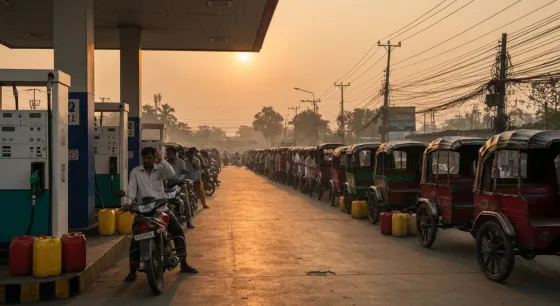
Spare a thought for Tariqul Islam. The Dhaka ride-share driver now spends hours queuing for petrol that costs more than it did last month, all because of a war being fought thousands of miles away. Welcome to globalisation in 2026, where a missile exchange in the Gulf turns into a missed school run in Bangladesh.
The short version
The 2026 Iran war, sparked by US and Israeli military action against Iran, has thrown a spanner into global energy supplies. Bangladesh, a country of more than 170 million people that imports roughly 95% of its energy, is taking it on the chin. Fuel is scarcer, prices are climbing, factories are running on fumes, and the World Bank now expects the economy to grow just 3.9% in the fiscal year ending June 2026. Not exactly the boom anyone hoped for.
Why a war in the Gulf hits a driver in Dhaka
The clue is in the geography. Around 20% of the world's oil and gas trade squeezes through the Strait of Hormuz, that narrow stretch of water Iran could (and reportedly has) disrupted. Choke the strait, and tankers stop arriving on schedule everywhere from Rotterdam to Chattogram.
Bangladesh feels it more than most because it does not really do energy independence. Nearly all its oil and gas is imported, often via routes that depend on Gulf stability. When tankers reroute or vanish from the schedule, the pumps run dry and the LNG terminals get nervous.
The household squeeze
For ordinary Bangladeshis, the consequences are very tangible:
- Long queues at petrol stations, with drivers like Tariqul losing income while they wait
- Higher transport costs feeding into food and grocery prices
- Power cuts as the grid struggles with patchy gas supplies
- Universities closing early for Eid and shopping centres reportedly ordered to shut by 8pm to save fuel
If you have ever moaned about a 5p rise at a UK forecourt, imagine the same shock landing in a household where fuel and food already eat most of the monthly budget. The World Bank flagged that national poverty rose to 21.4% in 2025 from 18.7% in 2022, and that was before this latest crunch.
The garment industry's bad week (and month, and quarter)
Here is where it gets uncomfortable for British shoppers too. Bangladesh is the world's second-largest garment exporter after China, churning out around $39 billion of clothing a year and employing roughly 4 million people. A decent slice of what hangs on the rails at Primark, M&S, H&M and Zara starts life in a Dhaka or Chattogram factory.
Now those factories are dealing with patchy power, pricier inputs and skittish buyers. The article cites garment shipments down 5% to 13% in recent months. Other reporting is gloomier still: EU apparel imports from Bangladesh reportedly fell more than 25% year-on-year in January 2026. Industry voices, including the Bangladesh Chamber of Industries' president, suggest factory output has dropped 30% to 40% and business costs have risen 35% to 40%, although those are industry estimates rather than audited figures.
The takeaway is the same either way: every day a loom sits idle, a worker loses wages and a high street brand inches closer to a stockout.
The government's tricky balancing act
Dhaka is doing what governments tend to do in an energy panic: throwing money at the problem and hoping the cheque clears. Officials are reportedly preparing to spend roughly an extra $1.07 billion on LNG subsidies in the April to June quarter, a figure that has not been independently verified but tells you the direction of travel.
Bangladesh has also reportedly sought around $2 billion in emergency loans, and neighbouring India has stepped in with about 5,000 tonnes of emergency diesel, drawing on its more diversified suppliers, which now include Russia. Helpful, certainly. A long-term fix, definitely not.
What the big forecasters are saying
The mood music from the multilaterals is distinctly minor key:
- The World Bank expects Bangladesh's economy to grow just 3.9% in the fiscal year ending June 2026, well below recent norms
- The Asian Development Bank has trimmed its outlook for developing Asia and the Pacific, with a 4.7% growth figure cited in the article (though that 4.7% appears in some ADB materials specifically for developing Southeast Asia, so treat the regional attribution with a pinch of salt)
- Inflation across the region is expected to hover above 5%, eating into already squeezed household budgets
Translation: the recovery story many were hoping to write in 2026 has been quietly rewritten as a damage-limitation exercise.
Why this matters to readers in the UK
It is tempting to file all this under somebody else's problem. That would be a mistake.
First, the price tags. Britain imports a lot of clothing from Bangladesh, and when factories run hot on costs, those numbers eventually creep onto UK price labels. Expect the basics, plain tees, cotton shirts, kids' uniforms, to feel a bit pricier later in the year.
Second, the energy story. The same disruption pushing up Bangladesh's LNG bill is shaping European gas markets too. UK households are not first in the queue at the pumps in Dhaka, but we are sitting in the same global tanker traffic jam.
Third, migration and remittances. Bangladesh is a major source of overseas workers and their remittances. A prolonged squeeze at home tends to show up later as pressure on labour markets and family networks abroad, including in the UK.
The likely path from here
Three things to watch over the next few months:
- Whether the Strait of Hormuz returns to anything like normal throughput. This is the single biggest variable.
- How quickly Bangladesh can lock in alternative fuel deals, particularly with India and Gulf suppliers willing to keep shipping
- Whether Western buyers stick with Bangladeshi factories or start spreading orders to Vietnam, India and elsewhere. Once those supply chains shift, they tend not to come back
None of this is irreversible. Bangladesh has weathered shocks before, from the pandemic to political upheaval, and its garment sector has shown a stubborn knack for survival. But survival is not the same as growth, and right now the country is firmly in the former camp.
The verdict
This is a textbook example of how a 21st century war is fought partly through pipelines, shipping lanes and credit lines. The bombs may fall on military bases, but the bills land in places like Dhaka, where a ride-share driver loses half a day's wages waiting for the pumps to open.
For UK readers, the lesson is simple. Cheap, reliable global supply chains are not a law of nature. They are a political achievement, and right now that achievement is looking a bit threadbare.
Read the original article at source.