
Schoolbags and Black Armbands: Iran's Football Team Sends a Powerful Message Before Nigeria Friendly
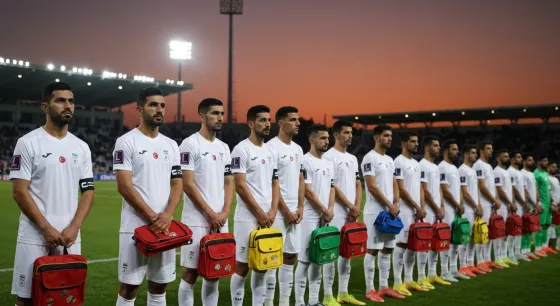
Iran's players wore black armbands and held children's schoolbags in a silent tribute to the Shajareh Tayyebeh school attack victims before facing Nigeria.











A Protest That Spoke Louder Than Any Chant
Football has long been a stage for political statements, but few have been as striking as what unfolded in Belek, Turkey on Friday evening. As the Iranian national anthem played before their friendly against Nigeria, the men's squad stood in black armbands, each player clutching a child's schoolbag. No banners. No slogans. Just a silent, gut-punch of a tribute to the victims of the Shajareh Tayyebeh school attack.
The gesture was unmistakable. On 28 February 2026, a US Tomahawk missile struck the girls' school in Iran on the opening day of Operation Roaring Lion. At least 175 people were killed, the majority of them girls aged between seven and twelve. US military investigators have since determined their own forces were likely responsible, with outdated targeting intelligence failing to distinguish the school from an adjacent IRGC naval compound it had once been part of.
Iran's team media officer referenced the attack before kick-off, though notably cited a figure of "165 girls" killed. The actual toll, revised upward by Iranian authorities after continued recovery efforts, stands at 175 and includes adult teachers and staff as well as children.
On the Pitch, Nigeria Had the Final Word
If the pre-match moment was sombre, the football itself offered no consolation for Iran. Nigeria ran out 2-1 winners in what was supposed to be a warm-up fixture ahead of the 2026 World Cup. Former FC Porto and Inter Milan striker Mehdi Taremi, now plying his trade at Olympiacos in Greece, featured for Iran but could not prevent the defeat.
Iran will have another chance to find their rhythm when they face Costa Rica in a second friendly in Turkey on Tuesday. But the real question hanging over this squad has nothing to do with form.
A World Cup in Limbo
Iran qualified for a fourth consecutive World Cup, a genuinely impressive streak spanning Brazil 2014, Russia 2018, Qatar 2022, and now the 2026 tournament hosted across the United States, Mexico, and Canada. The problem, of course, is the "United States" part of that equation.
Following the school attack, Donald Trump posted on Truth Social that it would not be "appropriate" for Iran to take part in the tournament "for their own life and safety." It is worth sitting with that sentence for a moment. The president of the host nation publicly suggesting a qualified team should stay away for safety reasons is, to put it diplomatically, unprecedented.
Iranian Football Federation president Mehdi Taj responded by declaring that Iran will not travel to the US for any World Cup matches. He pushed FIFA to relocate Iran's group games to Mexico, but the governing body rejected that request in mid-March. Where this leaves Iran's participation remains unresolved, with potential FIFA sanctions now looming.
The Women's Team Caught in a Different Storm
Iran's men are not the only national team making headlines for reasons beyond football. During the AFC Women's Asian Cup in Australia, the women's squad declined to sing the national anthem before their match against South Korea on 2 March. Iranian state television branded them "traitors" in response.
The fallout was significant. Several players were granted humanitarian visas by Australia. While most eventually returned to Iran, at least two players, Fatemeh Pasandideh and Atefeh Ramezanizadeh, chose to remain in Australia and began training with Brisbane Roar.
Football as a Mirror
The UN's human rights chief has urged the US to conclude its investigation into the school strike. UNESCO, Human Rights Watch, and Amnesty International have all flagged the attack as a potential violation of international humanitarian law. Against that backdrop, a group of footballers holding schoolbags on a pitch in southern Turkey feels less like a token gesture and more like one of the few tools of expression available.
Iran's World Cup participation, their players' safety, and the broader geopolitical fallout from the school attack are questions that will not be settled on a football pitch. But sometimes the pitch is the only place the world is watching.
Read the original article at source.