
Greek Fishermen, a Cave, and a Very Awake Killer Drone: The Lefkada Mystery
A Ukrainian-style sea drone turned up in a Lefkada cave, engine running. Here's what happened, whose it might be, and why it matters.












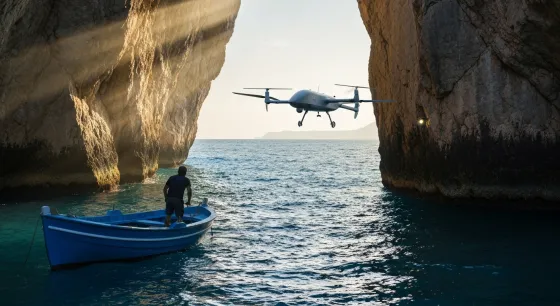
Picture the scene. You're a Greek fisherman, pootling along the coast near Lefkada, when you spot something tucked inside a sea cave. It isn't a sunbathing seal. It isn't a discarded jet ski. It's a sleek, low-slung naval drone, engine still humming away like a fridge nobody remembered to switch off, allegedly stuffed with enough explosives to ruin somebody's week.
That, more or less, is what greeted authorities on Thursday 7 May 2026 near Cape Doukato. Days later, the Greek navy towed the thing out to sea off Astakos and gave it the dignified send-off it deserved: a controlled blast.
What Actually Happened
Local fishermen stumbled upon the unmanned surface vessel (USV) inside a coastal cave on the south of Lefkada. According to Greek authorities and corroborating reports from Naval News and Kyiv Post, the craft was still operational when found. Its engine was reportedly running, which is the maritime equivalent of finding a stranger's car idling in your driveway.
The Greek military cordoned off the area, eventually moved the drone offshore, and detonated it in a controlled explosion near Astakos on the mainland coast. No injuries, no damage, no drama beyond the obvious 'what on earth is this doing here' factor.
So, Whose Drone Is It?
The leading theory, and one that Greek defence officials have leaned into, is that the vessel is Ukrainian. Specifically, a Magura, the now rather famous family of sea drones built by Kyiv. The Greek Ministry of Defence has identified it as a Magura V3, although photographs circulating in outlets like Kyiv Post suggest it may actually be the newer V5 variant. Either way, it's Ukrainian-flavoured hardware, a long way from home.
How long a way? The Magura V5 has a published range of around 700km, or roughly 432 miles. That's an impressive reach for what is essentially a remote-controlled speedboat with murderous intent, but it's still a fair stretch from the Black Sea to the Ionian. Which is part of what makes this whole episode so peculiar.
About Those Explosives
Here's where the story gets a bit fuzzy. The BBC reports the drone was carrying roughly 100kg of explosives. Greek outlet iefimerida puts the figure at 200kg. Greek City Times and others have gone as high as 300kg. A few reports suggest only detonators were aboard, no main charge.
The honest answer is that we don't yet know the precise payload. The lower BBC figure appears to reflect an official Greek estimate, while higher numbers come from local commentary and analyst speculation. Until Greek authorities publish a formal assessment, treat any specific number with a pinch of sea salt.
Why a Magura in Greek Waters Is a Big Deal
The Magura, charmingly named the Maritime Autonomous Guard Unmanned Robotic Apparatus, has earned a fearsome reputation since 2023. Ukrainian operators have used it to damage or sink several Russian Black Sea Fleet vessels, and in 2025 a Magura reportedly downed a Russian Su-30 fighter jet using mounted air-to-air missiles. That was, as far as anyone can tell, the first time a sea drone has bagged a fast jet. Not bad for a glorified jet ski.
If a Magura really has turned up in the Ionian Sea, that represents a serious geographic leap. Until now, these drones have been a Black Sea phenomenon. Their appearance in the Mediterranean would suggest either a deliberate operational expansion, an accidental drift, or something stranger involving cargo ships, support vessels, or covert delivery.
The Shadow Fleet Angle
Here's where it gets spicy for British readers paying attention to sanctions enforcement. The Ionian Sea is a busy shipping corridor, and it's regularly used by Russia's so-called 'shadow fleet'. These are the elderly, opaque-ownership tankers that quietly move sanctioned Russian oil around the world while everyone pretends not to notice.
Back in March 2026, Russia accused Ukraine of striking an LNG tanker between Libya and Malta. That claim was reported widely at the time, though independently confirming who did what at sea is famously difficult. A Ukrainian sea drone surfacing in Greek waters does rather invite the question of whether Kyiv is quietly extending its maritime reach toward the shadow fleet's preferred routes.
Worth saying clearly: that's speculation, not confirmed fact. But it's the speculation everyone's having.
The Greek Connection
There's another layer here. In November 2025, Greece and Ukraine signed a naval drone co-production deal, according to reports in Kathimerini and Ukrainian press. So Greece isn't a neutral bystander to the Magura programme; it's a partner.
That makes the political reaction inside Greece all the more pointed. The opposition has framed the cave incident as a national security failure, asking how an armed unmanned vessel from a partner nation ended up loitering in Greek waters without anyone noticing. The pro-Russian Hellenic Solution party, predictably, has gone further, calling it a 'conscious military provocation'.
Mystery Notes Aboard?
Several Greek outlets have reported that handwritten notes in Ukrainian were found inside the drone. That detail is genuinely interesting, if true, because operational military hardware doesn't usually contain doodles in the operator's mother tongue. It would also be a clumsy bit of opsec.
However, that claim hasn't been independently verified at the time of writing, so file it under 'intriguing if accurate, possibly nonsense if not'.
What This Means for the Rest of Us
For UK readers, the Lefkada mystery matters for a few reasons.
- Sanctions and oil. The shadow fleet keeps Russian oil flowing despite Western sanctions. Anything that disrupts those routes affects global pricing and the credibility of the sanctions regime.
- Maritime security. If sea drones can travel hundreds of miles and end up undetected in NATO member waters, that's a wake up call for every navy in Europe, including the Royal Navy.
- Holiday season optics. Lefkada is a popular summer destination for British tourists. An armed drone in a cave is the sort of thing that focuses minds on insurance small print.
The Verdict
Strip away the speculation and you're left with a striking, slightly absurd image. Fishermen, a cave, an idling killer drone, and a controlled explosion off the Greek coast. The technical details are still being argued over, the political fallout is just getting started, and the strategic implications could be considerable if this really is a sign of Ukrainian sea drones operating in the Mediterranean.
For now, treat the headline numbers cautiously, watch what Greek authorities release next, and assume that somewhere in Kyiv, an engineer is checking a logbook and asking awkward questions about a missing unit.
Read the original article at source.