
The UK Wants to Ground Your Teenager's Phone - Here's What the Trial Actually Looks Like
The UK government is trialling social media bans, screen time caps, and overnight curfews for teenagers. Here's how the six-week pilot programme actually works.









Digital Bedtime and Screen Time Caps: The Government's Bold Experiment
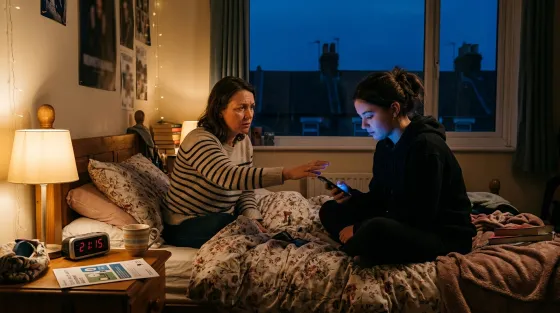
The UK government has decided it is time to find out what happens when you take TikTok away from a teenager. Voluntarily, mind you. Three hundred brave young people aged 13 to 17 are about to become guinea pigs in a six-week pilot programme that will test social media bans, daily time limits, and overnight curfews. If you have ever tried confiscating a 14-year-old's phone at dinner, you will appreciate the ambition here.
The trial, led by the Department for Science, Innovation and Technology (DSIT), splits participants into four groups. One group faces a complete social media ban. Another gets a one-hour daily cap on platforms like TikTok, Snapchat, and Instagram. A third group will have an overnight curfew blocking access between 9pm and 7am. The fourth group carries on scrolling as normal, serving as the control. Researchers will track sleep patterns, mood, and physical activity, while interviewing both the young people and their parents before and after the experiment.
Why Now?
This is not happening in a vacuum. The pilot sits alongside a much larger public consultation that opened on 2 March 2026 and runs until 26 May, with a government response expected in summer 2026. Technology Secretary Liz Kendall and Education Secretary Bridget Phillipson are both backing the initiative, which goes well beyond simple age gates.
The consultation asks some genuinely interesting questions: should addictive design features like infinite scrolling and autoplay be disabled for minors? Should children have unrestricted access to AI chatbots? These are the sorts of questions that feel overdue, frankly.
Political pressure has been building from all sides. The House of Lords voted in favour of a full social media ban for under-16s, and more than 60 Labour MPs joined Conservatives and Liberal Democrats in pushing for tighter age restrictions. MPs did reject a specific amendment supporting an under-16 ban in March 2026, but the direction of travel is clear.
The Bigger Picture
Australia has already taken the plunge, passing legislation in November 2024 banning under-16s from platforms including TikTok, Instagram, Snapchat, and X. Spain, France, Denmark, and Austria are all mulling comparable measures. The UK appears to be taking a more cautious, evidence-first approach, which is either admirably sensible or frustratingly slow depending on your perspective.
Alongside the government pilot, a separate academic study led by Professor Amy Orben at the University of Cambridge and the Bradford Institute for Health Research will recruit roughly 4,000 pupils aged 12 to 15 from ten Bradford schools. That study should provide a more statistically robust picture of how social media restrictions affect young people in practice.
Not Everyone Is Convinced a Ban Is the Answer
It is worth noting that some of the most prominent child safety organisations are wary of blunt instruments. The NSPCC and the 5Rights Foundation have both warned that a blanket ban could create a false sense of safety without actually addressing the underlying problems. Chris Sherwood, CEO of the NSPCC, has argued that the status quo clearly is not working but that the focus should be on forcing platforms to remove the design tricks that keep young people hooked.
Andy Burrows from the Molly Rose Foundation, established after 14-year-old Molly Russell's death was linked to harmful online content, has urged the government to follow the evidence rather than reach for simplistic solutions. That foundation's voice carries real weight in this debate.
Meanwhile, Ofcom and the ICO have jointly written to YouTube, TikTok, Facebook, Instagram, and Snapchat pressing them on child safety, age verification, and grooming prevention. Schools are tightening up too, with Ofsted inspectors now scrutinising phone policies during every inspection and schools expected to be phone-free by default.
The Verdict
This trial is a smart move. Rather than legislating first and asking questions later, the government is gathering actual data on what works. Whether a one-hour cap proves more practical than a total ban, or whether the overnight curfew turns out to be the sweet spot, we should know more by summer. Reports suggest nearly 30,000 consultation responses have already been received, which shows just how strongly parents and young people feel about this.
The real test, of course, will be whether the government acts on whatever the evidence shows, even if the answer is more nuanced than a headline-friendly ban.
Read the original article at source.