
Trump to Netanyahu: Stand Down — Iran's First Missiles Since April Rattle a Fragile Truce
Iran fires its first missiles at Israel since April, rattling a fragile truce, and Trump urges Netanyahu not to retaliate. Here's what happened and why.












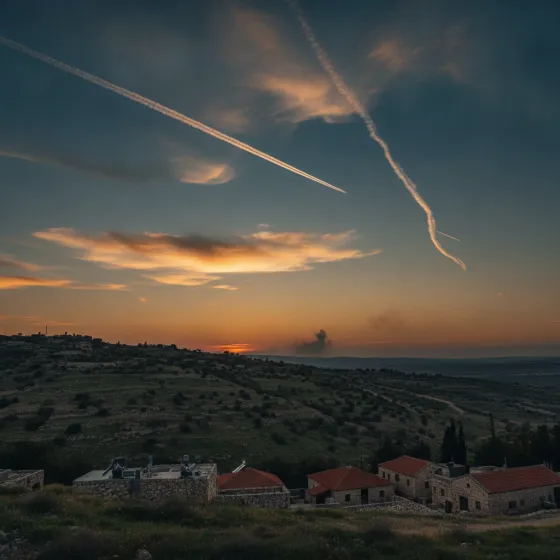
Just when the Middle East looked like it might enjoy a quiet weekend, the region did what it does best: it threw a curveball. Late on Sunday 7 June 2026, Iran's Revolutionary Guard Corps (IRGC) fired ballistic missiles at northern Israel, the first such bombardment since the shaky ceasefire that took hold in April. And in a twist nobody had on their bingo card, the loudest voice calling for calm was sitting in the White House.
What actually happened
Here are the facts, before the speculation machine warms up. Iran launched ballistic missiles towards Israel on Sunday night. The IRGC said it was hitting back at an Israeli strike earlier that same day on Beirut's southern suburbs, the densely populated district known as Dahiyeh. According to multiple outlets, the Israeli operation targeted what it described as a Hezbollah command centre, itself a response to Hezbollah fire into northern Israel.
Lebanese state media reported two people killed and 11 injured in the Beirut strike. The Independent, sensibly, noted it could not independently confirm exactly what was hit or whether the dead were Hezbollah members, so treat the finer details with appropriate caution.
As for Israel? The IDF said it intercepted incoming missiles and signalled it was ready to respond, in its words, 'with determination'. Worth flagging: CNN reported the IDF later said the attack continued after its first statement, and could not confirm Iran's specific claim about which target was struck. More on that below.
The Trump intervention
This is the genuinely surprising bit. Rather than cheering Israel on, Donald Trump publicly said he would ring Benjamin Netanyahu and urge him not to retaliate. His reasoning, delivered with characteristic bluntness: 'We don't need another one.'
Trump went further on Fox News, saying he was 'not happy' about Israel's strikes on Beirut and pointing out they were not coordinated with Washington. Reporting suggests the Beirut operation went ahead despite an explicit US request not to hit the Lebanese capital — which, if you are keeping score, is the kind of thing that strains an alliance.
Trump framed the whole mess in his usual sweeping style, warning the conflict could 'keep going like the last 47 years, or the last 3,000 years'. Rhetorical flourish rather than historical precision, but you get the point.
One claim worth a pinch of salt
The IRGC said it targeted Israel's Ramat David Air Base. That is Iran's own account of events. The IDF said it could not confirm the alleged base hit, so for now it sits firmly in the 'claimed, not verified' column. When a military announces precisely what it destroyed, it pays to wait for independent confirmation before nodding along.
Why the ceasefire date is fuzzy
You may see this described as the first Iranian missile attack since a ceasefire that began on 16 April. Here is an honest caveat: the exact date is inconsistent across sources. Several wire reports describe an 'early April' or 8 April ceasefire instead. The truce existed and it is now under enormous strain — but if you want a precise start date, the public record genuinely disagrees with itself.
The bigger picture: a Washington–Israel rift
Strip away the missiles for a moment and the real story may be the daylight opening up between two long-standing allies. The backdrop is what reporters are calling the '2026 Iran war' and a fragile US–Iran ceasefire that Trump claims is mere days from becoming a full agreement.
That gives Trump every incentive to keep things quiet. A fresh round of Israeli retaliation could blow up a deal he wants to bank. So we have an unusual spectacle: an American president downplaying an Iranian attack on Israel and leaning on Netanyahu to holster the weapons.
Israel, predictably, is not thrilled. The IDF made its readiness to hit back very clear, and Israeli sources told Axios and Reuters that a response was already being planned before Trump even picked up the phone. Iran, for its part, has warned that all US bases in the region would be 'legitimate targets' if Israel retaliates — a not-so-subtle reminder that escalation rarely stays contained.
Why this matters to you
If you are reading this from the UK, you might reasonably ask why a missile exchange thousands of miles away deserves your attention. A few reasons.
- Energy and your wallet: serious instability in the region has a habit of nudging oil prices, and that filters down to petrol pumps and heating bills.
- Travel: renewed conflict can mean airspace closures and disrupted flights across the eastern Mediterranean.
- Global stability: when the US and Israel visibly disagree on strategy, the usual assumptions about how this region is managed start to wobble.
The verdict so far
This was published as a developing story, with the timestamp showing late on 7 June 2026 and the full scale of the attack still unclear. Figures may well have been revised in later updates, so anyone claiming total certainty tonight is guessing.
What we can say is this: a fragile ceasefire just took a serious knock, Iran has demonstrated it is still willing to fire, and the most influential brake on escalation is — remarkably — the President of the United States telling Israel to sit this one out. Whether Netanyahu listens is the question that will define the days ahead.
Read the original article at source.