
When Your Robot Taxi Decides to Take a Break: Baidu's Wuhan Robotaxi Meltdown
Over 100 Baidu Apollo Go robotaxis stopped mid-traffic in Wuhan after a network failure, trapping passengers on busy roads for up to two hours.












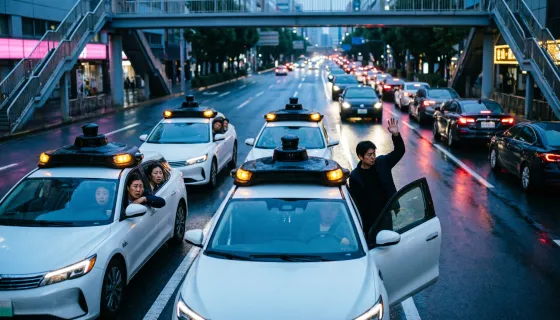
Over 100 Driverless Cars Froze Mid-Traffic, Leaving Passengers Trapped on Busy Roads
If you have ever been stuck in traffic and thought "well, at least my driver knows what they are doing," spare a thought for the passengers of Baidu's Apollo Go robotaxis in Wuhan on the evening of 31 March 2026. More than 100 of the company's driverless vehicles simultaneously ground to a halt thanks to what appears to have been a network failure, leaving some passengers stranded in moving traffic for up to two hours. Welcome to the future of transport.
What Actually Happened
Reports began flooding in around 9 PM local time. Across the sprawling city of Wuhan, Baidu's fleet of autonomous taxis simply stopped responding. Not in the gentle, "pulling over to a safe spot" way you might hope a robotaxi would handle an error. No, these vehicles halted wherever they happened to be at the time, including in the middle lanes of the city's elevated ring roads, where large trucks continued barrelling past at speed.
Wuhan's ring roads are elevated expressways designed to keep traffic flowing quickly, with no traffic lights and limited places to safely stop. Being stuck in a stationary vehicle in the middle of one is about as fun as it sounds.
Apollo Go's customer service team reportedly attributed the cause to "network issues," which is a touch more specific than the official police statement citing a "system malfunction." Either way, the result was the same: a fleet of robot cars that collectively decided to clock off for the evening.
Trapped, Charged, and Ignored
The human stories emerging from the incident are properly alarming. One passenger, identified in Chinese media reports as Mr Lu, described being trapped on the Third Ring Road elevated highway for nearly two hours with large trucks speeding past on both sides. Another, Ms Zhou, reported being stranded for around an hour and a half.
Perhaps most damning of all, some passengers reported that the in-car SOS button was, to use their words, "completely useless." When you are sitting in a driverless car that has decided to become a very expensive roadblock on an elevated motorway, an SOS button that does nothing is not exactly reassuring.
And in a detail that feels almost satirical, at least one passenger reported being charged the full fare for the journey. Apparently, the system is perfectly capable of processing payments even when it cannot manage the comparatively simple task of continuing to drive.
Collisions Reported
While the original reports focused on stranded passengers, CNBC's coverage indicates the mass shutdown also resulted in collisions on Wuhan's roads. When over 100 vehicles simultaneously become stationary obstacles in flowing traffic, it does not take a physics degree to work out what happens next. Fortunately, Wuhan police confirmed that no injuries were reported, which feels like the one genuinely lucky break in this entire episode.
How Many Cars Are We Actually Talking About?
Here is where things get a bit murky. The exact size of Baidu's fleet in Wuhan depends on who you ask. The original reporting describes "hundreds" of robotaxis operating in Wuhan, with more than 1,000 across China in total. However, CNBC puts the Wuhan fleet alone at over 1,000 vehicles, while Wuhan's own transportation bureau has previously stated the figure is closer to 400.
Whatever the true number, the broader Apollo Go operation is substantial. As of October 2025, the service had completed over 17 million rides across 22 cities, clocking up more than 240 million kilometres of testing and operational mileage. That is a lot of autonomous driving, which makes a mass failure like this all the more notable.
A Historic First, and Not the Good Kind
This appears to be the first time a mass shutdown of robotaxis has been reported in China. It is an unwelcome milestone for an industry that has been working hard to build public trust, and it comes at a particularly awkward time for Baidu. The company has been aggressively expanding its autonomous driving ambitions, launching a fully autonomous ride-hailing service on Yas Island in Abu Dhabi in January 2026 and securing Dubai's first fully driverless testing permit. Partnerships with Uber for Dubai and Lyft for a planned UK launch are also in the works, alongside a collaboration with PostBus in Switzerland.
Regulators in those markets will undoubtedly be taking notes.
Echoes of Waymo's San Francisco Incident
Comparisons with Waymo's December 2025 incident in San Francisco are inevitable, though the circumstances differ in one crucial respect. When a fleet of Waymo's self-driving cars came to a halt across San Francisco on 21 December 2025, the cause was external: a PG&E power outage knocked out the infrastructure the vehicles relied on. It was, in essence, a problem that would have affected any system dependent on the grid.
Baidu's situation appears to be an internal failure. Network issues within the company's own systems brought the fleet down, which raises rather different questions about resilience and redundancy. An external power cut is an act of circumstance. Your own network going down is an engineering problem you are expected to have planned for.
The Bigger Picture
This incident lands in the middle of a global conversation about how quickly autonomous vehicles should be deployed and what safeguards need to be in place when things go wrong. The fact that passengers were left with a non-functional SOS system, no way to safely exit on elevated roads, and in some cases still billed for the privilege is a tidy summary of what can go wrong when the technology outpaces the contingency planning.
It is also worth noting that this is not Baidu's first brush with robotaxi controversy. A previous incident involving a Baidu autonomous taxi in Zhuzhou led to the local government suspending robotaxi operations in that city entirely. Wuhan's authorities have not yet taken such drastic action, but the pressure to demonstrate that adequate safeguards exist will only intensify.
What Needs to Change
- Fail-safe protocols: If a robotaxi loses connectivity, it needs to be capable of safely pulling over rather than simply stopping where it is. A vehicle that halts in the middle lane of an elevated motorway is a danger to everyone around it.
- Emergency systems that actually work: An SOS button that does nothing during the one scenario where passengers genuinely need it defeats its entire purpose.
- Fair billing: Charging passengers for a ride that left them stranded in traffic for two hours is not just poor form. It is the kind of detail that erodes trust faster than any marketing campaign can rebuild it.
- Transparent communication: As of reporting time, Baidu had not issued an official public statement. In an industry built on persuading people to trust machines with their safety, silence is not a strategy.
The Verdict
Autonomous vehicles are coming. That much is clear. But incidents like this one in Wuhan serve as a sharp reminder that the technology is not yet ready to operate without robust fallback systems. More than 100 vehicles failing simultaneously is not a minor glitch. It is a systemic vulnerability, and one that could have had far worse consequences on a busier road or at higher speeds.
The promise of robotaxis is genuine: safer roads, reduced congestion, accessible transport. But that promise only holds if the vehicles can handle failure as gracefully as they handle a clear road on a sunny day. Right now, that is clearly not the case.
Baidu has some serious questions to answer, and the rest of the autonomous vehicle industry would do well to pay attention.
Read the original article at source.