
Musk Hops a Jet to Beijing With Trump Mid-Trial, While the Judge Taps Her Foot
Elon Musk left his $150bn trial on recall status and flew to Beijing with Trump. Here's what 'on recall' means and why lawyers are raising eyebrows.










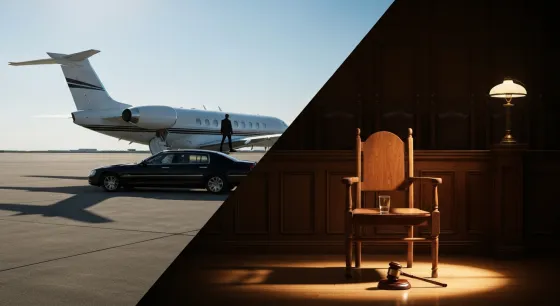
Picture the scene. You're suing your former co-founder for one hundred and fifty billion dollars, the judge has politely asked you to stick around in case she needs another word, and your phone buzzes with an invitation from the President of the United States to pop over to Beijing. What would a reasonable witness do? Reader, Elon Musk did not do that thing.
The short version, for those just tuning in
Elon Musk left the witness stand in Oakland on 30 April 2026 after testifying in his civil case against Sam Altman and Greg Brockman. Judge Yvonne Gonzalez Rogers placed him on recall status, meaning she could call him back at any moment. On Tuesday 12 May, Musk boarded Air Force One with Donald Trump and flew roughly 5,900 miles to Beijing, arriving the next day. Final testimony in his own trial wrapped up on the Wednesday. Closing arguments landed on Thursday 14 May. Musk, meanwhile, was about fourteen flight hours and one Pacific Ocean away.
You can see why a few legal eyebrows have shot skyward.
What 'on recall' actually means
Being on recall is not quite the same as being grounded, and that distinction matters. CBS News has pointed out that the judge did not explicitly order Musk to stay in the country. She kept him available, which is the legal equivalent of saying, 'don't go far, I might need you'. Beijing, by most measures, qualifies as far.
Jeffrey Bellin, a law professor at Vanderbilt, put it neatly to NBC News. 'A typical witness,' he said, 'would not leave the country if they were subject to recall.' Polite, accurate, and just savage enough.
Whether Musk asked the judge's permission before going is, charitably, unclear. NBC's sources say he did not. The Independent says it is not obvious either way. What we can say for certain is that judges tend to dislike surprises, especially the transcontinental kind.
The trial itself, in plain English
The case is the latest chapter in the long and increasingly bitter feud between Musk and Altman, the two men who co-founded OpenAI as a nonprofit back in 2015. Musk left in 2018. OpenAI later turned into a roaring commercial powerhouse without him. Musk now runs his own AI outfit, xAI, and has accused Altman and Brockman of betraying OpenAI's original mission.
He is seeking up to one hundred and fifty billion dollars in damages and wants both Altman and Brockman removed from the company they helped build. The jury in the case is advisory only, which is a polite way of saying their verdict is a suggestion. The actual decision rests with Judge Gonzalez Rogers. The same judge whose recall list Musk has just, in spirit if not in letter, ignored.
Altman, for his part, used his time in court to land a few choice lines of his own. He told the jury that Musk's 2018 exit had been a 'morale boost' and that the OpenAI nonprofit had been 'left for dead' once Musk pulled his funding. Musk, when pressed, conceded that xAI distils OpenAI's models, which is the AI equivalent of admitting you copy your homework off the kid you keep insulting.
Why Beijing, why now
This was not a lone wolf jolly. Musk was part of a broader tech delegation flown out with Trump that also included Apple boss Tim Cook and Nvidia's Jensen Huang. The trip's agenda was reportedly hefty, taking in the Iran conflict, trade imbalances with China, Taiwan, and the launch of new bilateral economic and AI oversight boards.
You can argue, and Musk's defenders will, that a CEO of his stature does not get to skip a presidential summit with Xi Jinping just because a courtroom on the other side of the planet might want a follow up question. You can also argue, and the judge might, that this is precisely the sort of thing recall status exists to prevent.
Why this should matter to readers in the UK
Beyond the soap opera, there are a couple of genuinely interesting threads here for a British audience.
First, the trial is shaping the future of AI governance in the United States, which sets the tone globally. Whatever the judge decides about OpenAI's structure, mission, and leadership will ripple through every conversation about AI regulation in Brussels, Westminster, and beyond. The Online Safety Act and the EU AI Act do not exist in a vacuum.
Second, the optics of a sitting US president taking the richest man in the world, the boss of Apple, and the boss of Nvidia to Beijing while one of them is mid-trial is, to put it mildly, a flex. It tells you something about how the current administration views the relationship between government, big tech, and global diplomacy. Those signals matter when British policymakers are trying to work out where the UK fits in an AI race that increasingly looks like a two horse contest between Washington and Beijing.
So has Musk done anything wrong?
Honestly, it depends on how you read the small print. The judge did not slam a gavel and shout 'stay put'. She kept him on recall, which is a softer instruction. The legal worst case is that she could compel him back, hit him with sanctions, or draw a negative inference if she felt the trip was an attempt to dodge further questioning. The political worst case is that it looks, to put it gently, cocky.
And here is the witty bit. Musk has built his whole brand on doing the thing that the rules nervously gesture at avoiding. Reusable rockets, brain chips, buying social networks for fun, posting at three in the morning. A polite suggestion from a federal judge was never going to keep him in the Bay Area when the alternative was a 747 to Beijing with the president.
What happens next
Closing arguments have already wrapped. Now we wait for Judge Gonzalez Rogers to decide whether Musk's claims hold up, whether OpenAI's leadership stays or goes, and whether one hundred and fifty billion dollars will be changing hands. Spoiler, that last one is extremely unlikely, but the rest is genuinely open.
If she rules against Musk, expect a Twitter, sorry, X tirade of historic proportions. If she rules in his favour, expect the AI industry to reorganise itself overnight. Either way, the lesson for any future witness on recall is already clear. Beijing is a long way to go for a working holiday.
Read the original article at source.